KCC-MISS: Every ₹1 invested adds ₹2.30 to farm value, Parliament told
Synopsis
A government-commissioned third-party study has put a precise number on what KCC-MISS delivers: ₹2.30 in agricultural value for every ₹1 spent — against a cumulative subsidy bill of ₹1.87 lakh crore. With the collateral-free loan ceiling just raised to ₹2 lakh and digital credit portals expanding, the scheme is being positioned as the backbone of India's formal farm credit architecture.
Key Takeaways
Every Re 1 invested under KCC-MISS generates ₹2.30 in net agricultural value addition, per a third-party assessment by the Institute for Social and Economic Change, Bengaluru .
Cumulative subsidy outlay under the scheme has reached an estimated ₹1.87 lakh crore since inception through 2024-25 .
The scheme has improved cropping intensity, multi-season cultivation, and credit discipline among beneficiary farmers.
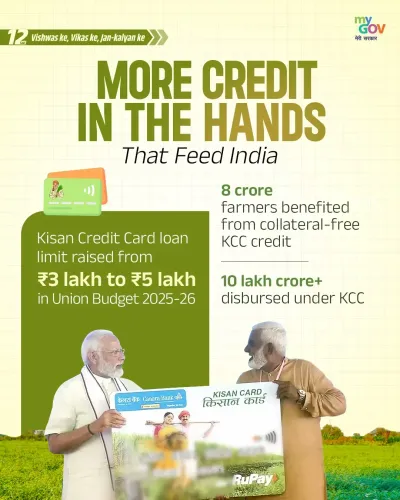
Collateral-free loan limit under KCC raised from ₹1.6 lakh to ₹2 lakh , effective 1 January 2025 .
New digital tools — Kisan Rin Portal , Jan Samarth , e-KCC , KRISHIKA — introduced to widen formal credit access for small and marginal farmers.
Scheme also supports inland fisheries working capital, with particular relevance for income diversification in the North-Eastern Region .
Every Re 1 invested under the Kisan Credit Card – Modified Interest Subvention Scheme (KCC-MISS) has generated ₹2.30 in net value addition to the agriculture and allied sector, the Lok Sabha was informed on Monday, 3 August, based on findings from a third-party assessment. The disclosure underscores the scheme's measurable economic multiplier effect on Indian farming households.
Key Assessment Findings
The evaluation, conducted by the Institute for Social and Economic Change, Bengaluru, found that KCC-MISS has materially reduced the interest burden on farmers while positively influencing cropping intensity and multi-season cultivation. Minister of State for Finance Pankaj Chaudhary shared these findings in the Lok Sabha in response to a parliamentary question.
The scheme's cumulative subsidy outlay has reached an estimated ₹1.87 lakh crore since inception through 2024-25, reflecting its scale and sustained fiscal commitment by the Centre.
Impact on Farmers and Credit Behaviour
Beneficiaries under KCC-MISS have cultivated larger land areas and adopted more diversified crop portfolios across seasons, supported by reliable irrigation access and concessional credit. The scheme has also improved the timeliness of agricultural input use by providing adequate working capital at critical sowing windows.
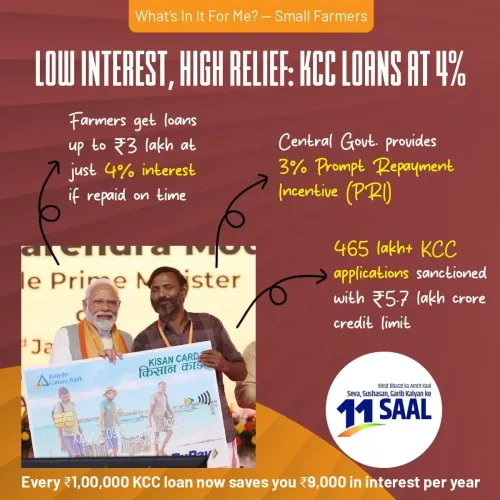
Farmers who received the Prompt Repayment Incentive (PRI) have shown stronger credit discipline, which has, in turn, boosted banks' confidence in extending further agricultural lending. This virtuous cycle — better credit access leading to better repayment — is among the more structurally significant outcomes noted in the assessment.
Livestock, Fisheries and Diversification
Beyond crop farming, KCC-MISS has supported dairy and livestock expansion, helping farmers reduce dependence on seasonal agriculture by integrating livestock and fisheries with crop production. Notably, the scheme has also backed working capital requirements for inland fisheries, a development seen as particularly significant for income diversification in the North-Eastern Region.
Technological Interventions and Policy Reforms
Minister Chaudhary highlighted several technology-driven reforms introduced to streamline agricultural credit delivery. These include the Kisan Rin Portal, the Jan Samarth portal, e-KCC, and the KRISHIKA platform, all aimed at expanding digital access for small and marginal farmers.
On the policy side, the government raised the collateral-free loan limit under KCC from ₹1.6 lakh to ₹2 lakh, effective 1 January 2025. Annual ground-level credit targets and priority sector lending mandates for banks have also been reinforced. The Reserve Bank of India (RBI), NABARD, State Level Bankers Committees (SLBCs), and individual banks have jointly conducted awareness programmes to increase farmer uptake of the scheme.
What Comes Next
With the collateral-free limit now raised and digital infrastructure expanding, the government appears focused on deepening KCC penetration among the estimated millions of small and marginal farmers who remain outside formal credit channels. The third-party validation of the ₹2.30 multiplier could strengthen the case for increased budgetary allocation in future fiscal cycles.
Point of View
But its credibility rests entirely on the methodology of a single third-party study — and Parliament was not furnished with the full report's caveats or sample size. A ₹1.87 lakh crore subsidy outlay is one of the largest in Indian agricultural history; the real question is whether the multiplier holds uniformly across rain-fed districts and marginal landholdings, or whether it is skewed by irrigated, commercially active farmers who would have borrowed anyway. The collateral-free limit hike and digital portals are meaningful steps, but formal credit penetration among the bottom quartile of landholders remains the unresolved challenge no portal alone can fix.
NationPress
18 Sept 2026
Frequently Asked Questions
What is the KCC-MISS multiplier effect on agriculture?
According to a third-party assessment by the Institute for Social and Economic Change, Bengaluru, every Re 1 invested under the Kisan Credit Card – Modified Interest Subvention Scheme generates ₹2.30 in net value addition to the agriculture and allied sector. The finding was shared with the Lok Sabha on 3 August by Minister of State for Finance Pankaj Chaudhary.
How much has the government spent on KCC-MISS since its inception?
The cumulative subsidy outlay under KCC-MISS has reached an estimated ₹1.87 lakh crore from the scheme's inception through 2024-25, making it one of the largest sustained agricultural credit subsidy programmes in India.
What is the new collateral-free loan limit under the Kisan Credit Card?
The government raised the collateral-free loan limit under the Kisan Credit Card from ₹1.6 lakh to ₹2 lakh, effective 1 January 2025, to ease access to formal credit for small and marginal farmers.
How has KCC-MISS affected farmer credit behaviour?
Farmers who received the Prompt Repayment Incentive under KCC-MISS have shown stronger credit discipline, which has increased banks' confidence in extending further agricultural loans. The scheme has also improved the timeliness of input purchases by ensuring working capital is available at critical crop-sowing periods.
Which new digital tools have been introduced alongside KCC-MISS?
The government has launched the Kisan Rin Portal, Jan Samarth portal, e-KCC, and the KRISHIKA platform to streamline agricultural credit delivery, simplify application procedures, and expand digital access for small and marginal farmers across India.