Anand Mahindra backs AI application layer as durable edge
Synopsis
Mahindra Group chairman Anand Mahindra has backed Palantir CEO Alex Karp's argument that AI's application layer — not the underlying model — is the most durable commercial and strategic asset, while reaffirming India's need for sovereign frontier model development.
Key Takeaways
Mahindra Group chairman Anand Mahindra posted on 2 July 2026 that the AI application layer holds more durable value than the model or compute layers.
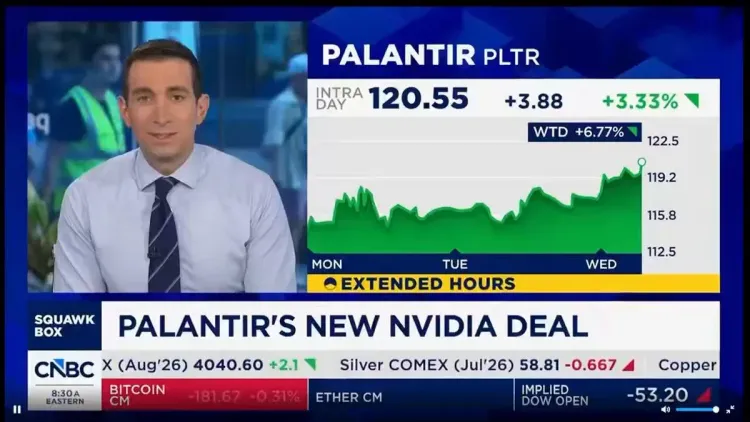
His comments were prompted by a CNBC interview by Palantir Technologies CEO Alex Karp , who argued critical infrastructure cannot run AI models without a purpose-built application layer.
Mahindra drew a parallel to his Tech Mahindra shareholder letter this year, comparing AI to the smartphone — valuable only because of the ecosystem built on top.
He maintained that India should still pursue sovereign frontier model development , but said verticalization of compute, models, and applications must happen simultaneously.
For defence, classified programmes, and regulated industries , Mahindra stressed that data governance, auditability, and security controls at the application layer are non-negotiable.
Indian IT services firms with deep enterprise workflow knowledge are positioned, in Mahindra's view, to own the application layer in a commoditising model landscape.
Mahindra Group chairman Anand Mahindra weighed in on the global AI stack debate on Thursday, 2 July 2026, arguing on X that the application layer — not the underlying model or chip — is where lasting commercial and strategic value will be created in artificial intelligence.
Context
Mahindra's post was prompted by a CNBC interview given by Palantir Technologies co-founder and CEO Alex Karp, whose remarks Mahindra described as likely to be 'widely discussed and debated.' Karp's central argument, as Mahindra summarised it, is that AI has three distinct layers — compute, model, and application — and that critical infrastructure cannot run on a model alone without a purpose-built application layer on top.
Mahindra said he had made a parallel argument in his recent letter to Tech Mahindra's shareholders this year, comparing AI to the modern smartphone: 'remarkable technology, but indispensable only because of the apps and experiences built on top of it. The ecosystem determines who creates lasting value, not the chip or the model underneath.'
Policy Backdrop
India has pursued a dual track on AI: encouraging sovereign frontier model development while leaning on domestic IT services firms to deepen enterprise integration. India's National Strategy for Artificial Intelligence, released in 2018 under the government's #AIforAll framework, laid the early groundwork for responsible AI adoption and indigenous capability building. The more recent IndiaAI Mission has extended this push, with rollout milestones now being closely watched by industry and policymakers alike.
Mahindra was careful to reaffirm his support for this sovereign ambition even as he endorsed Karp's application-layer thesis: 'I still believe India should pursue sovereign frontier model development. But if Karp's hypothesis is right, and the model layer is commoditising, then the verticalization of the compute, models and applications needs to happen at the same time.'
Stakeholders and Impact
The argument carries direct implications for Indian IT services companies such as Tech Mahindra, which have spent decades accumulating enterprise workflow knowledge across sectors including defence, banking, and regulated industries. Mahindra contended that this accumulated knowledge — not model ownership — is the true moat: 'model-agnostic, built on whichever open model fits best, carrying decades of enterprise workflow knowledge that no model provider owns.'
Quoting Karp directly, Mahindra highlighted the governance stakes: the application layer 'takes a large language model and makes it safe and precise… Everyone gets to ask the basic questions: who owns the data, where is it cached, are the prompts secure, is this being transferred to you?' For defence, classified programmes, and regulated industries, Mahindra noted, 'control over data, auditability and governance is non-negotiable, whichever model happens to sit underneath.' He also stressed that the application layer must allow business enterprises to preserve their 'alpha' — their proprietary competitive advantage.
What's Next
Mahindra closed by inviting broader reaction to Karp's interview, signalling that the debate over AI's value chain is far from settled. The question of whether foundation models will commoditise — and who captures the resulting surplus at the application layer — is increasingly central to India's technology and industrial strategy.
Policy watchers will be looking at forthcoming IndiaAI Mission milestones and any new frameworks for secure AI deployment in defence and critical sectors as a test of whether India's dual-track approach can deliver both sovereign model capability and globally competitive application-layer services.
Point of View
Mahindra is threading a needle that keeps India's policy options open. The emphasis on data governance and auditability in defence and regulated sectors also subtly reinforces the case for data localisation frameworks that Indian policymakers have long advocated. If the model layer does commoditise as Karp suggests, Indian IT services firms could be structurally advantaged — but only if they move fast enough to verticalize before global hyperscalers build their own application stacks.
NationPress
1 Oct 2026
Frequently Asked Questions
What did Anand Mahindra say about AI on X?
Anand Mahindra argued on X on 2 July 2026 that the application layer of AI — not the underlying model or compute — is where lasting commercial and strategic value is created, drawing on arguments made by Palantir CEO Alex Karp in a CNBC interview.
What is Alex Karp's argument about AI that Mahindra discussed?
Palantir CEO Alex Karp argued that AI has three layers — compute, model, and application — and that critical infrastructure cannot run AI models without a purpose-built application layer that ensures data security, auditability, and governance.
Does Anand Mahindra support India building its own AI models?
Yes. Mahindra explicitly stated he still believes India should pursue sovereign frontier model development, but added that if the model layer is commoditising, the verticalization of compute, models, and applications must happen simultaneously.
Why does the AI application layer matter for Indian IT companies?
Indian IT services firms like Tech Mahindra have accumulated decades of enterprise workflow knowledge across sectors such as defence and banking. Mahindra argues this knowledge — embedded in the application layer — is a durable competitive moat that no model provider owns.
What is India's national AI strategy?
India released its National Strategy for Artificial Intelligence under the #AIforAll framework in 2018, outlining priorities for responsible AI adoption and indigenous capability building. The more recent IndiaAI Mission has extended these goals with specific rollout milestones.