How Can AI Sovereignty Be Strengthened in India According to IBM's CEO?

Synopsis
At the World Economic Forum, IBM's CEO, Arvind Krishna, emphasized the need for India to enhance its AI sovereignty by fostering local capabilities in semiconductors and specialized AI models. He highlighted significant investments and advancements in the Indian tech sector, paving the way for innovative domestic applications.
Key Takeaways
IBM’s CEO calls for AI sovereignty in India.
Focus on local capabilities in semiconductors and models.
India is developing 12 AI models, with 4 launching soon. $70 billion investment in AI infrastructure.
Semiconductors demand expected to rise significantly.
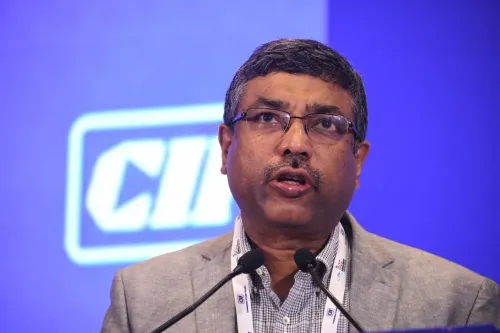
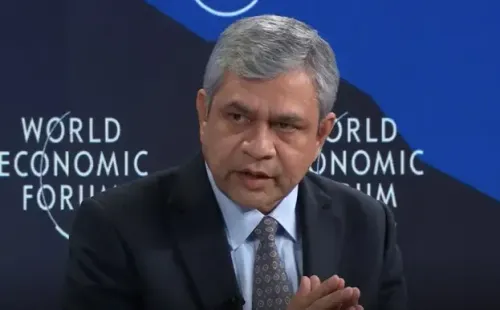
Davos, Jan 21 (NationPress) IBM's Chairman and CEO Arvind Krishna has encouraged Indian entrepreneurs to develop local skills in semiconductors, model creation, and practical applications to enhance AI sovereignty in India.
During his address at the World Economic Forum (WEF) annual gathering in Davos, Krishna highlighted that smaller, specialized AI models are swiftly bridging the gap with larger foundational models, now comprising nearly 95 percent of usage.
He stated, “The foundational ecosystem—whether it’s semiconductors, model development, or application usage—is where the major advancements will arise for India,” as he conveyed to NDTV Profit.
The IBM Chairman cited China’s DeepSeek as a case study, illustrating how success in the AI industry often follows numerous unsuccessful attempts. He emphasized that specialized AI systems trained on local datasets from India’s healthcare, defense, and legal sectors are essential for creating effective domestic applications, advocating for a culture of experimentation and acceptance of failure.
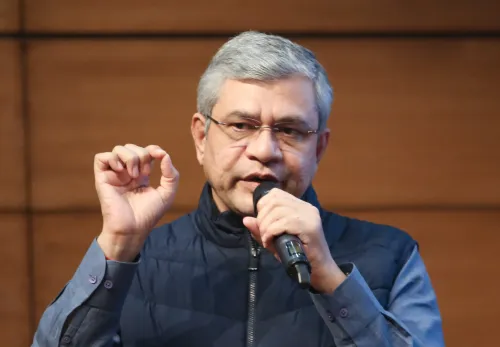
Union IT Minister Ashwini Vaishnaw, who spoke at the same event, noted that Indian IT companies have already shifted towards AI, resulting in increased hiring within the sector. He mentioned that India is currently developing 12 AI models, with at least four slated for launch soon.
The minister highlighted India’s commitment to a suite of focused, sector-specific small models capable of delivering productivity improvements across various industries, adding that the country has attracted $70 billion in investments for AI-enabling infrastructure, including data centers from major firms like Google and Amazon.
Additionally, he pointed out advancements in India's semiconductor initiatives, with 10 fabrication plants under construction, three pilot projects in progress, and four units expected to commence commercial operations by 2026.
He also mentioned the government's recent decision to permit private sector involvement in nuclear power generation, which could provide the energy scale required for extensive AI computing.
A recent report indicated a swift growth in electronics and semiconductors, predicting India’s semiconductor demand will rise from $33 billion in 2022 to $117 billion by 2030.
The government’s Rs 7,280 crore scheme for Sintered Rare Earth Permanent Magnets (REPM) is expected to significantly bolster India’s wider semiconductor manufacturing ambitions by ensuring reliable access to crucial materials.
aar/na
Point of View
It is crucial to acknowledge the importance of AI sovereignty in India's technological landscape. The insights shared by Arvind Krishna and Union IT Minister Ashwini Vaishnaw reflect a national strategy aimed at fostering innovation and self-reliance. These advancements are not just pivotal for India's growth but also for establishing a robust position in the global tech arena.
NationPress
26 Sept 2026
Frequently Asked Questions
Why is AI sovereignty important for India?
AI sovereignty is crucial for India to ensure that the country can develop and control its own AI technologies, leading to better local applications across various sectors.
What investments are being made in India's AI sector?
India has attracted $70 billion in investments for AI-enabling infrastructure, including data centers from major companies like Google and Amazon.
How many AI models is India currently developing?
India is currently developing 12 AI models, with plans to launch at least four of them soon.
What role do semiconductors play in AI development?
Semiconductors are fundamental to the AI ecosystem, as they provide the necessary hardware for model development and application usage.
What is the government's initiative for semiconductor manufacturing?
The government has launched a scheme for Sintered Rare Earth Permanent Magnets (REPM) to support India's semiconductor manufacturing goals.