Anand Mahindra on Musk's Trillion-Dollar Moment
Synopsis
Mahindra Group chairman Anand Mahindra revisited a 2018 message of support for Elon Musk as Tesla crossed a trillion-dollar market cap, arguing the real story is not the milestone but Musk's refusal to stop believing through years of failure and scepticism.
Key Takeaways
Mahindra Group chairman Anand Mahindra posted on 17 June 2026 recalling his 2018 message of encouragement to Elon Musk .
The post was triggered by Tesla reaching a trillion-dollar market-capitalisation milestone.
Mahindra's original 2018 support came during Tesla 's severe Model 3 production crisis, when the company faced peak public scepticism.
He argues that innovators are 'judged in their toughest moments, not their finest hours', and that fear of failure keeps entrepreneurs 'on a treadmill'.
The commentary carries implicit relevance for India 's domestic EV and deep-tech startup ecosystem, where long gestation periods test investor patience.
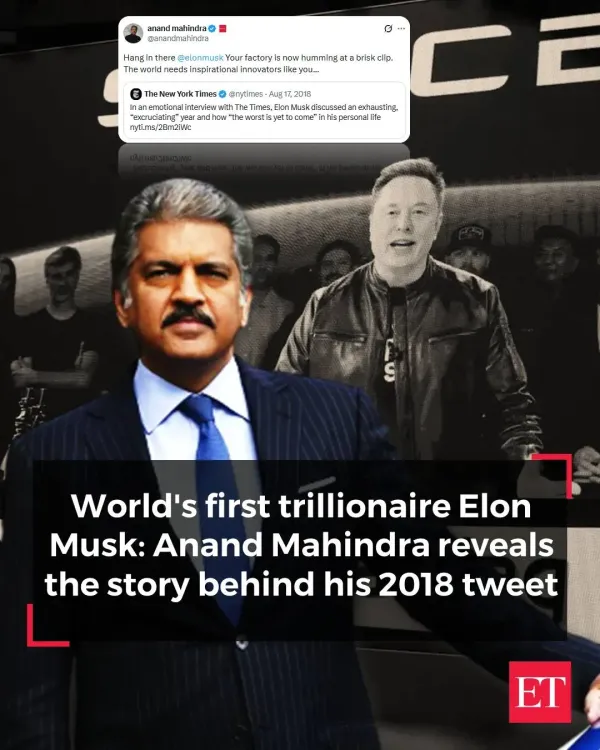
Mahindra Group chairman Anand Mahindra on Wednesday, 17 June 2026, revisited a message of encouragement he had posted to Elon Musk in 2018, using the occasion of Tesla's trillion-dollar market-capitalisation milestone to reflect on the nature of innovation, failure, and long-term belief.
Mahindra clarified the context of his earlier post, writing: 'I posted that message of encouragement to Elon in 2018 because innovators are often judged in their toughest moments, not their finest hours.' The remark was a direct callback to a period when Tesla was battling severe production bottlenecks on its Model 3 assembly lines, triggering sharp stock volatility and widespread public scepticism about the company's ability to scale.
Context
In 2018, Tesla was under intense scrutiny as its ambitious production targets for the Model 3 repeatedly fell short, prompting questions about the viability of the electric-vehicle maker's business model. It was during this period of peak uncertainty that Mahindra, one of India's most prominent industrialists, chose to publicly express support for Musk. The gesture was consistent with Mahindra's long-standing practice of using social media to champion entrepreneurial resilience.
The contrast Mahindra draws is deliberate: 'The headlines today are about a trillion-dollar milestone. The real story is that he never stopped believing that today's impossibility could become tomorrow's reality.' By anchoring his current post to an eight-year-old message, he frames Tesla's valuation achievement not as a sudden event but as the endpoint of a sustained, often painful, journey.
Policy Backdrop
The electric-vehicle sector globally — and in India in particular — has been shaped by a policy environment that rewards long-term capital commitment over short-term profitability. India's own EV push, backed by production-linked incentives and state-level subsidy frameworks, has drawn direct comparisons with the early-stage struggles that capital-intensive innovators like Tesla endured before achieving commercial scale.
Mahindra's own group has significant skin in this game: Mahindra Electric is among the domestic manufacturers competing in a market where consumer and investor patience for long gestation periods is still being tested. His commentary on Musk's journey carries implicit resonance for the domestic EV ecosystem and its stakeholders.
Stakeholders and Impact
For India's technology entrepreneurs and startup founders, Mahindra's post lands as a pointed reminder that public market sentiment at any given moment is a poor proxy for ultimate commercial success. The message — 'if you are afraid of failure, you will remain on a treadmill' — distils a philosophy that has particular weight coming from the chairman of a diversified conglomerate that has itself navigated multiple cycles of disruption.
Investors tracking the global EV space will note that Mahindra's framing implicitly validates the 'patient capital' thesis: that breakthrough technologies require backers and founders willing to absorb prolonged periods of negative sentiment. This view has direct bearing on how domestic venture capital and institutional money is allocated to deep-tech and mobility startups in India.
What's Next
Tesla's ability to sustain its trillion-dollar valuation will be tested by upcoming quarterly results, new product rollouts, and the intensifying competition it faces from Chinese and domestic EV manufacturers worldwide. Whether the milestone proves durable or cyclical will determine how Mahindra's narrative of 'impossibility becoming reality' ages in the months ahead.
For the broader community of innovators and investors that Mahindra regularly addresses through his social media platform, the more lasting takeaway may be the behavioural one: that the willingness to persist through public failure — not the valuation headline — is the actual competitive differentiator in capital-intensive technology sectors.
Point of View
He subtly shifts the locus of value from market capitalisation to founder psychology. This framing is consistent with a broader pattern among India's senior industrialists of using global tech success stories to shape domestic entrepreneurial culture at a moment when the country's own deep-tech and EV sectors are navigating similarly uncertain early stages. The line 'if you are afraid of failure, you will remain on a treadmill' is the kind of aphorism that travels well beyond its original context — and Mahindra knows it.
NationPress
19 Sept 2026
Frequently Asked Questions
Why did Anand Mahindra post about Elon Musk in 2026?
Mahindra used Tesla's trillion-dollar market-capitalisation milestone as an occasion to revisit a message of encouragement he had sent Musk in 2018, during Tesla's Model 3 production crisis, to highlight that persistence through failure — not the valuation headline — is the real story.
What did Anand Mahindra say about Elon Musk in 2018?
Mahindra posted a message of encouragement to Musk in 2018 because, as he explained in his June 2026 post, innovators are often judged in their toughest moments rather than their finest hours. The exact wording of the 2018 post has not been independently verified.
What is Tesla's trillion-dollar milestone about?
Tesla reached a one-trillion-dollar market capitalisation milestone, a landmark that Mahindra referenced as the headline occasion for his post, though he argued the more important story was Musk's sustained belief through years of setbacks.
What does Anand Mahindra mean by 'afraid of failure, you will remain on a treadmill'?
Mahindra uses the treadmill metaphor to argue that entrepreneurs who avoid risk to escape failure end up expending energy without making real progress — a warning against excessive caution in high-stakes innovation.
How is Anand Mahindra's post relevant to India's EV sector?
Mahindra Group has its own electric-vehicle business, and his commentary on Tesla's long road from crisis to trillion-dollar valuation implicitly validates the patient-capital approach that India's domestic EV and deep-tech startups also require from investors and policymakers.