Northeast states push for dedicated education ministers' forum to fast-track NEP 2020
Synopsis
Seven Northeast states wrapped up a landmark education conclave in Nagaland by calling for something the region has never had — a dedicated forum of education ministers to steer NEP 2020 implementation. With infrastructure gaps, indigenous knowledge preservation, and brain drain all on the table, the proposal to New Delhi could reshape how the Centre engages with the region's educational future.
Key Takeaways
The Education Conclave 2026 concluded in Nagaland on 19 September 2026 , with 748 participants from 7 Northeast states and 32 schools and technical colleges .
States agreed to propose a dedicated forum of education ministers of the Northeastern states to the Central government.
Tripura's Higher Education Minister Kishor Barman proposed a regional faculty network , shared research infrastructure , and a common digital platform for academic collaboration.
The conclave called for a shift from measuring programme coverage to assessing verified learning outcomes .
Five priority commitments were identified: access , quality , skill development , research and innovation , and entrepreneurship .
The Centre's representative stressed documenting indigenous knowledge , languages, and traditional practices as a regional opportunity under NEP 2020.
Seven Northeastern states concluded the Education Conclave 2026 in Nagaland on 19 September 2026 with a unified call for a dedicated forum of education ministers and stronger Centre-state coordination to accelerate the implementation of the National Education Policy (NEP) 2020 across the region. The two-day conclave, held in Kohima, drew 748 participants from all seven Northeast states, 32 schools, and technical colleges.
Conclave Theme and Key Outcomes
Organised on the theme 'Implementation of NEP 2020: Vision, Challenges and Opportunities for the North Eastern States', the event culminated at a valedictory function at J.P. Park and Banquets, Naga United Village, Chumoukedima. Presenting the resolution, Sarita Yadav, Secretary of Higher and Technical Education, Nagaland, said the states had collectively agreed to propose a dedicated forum of education ministers of the Northeastern states, with a formal proposal to be sent to the Central government. She added that delegates also agreed to shift focus from measuring programme coverage to assessing verified learning outcomes — a significant policy recalibration.
What the Chief Guest Said
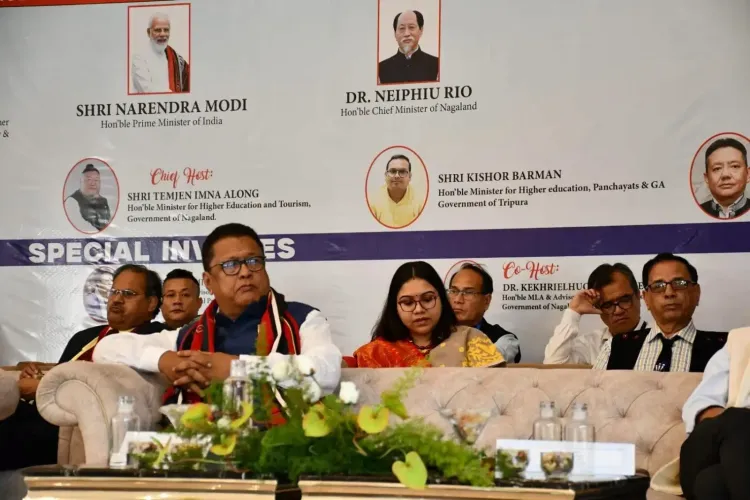
Tripura's Higher Education Minister Kishor Barman, who attended as the chief guest, described the conclave as 'not an ending but the beginning of a new chapter' for education in the region. He stressed that the success of any education policy must ultimately be measured by the change it delivers to students, including those in remote villages. Barman proposed a regional faculty network, shared research infrastructure, student mobility programmes, joint research initiatives, and a common digital platform to foster academic collaboration across the Northeast.
Highlighting the region's unique advantages, he cited bamboo as an example of how a local resource could be integrated into courses spanning engineering, product design, architecture, management, and digital mapping to drive research, employment, and enterprise. He also called for converting 'brain drain' into 'brain circulation' — creating mechanisms through alumni networks, mentoring, remote work, and return-to-region schemes so that young people who migrate can still contribute to their home states.
Centre's Perspective on NEP Roll-Out
Anandrao V. Patel, Additional Secretary in the Department of Higher Education under the Union Ministry of Education, underlined the potential of NEP 2020 to expand equitable access to higher education, promote multidisciplinary learning, and encourage research and entrepreneurship across the Northeast. He emphasised the need for stronger collaboration among universities, colleges, research institutions, and students. Notably, Patel also called for documenting and promoting the region's indigenous knowledge, languages, arts, crafts, and traditional community practices, suggesting the Northeast could become a significant centre for cultural exchange and knowledge development.
Five Key Commitments for the Region
Minister Barman identified five priority areas for the Northeast under NEP 2020: access, quality, skill development, research and innovation, and entrepreneurship. He also called for greater convergence among tourism, agriculture, biodiversity, and technology — sectors in which the Northeast holds a natural comparative advantage. Yadav added that states had flagged specific infrastructure gaps and region-specific educational challenges requiring greater support from both the Centre and state governments.
What Comes Next
The proposal for a dedicated ministerial forum is expected to be formally submitted to the Central government, and will be a key measure of whether the conclave's ambitions translate into institutional action. With all seven Northeastern states now aligned on a common framework, the pressure on the Centre to respond — and on individual state education departments to close infrastructure deficits — is likely to mount in the months ahead.
Point of View
Combined with high out-migration of talent, make it both the hardest testing ground and the most consequential one for NEP 2020. The 'brain circulation' framing is a politically astute repackaging, but it needs binding institutional mechanisms, not just alumni networks. Whether the Centre converts this proposal into a formal, functional body — or lets it join the long list of regional consultations that produced communiqués and little else — will be the real measure of NEP's inclusive ambition.
NationPress
20 Sept 2026
Frequently Asked Questions
What was decided at the Education Conclave 2026 in Nagaland?
The two-day conclave concluded with seven Northeast states agreeing to propose a dedicated forum of education ministers to the Central government to accelerate NEP 2020 implementation. States also called for a shift from measuring programme coverage to verifying actual learning outcomes, and flagged region-specific infrastructure gaps requiring Centre support.
What is the proposed dedicated forum of education ministers?
It is a proposed regional body comprising education ministers from all seven Northeastern states, designed to coordinate NEP 2020 implementation and channel a unified set of demands to the Central government. A formal proposal is to be submitted to New Delhi following the conclave.
What did Tripura's Higher Education Minister Kishor Barman propose at the conclave?
Minister Barman proposed a regional faculty network, shared research infrastructure, student mobility programmes, joint research initiatives, and a common digital platform for the Northeast. He also advocated converting 'brain drain' into 'brain circulation' by enabling young migrants to contribute to their home states through alumni networks and remote work arrangements.
Why does NEP 2020 implementation matter specifically for the Northeast?
The Northeast faces unique challenges including infrastructure gaps, high out-migration of educated youth, and a rich but under-documented base of indigenous knowledge and languages. NEP 2020 offers a framework for equitable access, multidisciplinary learning, and skill development — but officials at the conclave said these gains require greater Centre-state coordination and dedicated funding support.
Who attended the Education Conclave 2026?
The conclave drew 748 participants representing all seven Northeastern states, 32 schools, and technical colleges, along with senior officials from the Union Ministry of Education. Tripura's Higher Education Minister Kishor Barman attended as the chief guest.