Dr. Jitendra Singh: NEP a game changer, tech democratising education
Synopsis
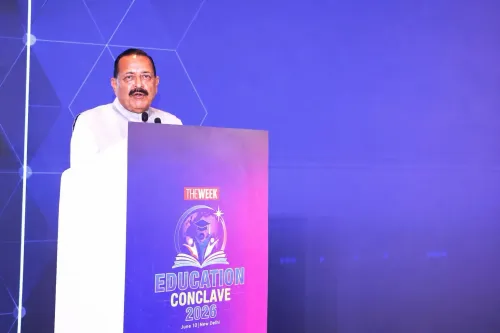
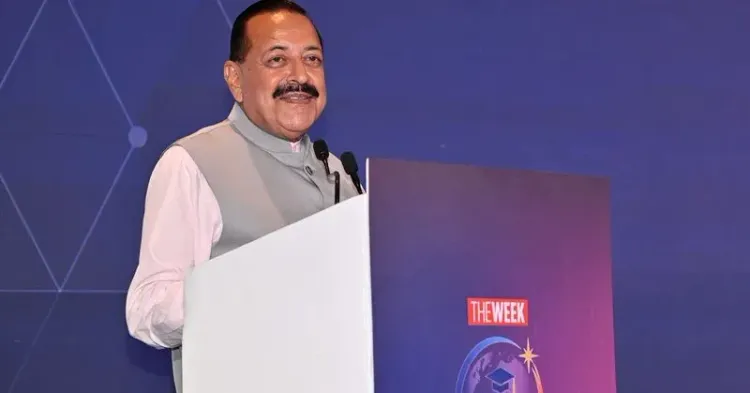
Union Minister Dr. Jitendra Singh, speaking at The Week Education Conclave 2026, called NEP 2020 a 'game changer' and said technology is democratising education in India. His remarks reinforce the government's push to link science, technology, and education policy under a unified reform agenda.
Key Takeaways
Jitendra Singh addressed The Week Education Conclave 2026 on 11 June 2026 .
He described NEP 2020 as a 'game changer' for Indian education.
He emphasised that technology is democratising access to education across the country.
NEP 2020 was approved on 29 July 2020 — the first major education policy overhaul in 34 years .
Digital platforms SWAYAM and DIKSHA , launched in 2017 , form the infrastructure backbone aligned with NEP goals.
Operationalisation of the National Research Foundation remains a key implementation milestone to watch.
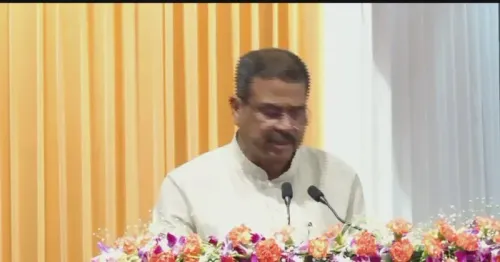
Union Science and Technology Minister Dr. Jitendra Singh on Thursday, 11 June 2026 shared remarks from The Week Education Conclave 2026, describing the National Education Policy (NEP) 2020 as a 'game changer' and underscoring how technology is democratising access to education across India.
Context
Speaking at the conclave, Dr. Singh highlighted the transformative potential of NEP 2020, calling it a landmark shift in how India approaches learning at every level. His remarks framed technology not merely as a supplement to classrooms but as a structural force reshaping who can access quality education and how.
The minister's comments align closely with his dual portfolio — overseeing science and technology alongside his role in the Prime Minister's Office — giving him a cross-ministerial vantage point on how policy and digital infrastructure intersect in education reform.
Policy Backdrop
NEP 2020, approved by the Union Cabinet on 29 July 2020, was the first comprehensive overhaul of India's education framework in 34 years, replacing the National Policy on Education 1986. It introduced multidisciplinary learning, flexible credit transfer, multilingual content delivery, and an explicit mandate for technology integration at all levels of schooling and higher education.
Digital platforms such as SWAYAM and DIKSHA, both launched in 2017, laid the infrastructure groundwork that NEP 2020 later built upon. The COVID-19 pandemic accelerated the adoption of these tools, validating the policy's emphasis on remote and hybrid learning models. The National Research Foundation, another NEP-linked initiative, remains a key institution to watch as implementation deepens.
Stakeholders and Impact
The primary beneficiaries of NEP's technology-driven approach are students in geographically remote or economically underserved regions, for whom digital platforms reduce dependence on physical infrastructure. Teachers and higher education institutions are also central stakeholders, as curriculum redesign and new assessment frameworks require sustained capacity-building.
Dr. Singh's framing of technology as a democratising force carries particular weight given India's scale — with hundreds of millions of learners spread across diverse linguistic and socioeconomic contexts, uniform physical access remains a challenge that digital tools are increasingly expected to bridge.
What's Next
Attention will now turn to the pace of NEP implementation, including the rollout of new curriculum frameworks, the operationalisation of the National Research Foundation, and the expansion of digital learning infrastructure to underserved districts. Parliamentary notifications and regulatory updates on credit-transfer mechanisms and multilingual content standards will serve as key benchmarks for progress.
Dr. Singh's public endorsement at a high-profile conclave signals continued political momentum behind NEP 2020, reinforcing that education reform remains a priority agenda item heading into the latter half of the decade.
Point of View
Evolving reform rather than a completed legislative act. His specific framing of technology as a democratising force — rather than a mere efficiency tool — suggests the administration is keen to position digital education as an equity intervention, not just a convenience. Coming from a minister who bridges the science-technology and PMO portfolios, the remarks also hint at a broader convergence of India's tech policy and education agenda. The real test, however, will be in the implementation metrics: curriculum rollout timelines, National Research Foundation funding, and measurable gains in learning outcomes at the grassroots level.
NationPress
26 Oct 2026
Frequently Asked Questions
What did Jitendra Singh say about NEP 2020 at The Week Education Conclave 2026?
Dr. Jitendra Singh called NEP 2020 a 'game changer' and said technology is democratising education in India, speaking at The Week Education Conclave 2026 on 11 June 2026.
What is NEP 2020 and when was it approved?
The National Education Policy 2020 is India's comprehensive education reform framework approved by the Union Cabinet on 29 July 2020. It was the first major overhaul of Indian education policy in 34 years, replacing the 1986 policy.
How is technology helping democratise education in India under NEP 2020?
NEP 2020 integrates digital platforms such as SWAYAM and DIKSHA to deliver multilingual content, enable adaptive assessment, and extend quality education to students in remote or underserved regions who lack access to physical infrastructure.
What is the National Research Foundation and how does it relate to NEP?
The National Research Foundation is an NEP-linked institution designed to fund and coordinate research across Indian universities. Its full operationalisation is one of the key pending milestones in NEP implementation.
What is Dr. Jitendra Singh's ministerial portfolio?
Dr. Jitendra Singh is the Union Minister of State (Independent Charge) for Science and Technology and Earth Sciences, and also holds the position of Minister of State in the Prime Minister's Office and Department of Personnel and Training.