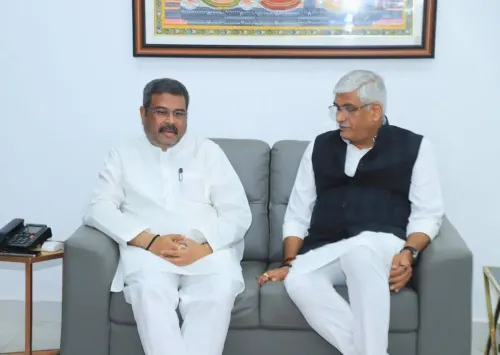
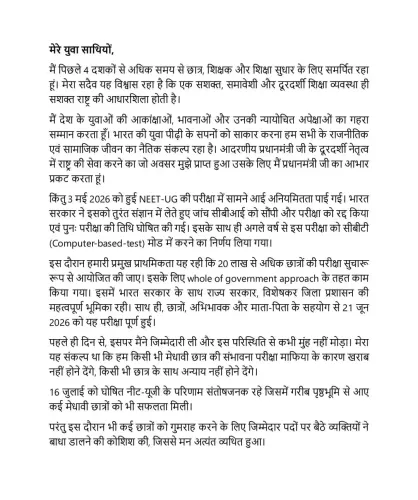
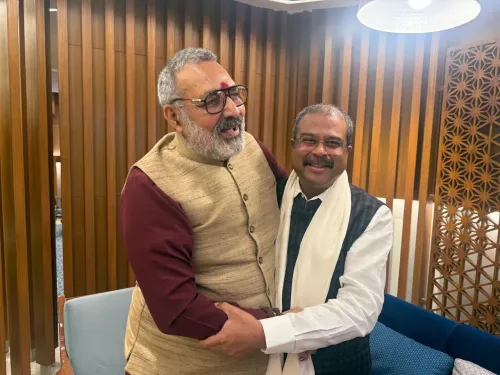
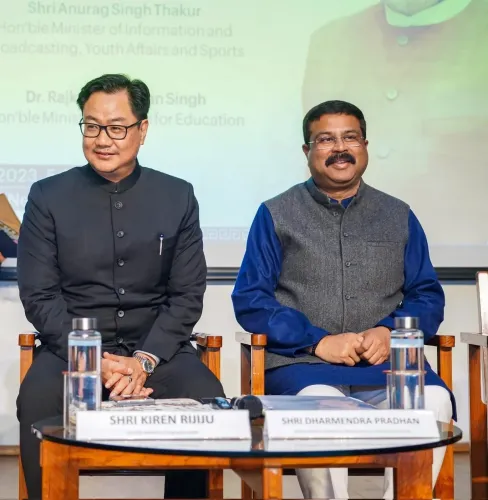
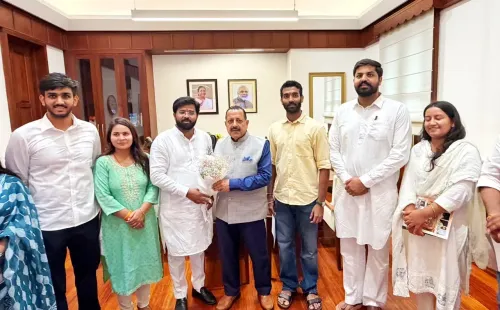
Dr Jitendra Singh pays tribute to Dharmendra Pradhan as Education Minister
Synopsis
Union Minister Dr. Jitendra Singh on 25 July 2026 paid tribute to Dharmendra Pradhan as he stepped down as India's Education Minister, citing his student-centric leadership and role in advancing the National Education Policy 2020. The post signals a ministerial transition with implications for ongoing education reforms.
Key Takeaways
Dharmendra Pradhan has stepped down as India's Minister of Education , prompting a cross-ministerial tribute from Dr.
Jitendra Singh on 25 July 2026 .
Pradhan was appointed Education Minister in July 2021 , succeeding Ramesh Pokhriyal Nishank , and oversaw early rollout of the National Education Policy 2020 .
The NEP 2020 , approved in July 2020 , replaced the 1986 policy and introduced multidisciplinary learning, vocational education and digital infrastructure reforms.
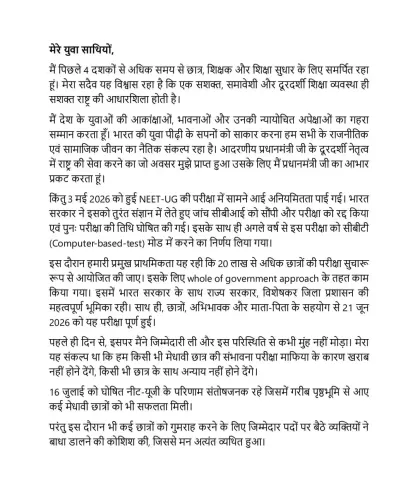
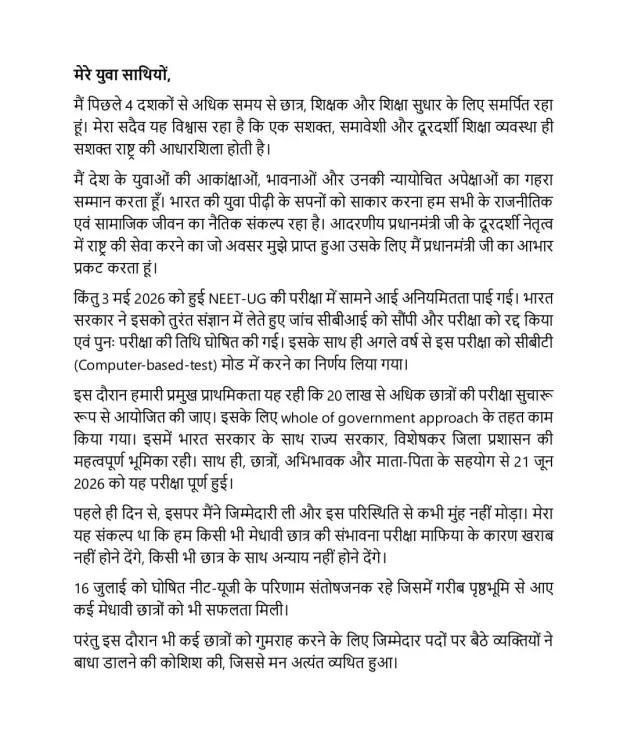
Singh described Pradhan as a leader who kept 'students at the centre' and left behind 'an important and evolving conversation on the future of education in India.' The transition raises questions about continuity on NEP implementation timelines , curriculum redesigns and education funding in Parliament.
Announcement of Pradhan's successor as Education Minister is now the immediate focus for the education sector and policy stakeholders.
Union Science and Technology Minister Dr. Jitendra Singh on Saturday, 25 July 2026 took to X to pay tribute to Dharmendra Pradhan as the latter stepped down from his role as India's Minister of Education, acknowledging his tenure as one marked by deep engagement with students and a clear commitment to strengthening the country's education ecosystem.
In his post, Dr. Singh wrote that 'few leaders have remained so closely aligned with the aspirations and concerns of young India,' adding that Pradhan 'navigated the complexities of educational leadership while keeping students at the centre.' He concluded by thanking Pradhan for his 'service and contribution to nation-building.'
Context
Dharmendra Pradhan was appointed Minister of Education in July 2021, succeeding Ramesh Pokhriyal Nishank. His tenure coincided with one of the most significant periods of policy transformation in Indian education, anchored by the rollout of the National Education Policy (NEP) 2020 — a Cabinet-approved framework that replaced the 1986 policy with an emphasis on multidisciplinary learning, vocational education and digital infrastructure. Pradhan oversaw the early implementation phases of this landmark reform across school and higher education institutions. Prior to heading the Education Ministry, Pradhan held portfolios in Petroleum and Natural Gas as well as Skill Development, giving him a broad base in human capital and resource management before taking charge of education.Policy Backdrop
The NEP 2020, approved by the Union Cabinet in July 2020, represented the first comprehensive overhaul of India's education framework in over three decades. Its implementation required sustained inter-ministerial coordination, engagement with state governments and a recalibration of curriculum structures from the foundational to the higher education level. Pradhan's role during this period was to translate the policy's broad vision into institutional action — a task that involved managing stakeholder expectations across teachers, universities, state education boards and student communities. Cross-ministerial tributes of this nature, such as the one posted by Dr. Singh, reflect the Modi government's broader emphasis on integrated human capital development and the political salience of youth engagement as a governance priority.Stakeholders and Impact
The transition at the Ministry of Education has direct implications for students, teachers and higher education institutions across India, many of which are at varying stages of adapting to NEP 2020 mandates. Curriculum redesigns, the introduction of the Academic Bank of Credits and the push for regional-language instruction are among the ongoing reform threads that will require continuity under any incoming minister. Periodic ministerial reassignments are a recognised feature of administrative management within the government, often used to refresh portfolios or address shifting priorities. The education sector, given its scale and the reform momentum built since 2020, will be closely watched for signals of continuity or recalibration.What's Next
Attention will now turn to the announcement of Pradhan's successor as Education Minister and any immediate signals on the pace of NEP implementation timelines, parliamentary discussions on education funding and the broader direction of school and higher education policy. Pradhan himself is expected to continue in public life, with his next assignment likely to be announced as part of any broader cabinet restructuring. The conversation on the future of Indian education — which Dr. Singh described as 'important and evolving' — will continue to unfold in the months ahead.Point of View
Insulating them from the perception of disruption during a reshuffle. The tribute's tone of continuity over closure suggests the administration is managing the transition as routine administration rather than a policy pivot.
NationPress
25 Oct 2026
Frequently Asked Questions
Why did Dharmendra Pradhan step down as Education Minister?
The specific reasons for Dharmendra Pradhan stepping down as Education Minister have not been officially stated; ministerial reassignments in the Modi government are typically part of periodic cabinet restructuring to refresh portfolios or address shifting priorities.
What did Dharmendra Pradhan achieve as Education Minister?
Dharmendra Pradhan oversaw the early implementation of the National Education Policy 2020 , which replaced the 1986 policy and introduced multidisciplinary learning, vocational education and digital infrastructure reforms across school and higher education in India.
Who will be the next Education Minister of India after Dharmendra Pradhan?
The successor to Dharmendra Pradhan as India's Education Minister had not been officially announced at the time of this report; the appointment is expected to be part of a broader cabinet announcement.
What is the National Education Policy 2020?
The National Education Policy 2020 is a Cabinet-approved framework that replaced India's 1986 education policy, emphasising multidisciplinary learning, vocational education, regional-language instruction and digital infrastructure across school and higher education.
Who is Dr. Jitendra Singh?
Dr. Jitendra Singh is the Union Minister of State (Independent Charge) for Science and Technology and Earth Sciences, and also holds a Minister of State portfolio in the Prime Minister's Office and the Ministry of Personnel.