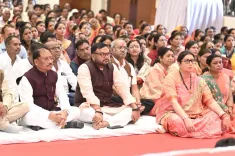
Giriraj Singh marks Mann Ki Baat's 12-year journey
Synopsis
Union Textiles Minister Giriraj Singh saluted Mann Ki Baat's 12-year journey on 25 October 2026, calling PM Modi's monthly radio address a powerful platform for citizen-driven stories of service and public participation.
Key Takeaways
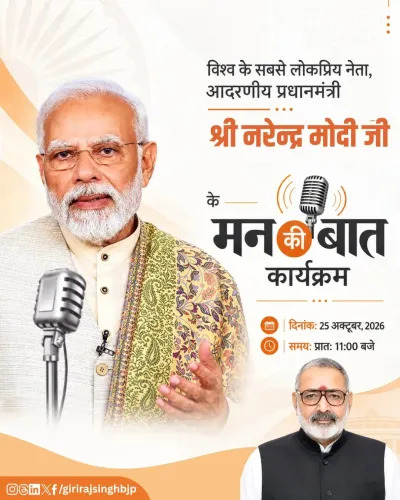
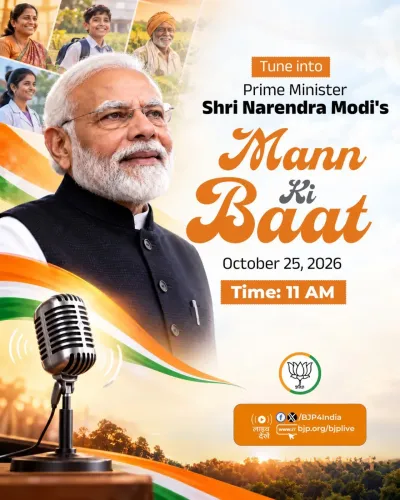
Union Textiles Minister Giriraj Singh posted a tribute to Mann Ki Baat on 25 October 2026 , marking its 12-year run.
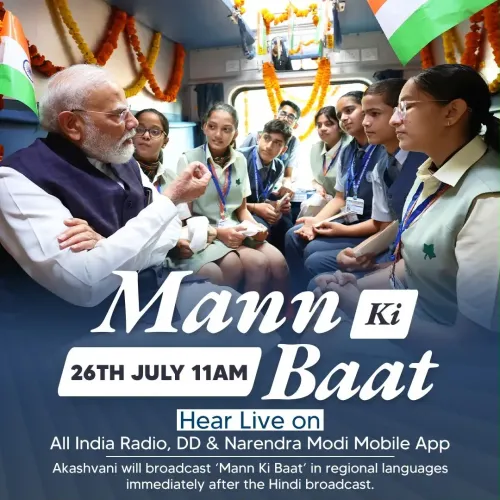
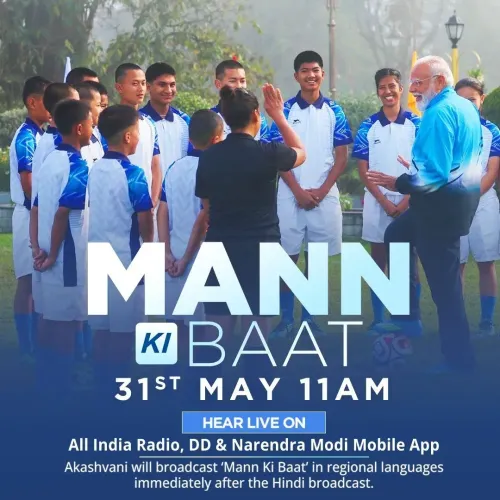
Mann Ki Baat was launched by Prime Minister Narendra Modi on 3 October 2014 on All India Radio.
Singh described the programme as a 'powerful medium' for stories of public participation and selfless service.
The programme has formed a core part of the central government's direct-outreach strategy since 2014.
BJP ministers routinely amplify Mann Ki Baat milestones on social media, extending its reach to digital audiences.
Twelve years of a radio programme that turned ordinary citizens into prime-time protagonists — and Union Textiles Minister Giriraj Singh marked the occasion on Sunday, 25 October 2026, with a tribute to the spirit that keeps Mann Ki Baat running.
In his post, Singh described the programme's journey as 'janshaakti, janasevaa aur asaadharan yogadaan ko naman karne ki yatra' — 'a journey of saluting the people's strength, public service, and extraordinary contribution.' He called it a 'powerful medium' for bringing forward inspiring stories of public participation and selfless service.
From All India Radio to a national institution
Prime Minister Narendra Modi launched Mann Ki Baat on 3 October 2014 as a monthly radio address on All India Radio. What distinguished it from conventional government broadcasts was its format: the PM spotlighting letters and stories sent in by citizens — farmers, teachers, students, self-help groups — rather than leading with policy announcements. That editorial choice made listeners feel like contributors, not just an audience.
Over the years, the programme became one of the central government's most consistent direct-outreach tools, weaving together citizen initiatives, unsung local heroes, and government schemes into a single accessible broadcast. Its reach — across regional AIR stations and translated into multiple Indian languages — gave it an audience that cuts across the urban-rural divide.
Ministers, milestones, and the BJP's communication playbook
Singh's tribute is one of many from BJP leaders on Mann Ki Baat milestones, reflecting a deliberate pattern: senior ministers amplify the programme on social media, extending its reach well beyond radio listeners to younger, digitally active audiences. For a party that has invested heavily in direct-to-citizen communication since 2014, Mann Ki Baat sits at the centre of that strategy.
The programme's consistent focus on 'nishkaam seva' — selfless service — also dovetails with a broader cultural messaging effort, framing governance not just as policy delivery but as a shared national endeavour. Singh's endorsement of that framing, using words like 'janshakti' (people's power) and 'janabhagidari' (public participation), echoes the vocabulary the programme itself has normalised over a decade-plus of broadcasting.
Twelve years in, Mann Ki Baat has outlasted most political communication experiments in modern Indian history. The stories it carries — of ordinary people doing extraordinary things — may prove more durable than any single policy headline.
Point of View
Story-led, and deliberately apolitical in tone even as ministers rally around it on social media. At 12 years, the programme's longevity itself becomes a political argument — that direct, consistent engagement with ordinary citizens builds durable legitimacy. Whether future governments inherit or retire the format will be a telling indicator of how central communication philosophy is to Indian electoral politics.
NationPress
25 Oct 2026
Frequently Asked Questions
When did Mann Ki Baat start?
Mann Ki Baat was launched by Prime Minister Narendra Modi on 3 October 2014 as a monthly radio address on All India Radio.
What is Mann Ki Baat about?
Mann Ki Baat is a monthly radio programme in which Prime Minister Narendra Modi highlights stories of citizen service, community participation, and government initiatives, drawing heavily from letters and inputs sent by the public.
Why did Giriraj Singh post about Mann Ki Baat?
Union Textiles Minister Giriraj Singh posted a tribute on 25 October 2026 to mark 12 years of Mann Ki Baat, calling it a powerful medium for inspiring stories of public participation and selfless service.
How many episodes of Mann Ki Baat have been broadcast?
The exact episode count as of October 2026 has not been specified in available information, but the programme has aired monthly since October 2014, making it one of India's longest-running political radio formats.
What is the significance of Mann Ki Baat for Indian citizens?
Mann Ki Baat gives ordinary citizens a platform on national radio by featuring their stories of service and community work, positioning them as active contributors to national progress rather than passive recipients of government policy.