Anand Mahindra on Bloomberg Forum's best lesson: Singapore's AI playbook

Synopsis
Mahindra Group chairman Anand Mahindra joined the Bloomberg New Economy Forum advisory board in New Delhi and says a conversation with Singapore DPM Gan Kim Yong on turning AI into national competitive advantage was his most valuable takeaway from the gathering.
Key Takeaways
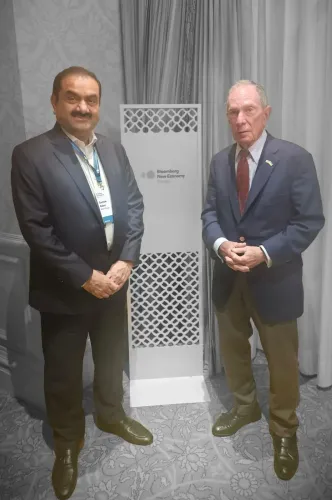
Mahindra Group chairman Anand Mahindra joined the advisory board of the Bloomberg New Economy Forum in New Delhi at the invitation of Mike Bloomberg .
Mahindra and Bloomberg previously co-chaired the 2018 Global Climate Action Summit in California alongside Patricia Espinosa .
Mahindra cited a conversation with Singapore Deputy Prime Minister Gan Kim Yong — not the main-stage sessions — as his biggest takeaway.
He described Gan's framing as 'one of the clearest and most coherent national strategies I've heard for turning AI into a competitive advantage.' Mahindra reflected that the real value of global forums often lies in informal exchanges rather than formal panels.
His post underlines how Singapore's AI model is drawing serious attention from business and policy leaders in much larger economies.
The most valuable insight at a global forum rarely comes from the main stage. Mahindra Group chairman Anand Mahindra learned that lesson again at the Bloomberg New Economy Forum in New Delhi, where a candid side conversation with Singapore Deputy Prime Minister Gan Kim Yong left a deeper mark on him than any panel session.
From the Climate Summit stage to New Delhi's boardrooms
Mahindra opened with a confession: he is 'not a great fan of global conclaves,' finding the conversations 'more predictable than the guest lists.' The exception, he wrote on 17 October 2026, is Mike Bloomberg — a man he simply cannot say no to. Their relationship stretches back to 2018, when Bloomberg persuaded Mahindra to co-chair the Global Climate Action Summit in California alongside Mexican diplomat and former UNFCCC Executive Secretary Patricia Espinosa. Mahindra called that summit 'an extraordinary learning experience.' When Bloomberg invited him onto the advisory board of the New Economy Forum's New Delhi edition, the answer was the same: yes.
The Bloomberg New Economy Forum is an invitation-only series convened to tackle emerging trends in technology, trade, and policy. Its arrival in New Delhi signals the growing centrality of India in global conversations about economic transformation — a shift that even sceptics of the conclave circuit find hard to ignore.
Gan Kim Yong's AI strategy — the conversation that mattered most
Mahindra's biggest takeaway had nothing to do with a keynote address. It was a conversation with Singapore's Deputy Prime Minister Gan Kim Yong, whom he described as articulating 'one of the clearest and most coherent national strategies I've heard for turning AI into a competitive advantage.' He did not detail the specifics — by design, perhaps; the point was the quality of the thinking, not a policy brief. But the impression it left was sharp enough to make it into his post.
Singapore has built a well-documented record of translating national AI roadmaps into economic results. The city-state's disciplined approach — linking AI investment to specific productivity outcomes, workforce retraining, and regulatory clarity — is studied by policymakers in economies many times its size. For a country of roughly 6 million people to command that kind of attention at a global forum is itself a data point worth sitting with.
What small nations teach large ones about AI ambition
The broader reflection Mahindra offered is the article's real kicker: 'how much countries can learn from one another, regardless of their size.' That framing matters in the Indian context. India is deep in its own AI policy journey — building compute infrastructure, debating governance frameworks, and betting on homegrown talent. Singapore's model, with its emphasis on speed, coherence, and public-private alignment, offers a template that a large, complex democracy might adapt rather than simply admire.
Global forums are easy to dismiss as networking theatre. Mahindra's post — candid, self-deprecating, and genuinely curious — is a reminder that the real work often happens in the margins. The stage is for optics. The corridor is for strategy.
Point of View
And the chairman of one of India's largest conglomerates is saying so out loud. For the Bloomberg New Economy Forum, Mahindra's participation adds marquee credibility to its New Delhi edition and signals that India's top industrialists see forum diplomacy as a legitimate policy-learning channel. The broader pattern — senior executives using social media to compress boardroom thinking into public discourse — continues to blur the line between corporate communication and policy advocacy in India's tech debate.
NationPress
17 Oct 2026
Frequently Asked Questions
What is the Bloomberg New Economy Forum and why is it in New Delhi?
The Bloomberg New Economy Forum is an invitation-only global series convened to discuss technology, trade, and economic policy. Its New Delhi edition reflects India's rising profile in global conversations about economic transformation.
What did Anand Mahindra say about Singapore's AI strategy?
Mahindra said Singapore Deputy PM Gan Kim Yong articulated 'one of the clearest and most coherent national strategies I've heard for turning AI into a competitive advantage,' calling it his biggest takeaway from the forum.
Who is Gan Kim Yong and what is his role?
Gan Kim Yong is Singapore's Deputy Prime Minister. He has publicly outlined national approaches to technology adoption and economic competitiveness, including Singapore's AI roadmap.
What was the 2018 Global Climate Action Summit that Mahindra mentioned?
The 2018 Global Climate Action Summit was a gathering in California focused on subnational climate commitments. Anand Mahindra co-chaired it alongside Mike Bloomberg and Mexican diplomat Patricia Espinosa.
What is Anand Mahindra's connection to Mike Bloomberg?
Bloomberg persuaded Mahindra to co-chair the 2018 Global Climate Action Summit in California. That experience led Mahindra to accept Bloomberg's subsequent invitation to join the advisory board of the New Economy Forum in New Delhi.