Anand Mahindra bets on Physical AI to rewrite India's tech story

Synopsis
Mahindra Group chairman Anand Mahindra on 6 October 2026 declared Physical AI — intelligent systems running blast furnaces, cement kilns, and factory floors — among the most transformative AI applications, backing a live Tech Mahindra and AI4ProdOutcomes deployment and calling it India's next technology frontier.
Key Takeaways
Anand Mahindra publicly backed Physical AI on 6 October 2026 , calling it potentially the most transformative application of artificial intelligence.
AI4ProdOutcomes Physical AI models will be deployed alongside Tech Mahindra AI agents in demanding industrial environments including blast furnaces and cement kilns.
Mahindra framed Physical AI as India's opportunity to extend its technology leadership beyond software into heavy manufacturing.
Physical AI targets environments where conventional automation struggles — extreme heat, continuous processes, and high-consequence real-time decisions.
The collaboration pairs domain-specific industrial AI models with Tech Mahindra's enterprise integration and global delivery scale.
Mahindra suggested India's next major technology chapter could be 'written on the factory floor' rather than purely in code.
The world's AI conversation has been dominated by chatbots, image generators, and voice assistants — but Mahindra Group chairman Anand Mahindra is pointing at something far heavier: blast furnaces, cement kilns, and entire factory floors run by intelligent machines. On Tuesday, 6 October 2026, Mahindra took to X to argue that 'Physical AI' — artificial intelligence embedded in industrial environments — could be the most transformative application of the technology yet, and that India has a real shot at leading that charge.
From chatbots to blast furnaces: what Physical AI actually means
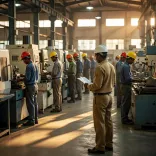
While generative AI has captured consumer imagination, Physical AI refers to intelligent systems that perceive, decide, and act within the physical world — operating heavy industrial machinery, optimising continuous-process manufacturing, and coordinating complex factory logistics in real time. The environments Mahindra names are deliberately extreme: a blast furnace runs at temperatures above 1,500°C, a cement kiln demands precise thermal control across kilometres of rotating equipment, and a factory floor involves hundreds of interdependent variables simultaneously. These are exactly the settings where human error is costly and conventional automation reaches its limits.
Mahindra cited a concrete collaboration to anchor his vision. AI4ProdOutcomes, a company building Physical AI models for industrial production, will deploy those models alongside Tech Mahindra's AI agents in what he described as 'some of the world's toughest and most demanding industrial environments.' The pairing matters: AI4ProdOutcomes brings domain-specific industrial models; Tech Mahindra brings the enterprise integration muscle and global delivery scale to put them to work at speed.
India's next technology chapter — written on the factory floor
Mahindra's framing is deliberately ambitious. India has built a formidable global reputation in software services and digital technology — an industry worth hundreds of billions of dollars and tens of millions of jobs. But that story has been largely about screens, code, and data centres. His post suggests the next chapter could be physical: intelligence embedded in the materials, metals, and manufacturing processes that underpin the real economy.
'We've long celebrated India's prowess in software and digital technology,' he wrote. 'Perhaps the next significant chapter of our technology story will be written not just in lines of code, but on the factory floor.' For a country that has simultaneously pushed an advanced manufacturing agenda — semiconductors, defence production, electric vehicles — and built world-class AI engineering talent, the convergence is at least plausible, if still early.
Why the industrial AI bet is bigger than it sounds
Heavy industry is one of the last frontiers of meaningful AI disruption. Consumer and enterprise software have been transformed; physical processes — steelmaking, cement, chemicals, mining — have lagged because they demand real-time sensor fusion, tolerance for harsh conditions, and decisions with immediate, irreversible consequences. The company that cracks reliable Physical AI for these environments does not just sell software; it sells continuous uptime, energy savings, and yield improvements worth millions of dollars per plant per year. That is a very different, and potentially much larger, value proposition than a productivity chatbot.
Mahindra's endorsement — backed by a live deployment through Tech Mahindra — signals that at least one major Indian conglomerate is prepared to move beyond the AI hype cycle and stake infrastructure-level bets on where the technology goes next.
Point of View
The commercial template becomes replicable across steel, chemicals, mining, and defence manufacturing — sectors India is actively trying to scale under its advanced manufacturing push. The real watch item is whether Indian-built Physical AI can win contracts outside India, turning a domestic industrial story into a global export.
NationPress
6 Oct 2026
Frequently Asked Questions
What is Physical AI and how is it different from regular AI?
Physical AI refers to intelligent systems that operate in and interact with the physical world — running industrial machinery like blast furnaces or cement kilns — rather than generating text, images, or code. Unlike generative AI that lives on screens, Physical AI must process real-time sensor data and make decisions with immediate, irreversible physical consequences.
What did Anand Mahindra say about Physical AI?
On 6 October 2026, Mahindra posted on X that Physical AI could be 'one of the most transformative applications' of artificial intelligence, and that India could lead this transformation through a deployment involving Tech Mahindra AI agents and AI4ProdOutcomes Physical AI models in tough industrial environments.
What is the Tech Mahindra and AI4ProdOutcomes collaboration?
AI4ProdOutcomes builds Physical AI models designed for industrial production environments. These models will work alongside Tech Mahindra's AI agents to operate in demanding settings such as blast furnaces and cement kilns, combining specialist industrial AI with Tech Mahindra's enterprise integration capabilities.
Why does Anand Mahindra think India can lead in Physical AI?
Mahindra argued that India's established strength in software and digital technology, combined with its growing manufacturing ambitions, positions it well to extend its technology story into Physical AI — writing the next chapter 'on the factory floor' rather than purely in lines of code.
Which industries could benefit most from Physical AI in India?
Sectors involving continuous heavy-process manufacturing stand to gain the most — steel (blast furnaces), cement (rotary kilns), chemicals, mining, and automotive assembly. These are environments where real-time AI-driven control can deliver significant energy savings, yield improvements, and reduced downtime.