India reaffirms maternal and child health commitment at World Health Assembly
Synopsis
At the 79th World Health Assembly in Geneva, Health Minister Nadda didn't just reaffirm India's commitment to maternal and child health — he signalled a deeper financial and technical stake, with a $2 million annual PMNCH contribution in process and an open offer to export India's public health playbook globally.
Key Takeaways
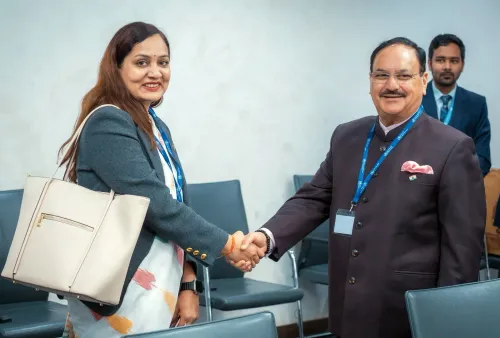
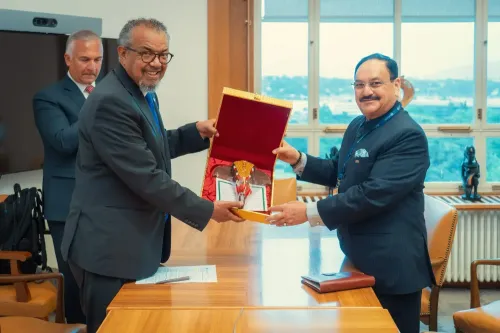
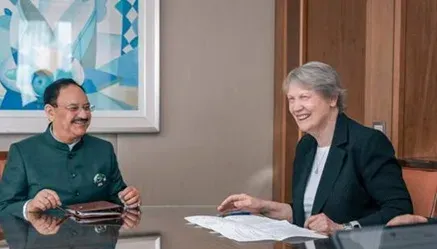
Health Minister Jagat Prakash Nadda met PMNCH Board Chair Helen Clark on the sidelines of the 79th World Health Assembly in Geneva on 20 May .
India holds the position of Vice Chair of the PMNCH Board and Chair of the Standing Committee .
India's annual grant of $2 million in perpetuity to PMNCH is currently under process.
India was among the first countries to launch a dedicated national adolescent health programme in 2014 .
India has recorded reductions in MMR and IMR at a pace reportedly surpassing global trends.
Nadda offered India's digital public health goods and technical expertise to support other countries through PMNCH platforms.
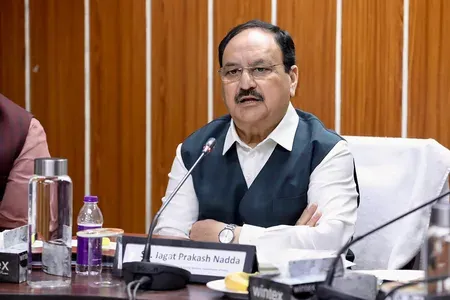
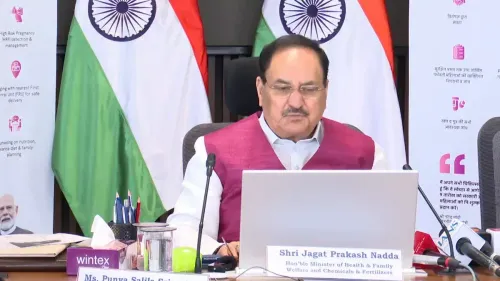
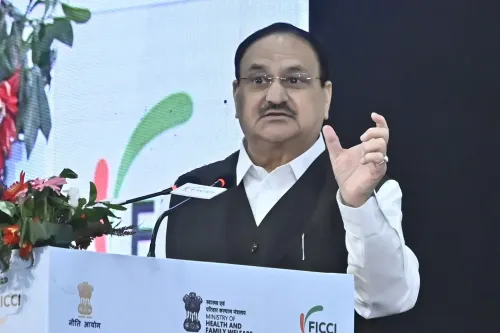
Union Minister for Health and Family Welfare Jagat Prakash Nadda on Wednesday, 20 May reaffirmed India's commitment to advancing the global agenda for women's, children's and adolescents' health during a bilateral meeting at the 79th World Health Assembly in Geneva. The meeting, held on the sidelines of the Assembly, was with Helen Clark, Board Chair of the Partnership for Maternal, Newborn and Child Health (PMNCH), according to an official statement from the Ministry of Health and Family Welfare.
India's Leadership Role in PMNCH
Nadda highlighted India's association with PMNCH since its inception in 2005, underscoring the country's active leadership as Vice Chair of the Board and Chair of the Standing Committee. He also informed that India's annual grant contribution of $2 million in perpetuity is currently under process — a signal of long-term financial commitment to the partnership's objectives.
Public Health Achievements Cited
The minister pointed to measurable gains in India's health indicators, noting significant reductions in the Maternal Mortality Ratio (MMR) and Infant Mortality Rate (IMR) at a pace reportedly surpassing global trends. He described India as 'a hub of innovation and large-scale delivery of health interventions with equity and accessibility,' keeping women, children and adolescents at the core of its service delivery model.
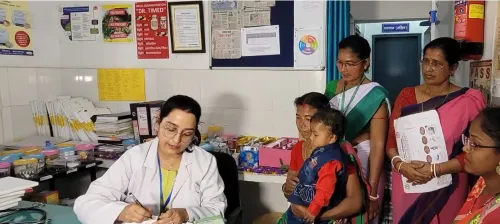
Nadda also noted that India was among the first countries to launch a dedicated national programme for adolescents in 2014, delivering interventions through facility-based, school-based and community-based channels across the country.
Offer of Global Technical Support
Beyond domestic achievements, Nadda expressed India's readiness to share evidence-based best practices and provide technical guidance to other countries. He invited PMNCH to showcase India's successful models and innovations through both physical and virtual platforms, pointing to India's growing repository of digital public health goods as a resource available to the global community.
India's commitment was further extended to addressing the growing burden of Non-Communicable Diseases (NCDs), with Nadda signalling willingness to support PMNCH across its expanding priority areas including Women's, Children's and Adolescents' Health (WCAH).
Global Recognition and What Comes Next
Helen Clark acknowledged India's continued leadership and contributions to global public health, recognising its important role within PMNCH and the wider global health architecture. This bilateral engagement at Geneva positions India as a key voice in shaping post-pandemic global health priorities, particularly as multilateral bodies recalibrate their focus toward maternal and child health outcomes in low- and middle-income countries. The formalisation of India's $2 million annual contribution is expected to further consolidate its standing within the partnership.
Point of View
A leadership role, and an offer of technical exports, New Delhi is crafting a 'global health donor' identity — a notable shift for a country that spent decades as primarily a recipient of international health aid. The real question is whether India's celebrated MMR and IMR gains translate into a replicable model for other low- and middle-income countries, or whether they reflect conditions too specific to India's scale and federal health infrastructure to travel well. The $2 million annual contribution, while symbolically important, is modest relative to PMNCH's overall budget — the credibility of India's global health leadership will ultimately rest on the quality of technical cooperation, not the quantum of the grant.
NationPress
3 Oct 2026
Frequently Asked Questions
What did Health Minister Nadda announce at the World Health Assembly?
At the 79th World Health Assembly in Geneva on 20 May, Health Minister Jagat Prakash Nadda reaffirmed India's commitment to global maternal, newborn and child health and confirmed that India's annual grant of $2 million in perpetuity to PMNCH is currently under process. He also offered India's technical expertise and digital public health resources to other countries.
What is PMNCH and what role does India play in it?
The Partnership for Maternal, Newborn and Child Health (PMNCH) is a global alliance focused on improving health outcomes for women, children and adolescents, established in 2005. India has been a member since inception and currently serves as Vice Chair of the PMNCH Board and Chair of its Standing Committee.
How has India performed on maternal and child health indicators?
According to the Health Ministry, India has recorded significant reductions in its Maternal Mortality Ratio (MMR) and Infant Mortality Rate (IMR) at a pace reportedly surpassing global trends. India also launched one of the world's first dedicated national adolescent health programmes in 2014.
What support is India offering to other countries through PMNCH?
India has expressed readiness to share evidence-based best practices, provide technical guidance, and offer its growing repository of digital public health goods to other countries. Nadda invited PMNCH to showcase India's health models through physical and virtual platforms.
What is the significance of India's $2 million annual PMNCH contribution?
The $2 million annual grant in perpetuity signals India's long-term financial commitment to the PMNCH partnership. While the amount is being processed, it reinforces India's ambition to be recognised as a global health contributor rather than solely a recipient of international health assistance.