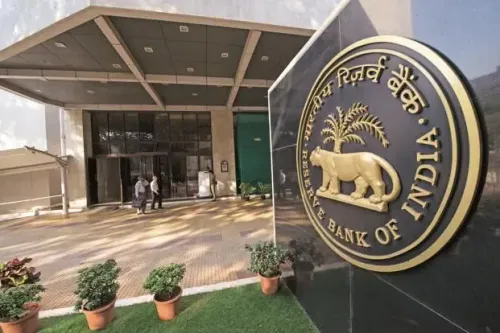
RBI forex measures may boost BoP by over $30 billion short-term: HSBC
Synopsis
HSBC estimates that India's combined government and RBI forex package — spanning subsidised NRI deposits, cheaper ECB swaps, capital gains tax cuts, and tighter exporter repatriation timelines — could boost the balance of payments by over $30 billion in the short run. The RBI held the repo rate at 5.25%, but went 'all in' on the forex front in a notably split policy approach.
Key Takeaways
Government and RBI measures could improve India's balance of payments by more than $30 billion in the short run, according to HSBC .
RBI held the repo rate at 5.25% at the June policy meeting while deploying a broad forex support package.
A subsidised NRI deposit window will see the RBI bear full hedging costs on fresh 3–5 year deposits raised until September 2026 .
Long-term capital gains tax cut from 12.5% and withholding tax on interest income reduced from 20% to support FII bond investment.
Exporter repatriation timeline shortened from 15 months to 9 months to accelerate inflows.
Petrol and diesel prices raised by ₹7.5 per litre to help narrow the current account deficit.
The latest measures by the government and the Reserve Bank of India (RBI) to strengthen the rupee and attract foreign capital could improve India's balance of payments (BoP) by more than $30 billion in the short run, according to a report by HSBC. The improvement is expected to come through both a narrowing of the current account deficit (CAD) and a surge in capital inflows.
RBI's Split Approach on Forex and Rates
Ahead of the June policy meeting, markets were closely watching two fronts: rupee support measures and the policy rate decision. HSBC's report noted that the RBI adopted a split strategy — deploying an aggressive, broad-based forex package while staying restrained on rates.
'We think the RBI took a split approach, going 'all in' on forex (FX) with a broad package of measures, while staying more restrained on rates by holding the repo at 5.25 per cent, in line with our expectation,' the report said.
Key Measures to Attract Foreign Inflows
The RBI and the government jointly announced a raft of measures aimed at drawing foreign capital into India. These include a subsidised window for NRI deposits, under which the RBI will bear the full hedging cost for fresh 3–5 year deposits raised by banks until September 2026. A cheaper forex swap facility was also introduced to encourage public sector undertakings (PSUs) to raise external commercial borrowings (ECBs).
Launching both instruments simultaneously signals what HSBC described as an 'all-in' approach to shoring up the external sector.
Bond Market Reforms and Capital Gains Relief
To support foreign institutional investor (FII) participation in government bonds, authorities reduced the 12.5 per cent long-term capital gains tax and the 20 per cent withholding tax on interest income. The fully accessible route (FAR) universe was also expanded to include 15, 30, and 40-year government securities (G-secs), with no investment limits imposed.
'Even if near-term inflows are modest, these are constructive market-deepening steps — particularly if they help pave the way for bond index inclusion over the medium term. Notably, there were no formal measures to restrict capital outflows by individuals or corporates. We view the absence of 'capital controls' positively,' the HSBC report stated.
Exporter Repatriation and CAD Narrowing
On the current account side, the timeline for exporters to repatriate proceeds has been shortened to nine months from the earlier 15 months, a move designed to pull inflows forward over the coming months. Earlier steps to reduce the CAD — including raising petrol and diesel pump prices by ₹7.5 per litre — are also expected to help trim the deficit, according to the report.
Together, these measures represent one of the more comprehensive external-sector interventions in recent memory, and their combined effect on the BoP will be closely tracked by markets in the quarters ahead.
Point of View
Even at the cost of signalling rate hesitancy. The $30 billion BoP improvement projected by HSBC is contingent on actual inflow materialisation — subsidised windows and tax cuts create incentives, but do not guarantee take-up. The expansion of FAR to ultra-long G-secs is the most structurally significant move, quietly laying the groundwork for bond index inclusion that could dwarf short-term inflow measures. The absence of capital controls is the right call, but the pressure that made such a package necessary in the first place deserves equal scrutiny.
NationPress
21 Oct 2026
Frequently Asked Questions
How much could India's balance of payments improve from the new RBI and government measures?
According to HSBC, the combined measures could improve India's balance of payments by more than $30 billion in the short run, through a narrowing of the current account deficit and an increase in capital inflows.
What is the subsidised NRI deposit window announced by the RBI?
It is a facility under which the RBI will bear the full hedging cost for fresh 3–5 year NRI deposits raised by banks, valid until September 2026. The measure is designed to make India a more attractive destination for non-resident Indian savings.
Why did the RBI hold the repo rate at 5.25% despite rupee pressure?
The RBI opted for a split approach — deploying aggressive forex support measures while keeping the repo rate unchanged at 5.25%, in line with market expectations. HSBC described this as going 'all in' on forex while staying restrained on rates.
How does the FAR expansion support foreign investment in Indian bonds?
The fully accessible route now includes 15, 30, and 40-year government securities with no investment limits, making Indian sovereign debt more accessible to long-term foreign investors and potentially supporting future bond index inclusion.
How do the petrol and diesel price hikes relate to the current account deficit?
Raising petrol and diesel pump prices by ₹7.5 per litre is expected to reduce domestic fuel consumption and import demand, thereby helping narrow India's current account deficit as part of the broader external-sector stabilisation effort.