Did S. Korea's exports really reach an all-time high of $709.7 billion in 2025?
Click to start listening
Synopsis
South Korea has achieved a groundbreaking milestone in its trade history, hitting exports of $709.7 billion in 2025. This remarkable achievement, driven by the semiconductor sector and AI advancements, marks a new era for the nation. Discover how diverse markets and strong demand fueled this unprecedented growth.
Key Takeaways
- Exports reached $709.7 billion, the highest ever for South Korea.
- Semiconductors led the way with a 22.2% increase in exports.
- Trade surplus of $78 billion was achieved.
- Imports slightly decreased by 0.02%.
- Diverse markets helped mitigate declines in traditional destinations.
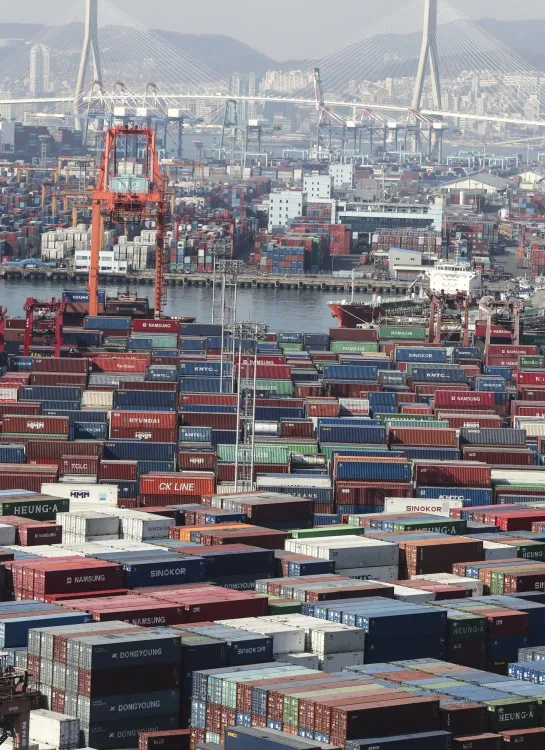
Seoul, Jan 1 (NationPress) In 2025, South Korea's exports soared to an unprecedented $709.7 billion, marking the first time the nation has exceeded the $700 billion threshold, according to data released by the government on Thursday.
This represents a 3.8 percent increase in annual exports compared to the previous year, with exports of semiconductors witnessing a remarkable 22.2 percent surge year-on-year, reaching an all-time high of $173.4 billion, fueled by the burgeoning field of artificial intelligence (AI), as reported by the Ministry of Trade, Industry and Resources, per Yonhap news agency.
Meanwhile, imports experienced a slight decline of 0.02 percent, totaling $631.7 billion in 2025, which led to the largest trade surplus since 2017, amounting to $78 billion.
The ministry highlighted that the historic export figures from last year were supported by the strong performance of vital export categories like semiconductors, automobiles, and ships, along with the expansion of smaller sectors such as agro-fisheries and cosmetics.
Furthermore, the diversification of export markets was evident last year. While shipments to the United States and China saw a decline due to rising trade protectionism, exports to the Association of Southeast Asian Nations (ASEAN), Latin America, and the Commonwealth of Independent States (CIS) increased, as noted by the ministry.
In terms of individual items, semiconductor exports reached a historic $173.4 billion, attributed to a substantial rise in the average price of memory chips amid ongoing high demand from AI data centers.
Car exports also saw an increase of 1.7 percent, totaling $72 billion, despite impacts from U.S. tariffs.
While shipments to the world's largest economy decreased due to tariffs, exports to the European Union (EU) and the CIS grew, spurred by demand for hybrid and used vehicles.
Exports in the biohealth sector increased by 7.9 percent to $16.3 billion, while shipments of ships and computers rose by 24.9 percent and 4.5 percent, respectively, totaling $32 billion and $13.8 billion.
Importantly, exports of agro-fisheries products rose by 6 percent to $12.4 billion, and cosmetics exports surged by 11.8 percent to $11.4 billion, propelled by the global popularity of Korean culture.
Conversely, exports of petrochemical products and steel fell by 11.4 percent and 9 percent, respectively, to $42.5 billion and $30.3 billion, mainly due to global oversupply.
Regarding export destinations, shipments to the U.S. dropped by 3.8 percent to $122.9 billion in 2025, as exports of automobiles, auto parts, machinery, and other goods decreased following the tariff policies of the Donald Trump administration. South Korea's trade surplus with the U.S. fell by $6.1 billion from the previous year to $49.5 billion.
Similarly, exports to China decreased by 1.7 percent to $130.8 billion, influenced by lower demand for petrochemical products, wireless communication devices, and machinery.
On the contrary, shipments to ASEAN grew by 7.4 percent to $122.5 billion, primarily due to semiconductor exports, while exports to the EU increased by 3 percent to $70.1 billion, driven by strong demand for automobiles and ships.
Exports to the CIS surged by 18.6 percent to $13.7 billion, and exports to India climbed by 2.9 percent to a record $19.2 billion.
Additionally, exports to the Middle East rose by 3.8 percent to $20.4 billion, marking the fifth consecutive year of increase, while exports to Latin America grew by 6.9 percent to $31 billion.
In December, outbound shipments increased by 13.4 percent year-on-year to $69.6 billion, extending a winning streak to 11 consecutive months. Imports rose by 4.6 percent to $57.4 billion, resulting in a trade surplus of $12.2 billion, according to the ministry.
Point of View
It is essential to recognize South Korea's significant achievement in global trade. The remarkable export numbers not only reflect the nation's economic resilience but also highlight the increasing diversification of its markets amidst geopolitical challenges. The growth in sectors like semiconductors and biohealth underscores the importance of innovation and adaptability in today’s economy.
NationPress
03/01/2026
Frequently Asked Questions
What was South Korea's total export value in 2025?
South Korea's exports reached an all-time high of $709.7 billion in 2025.
Which sector saw the highest growth in exports?
The semiconductor sector experienced the highest growth, with exports increasing by 22.2% to $173.4 billion.
How did imports change in 2025?
Imports decreased slightly by 0.02% to $631.7 billion.
What was the trade surplus for South Korea in 2025?
South Korea recorded a trade surplus of $78 billion in 2025.
Which regions saw increased exports from South Korea?
Exports to ASEAN, Latin America, and CIS increased, while shipments to the US and China declined.