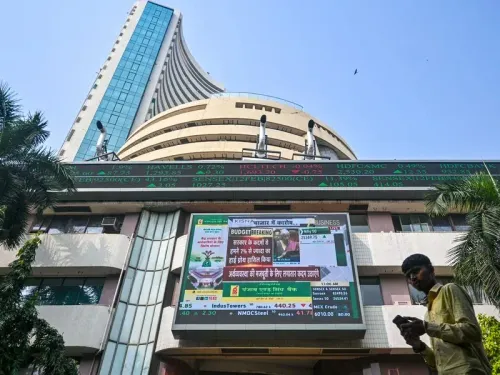
Sensex crashes 1,456 points, Nifty below 23,400 on West Asia tensions
Synopsis
Indian markets suffered their second straight session of heavy losses as West Asia tensions and surging crude oil prices sent Sensex tumbling 1,456 points and Nifty below 23,400. PM Modi's advisory to citizens to cut energy use and foreign travel deepened the anxiety — signalling that the geopolitical fallout may be more than a short-term market wobble.
Key Takeaways
Sensex plunged 1,456 points to close at 74,559 on 12 May 2025 — a fall of 1.92% .
Nifty50 dropped 436 points to settle at 23,379 , slipping below the 23,400 mark.
Nifty MidCap fell 2.54% and Nifty SmallCap tumbled 3.17% , indicating broad-based selling.
Tech Mahindra , HCL Tech , Titan , and TCS were top losers, falling up to 4.44% ; SBI was the only Sensex gainer.
PM Modi urged citizens to cut energy consumption, foreign travel, and gold purchases amid geopolitical and crude oil pressures.
Key Nifty support levels: 23,300 , 23,100 , and 23,000 ; resistance at 23,500 and 23,800 .
BSE Sensex plunged 1,456 points, or 1.92%, to close at 74,559 on Tuesday, 12 May, as escalating West Asia tensions, surging crude oil prices, and fears of broader economic fallout triggered a sharp selloff across Indian equity markets for the second consecutive session. The Nifty50 fell 436 points, or 1.83%, to settle at 23,379 — slipping below the psychologically significant 23,400 level.
Key Market Movements
The broader market bore the heaviest damage. The Nifty MidCap index dropped 2.54% while the Nifty SmallCap index tumbled 3.17%, signalling widespread risk aversion beyond blue-chip counters. Among the Sensex constituents, State Bank of India (SBI) was the sole stock to close in positive territory, with all other 29 shares ending the session in the red.
Tech Mahindra, HCL Technologies, Titan, and TCS were among the top losers, falling up to 4.44%. Sectorally, Nifty IT and Nifty Realty indices emerged as the sharpest laggards, while consumer durables and media shares also remained under pressure. In contrast, metal and oil & gas stocks outperformed the broader market, buoyed by higher commodity prices.
What Triggered the Selloff
The selloff was driven by a confluence of factors — escalating geopolitical tensions in West Asia, a sharp rise in crude oil prices, and growing anxiety over the economic spillover into import-dependent economies like India. Investor sentiment took a further hit after Prime Minister Narendra Modi urged citizens to reduce energy consumption, foreign travel, and gold purchases amid rising geopolitical uncertainties and elevated crude prices.
The remarks were widely interpreted as an acknowledgement that the ongoing conflict could have a material economic impact on India, intensifying fears across trading desks. Notably, this is the second straight session of losses, suggesting that the initial shock has not yet been absorbed by the market.
Technical Outlook and Support Levels
Analysts tracking the Nifty's technical structure noted that 23,300 now acts as the immediate support level, followed by 23,100, where significant Put open interest (OI) concentration is placed. According to market experts, the 23,000 psychological mark remains a critical support zone where strong buying demand had previously emerged.
On the upside, 23,500 has turned into immediate resistance following the breakdown, with 23,800 representing a heavier supply zone due to high Call OI concentration. Until the index reclaims these levels, the technical bias is likely to remain cautious.
Outlook: Crude and Currency in Focus
Analysts cautioned that persistent volatility in oil prices and uncertainty surrounding the geopolitical situation are likely to keep markets under pressure in the near term, particularly given India's significant dependence on crude oil imports. According to market observers,
Point of View
456-point Sensex crash is not just a market reaction — it is a confidence signal. PM Modi's public advisory to cut energy use and foreign travel is the kind of messaging that governments typically reserve for serious economic stress, and markets read it as exactly that. India's structural vulnerability to crude oil shocks has never been resolved, and every West Asia escalation exposes the same fault line. The IT and realty-led selloff suggests that investors are pricing in a dual risk: higher input costs from crude and a potential slowdown in discretionary spending. If crude stays elevated and the geopolitical situation does not de-escalate quickly, the 23,000 Nifty level — a strong historical support — could come under genuine test.
NationPress
25 Sept 2026
Frequently Asked Questions
Why did the Sensex crash today on 12 May 2025?
The Sensex crashed 1,456 points to 74,559 on 12 May 2025 due to escalating West Asia geopolitical tensions, surging crude oil prices, and fears of broader economic fallout for India. Sentiment was further dented by PM Modi's advisory urging citizens to reduce energy consumption and foreign travel.
How much did the Nifty fall and what are the key support levels?
The Nifty50 fell 436 points to settle at 23,379, slipping below 23,400. Analysts identify 23,300 as immediate support, followed by 23,100 and the critical 23,000 psychological mark, while 23,500 and 23,800 are key resistance levels.
Which sectors and stocks were the biggest losers?
Nifty IT and Nifty Realty were the worst-performing sectors. Tech Mahindra, HCL Technologies, Titan, and TCS fell up to 4.44%. SBI was the only Sensex constituent to close in the green.
Why did PM Modi advise citizens to cut energy use and gold purchases?
PM Modi urged citizens to reduce energy consumption, foreign travel, and gold purchases in response to rising geopolitical uncertainties and elevated crude oil prices. The remarks signalled concern over the economic impact of the West Asia conflict on India.
What is the market outlook given the current volatility?
Analysts expect near-term market sentiment to remain volatile due to crude oil price swings and currency concerns. However, any signs of geopolitical easing, combined with resilient domestic fundamentals and stable institutional flows, could support relief rallies.