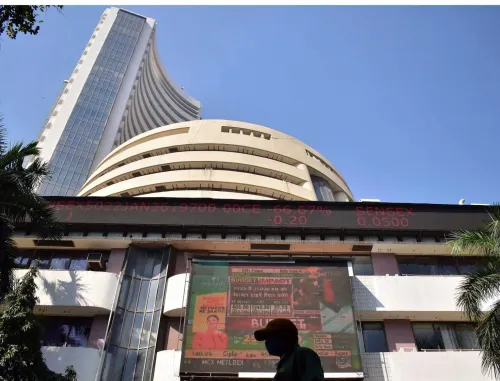
Why Did Sensex and Nifty Close Marginally Lower?
Click to start listening

Synopsis
On December 15, Indian stock markets faced a slight decline despite early recoveries, influenced by weak global cues. As investors remain cautious, key indicators are awaited to shape future market directions. Read on to discover how sector performance varied and what experts predict for the upcoming financial climate.
Key Takeaways
- Sensex closed at 85,213.36, down 54.30 points.
- Nifty finished at 26,027.30, a drop of 19.65 points.
- Auto stocks faced the most pressure, while media and FMCG sectors saw gains.
- Market sentiment remains cautious due to weak global cues.
- Investors are awaiting key economic indicators.
Mumbai, Dec 15 (NationPress) The Indian stock market showed signs of recovery from early declines on Monday but ultimately closed slightly lower as weaker global signals left investors feeling apprehensive.
By the end of the trading day, the Sensex concluded at 85,213.36, reflecting a decrease of 54.30 points or 0.06 percent. The Nifty also finished in negative territory, closing at 26,027.30, down 19.65 points or 0.08 percent.
Several major stocks faced selling pressure on the Sensex, with shares of Mahindra & Mahindra, Maruti Suzuki, Bajaj Finserv, Titan, HDFC Bank, Bharti Airtel, Bajaj Finance, Power Grid, and NTPC emerging as the biggest losers.
Conversely, only a select few stocks managed to close higher, with Hindustan Unilever, Trent, HCL Technologies, Infosys, and Asian Paints finishing in the positive.
The broader market displayed a mixed performance. The Nifty Midcap index dipped by 0.12 percent, while the Nifty Smallcap index outperformed the benchmarks, rising by 0.21 percent.
Sector-wise, the automobile stocks were under significant pressure, with the Nifty Auto index declining by 0.91 percent. The Nifty Pharma index also fell, down 0.4 percent.
In contrast, media and FMCG stocks experienced buying interest, with the Nifty Media index soaring by 1.79 percent and the Nifty FMCG index gaining 0.69 percent.
Analysts noted that market participants remained cautious throughout the session, monitoring weak global cues and seeking more clarity on overseas market trends.
“Ongoing foreign fund outflows and a weak rupee have kept the markets confined to a narrow range, with currency volatility likely to persist until clarity is achieved regarding the India–US trade deal,” market observers stated.
“Moving forward, market momentum is anticipated to be driven by earnings rather than valuations. Investors are also awaiting key economic indicators such as U.S. CPI inflation and unemployment figures, which will influence global liquidity expectations and the interest rate outlook for 2026,” experts commented.
Point of View
It is essential to recognize the cautious sentiment among investors driven by global uncertainties. This scenario illustrates the interconnectedness of markets worldwide and underlines the importance of keeping an eye on international developments as they significantly influence local trends.
NationPress
17/12/2025
Frequently Asked Questions
What factors influenced the decline in Sensex and Nifty?
Weak signals from global markets and ongoing foreign fund outflows contributed to the cautious sentiment among investors, leading to a slight decline in both indices.
Which sectors performed well and which did not?
While auto stocks faced considerable pressure, media and FMCG stocks showed positive movement, with the Nifty Media index increasing by 1.79 percent.
What should investors look out for moving forward?
Investors should keep an eye on key economic indicators such as U.S. CPI inflation and unemployment data, which will influence global liquidity expectations and interest rates.