Has India Unveiled an AI-Powered Screening for Diabetic Retinopathy?
Synopsis
India has taken a significant stride in public health by launching its first AI-enabled community screening program for Diabetic Retinopathy. This initiative aims to enhance early detection and management of diabetes-related eye conditions, addressing a critical health issue affecting millions.
Key Takeaways
AI-driven initiative for Diabetic Retinopathy screening.
Collaboration between AFMS , AIIMS , and the Health Ministry.
Real-time data generation for better health planning.
Implementing at seven diverse locations .
Focus on early detection and prevention.
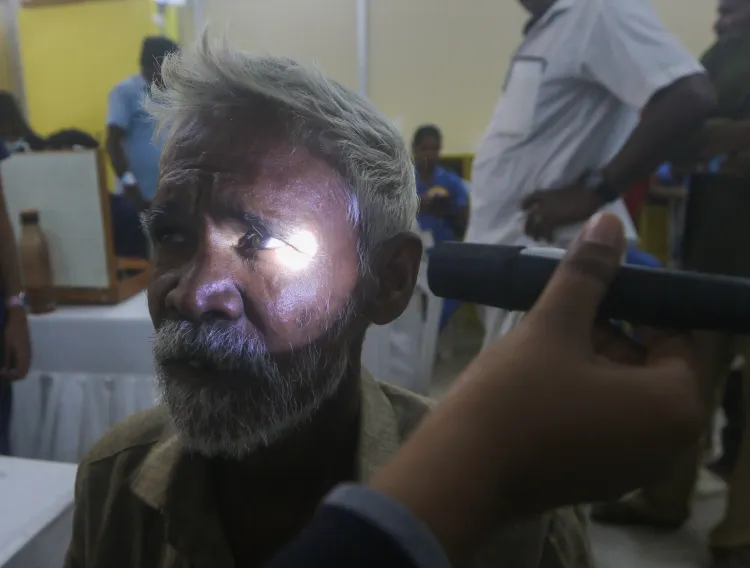
New Delhi, Dec 17 (NationPress) In an effort to address the increasing cases of vision impairment linked to diabetes, India has introduced its inaugural Artificial Intelligence (AI)-powered community screening initiative for Diabetic Retinopathy (DR).
This program is spearheaded by the Armed Forces Medical Services (AFMS) in partnership with the Dr. Rajendra Prasad Centre for Ophthalmic Sciences (RPC), AIIMS, and the eHealth AI Unit of the Health Ministry.
The initiative is described as a pivotal move towards enhancing the early detection of diabetic eye conditions and establishing a real-time national health intelligence system, according to the Ministry of Defence (MoD).
Screening will be carried out by trained medical personnel, including medical officers, nursing staff, and healthcare assistants, utilizing MadhuNetrAI—a web-based AI tool crafted by RPC.
This platform enables automated screening, grading, and triaging of retinal images obtained through handheld fundus cameras.
Moreover, it generates real-time data concerning disease prevalence and geographic distribution, thereby aiding evidence-based planning and policy development.
“During the pilot phase, the AFMS will roll out this initiative at seven sites—Pune, Mumbai, Bengaluru, Dharamshala, Gaya, Jorhat, and Kochi—encompassing metropolitan, rural, hilly, coastal, and remote areas. Personnel from each location will receive comprehensive training at RPC, AIIMS, followed by extensive community screening,” stated the Ministry.
Patients diagnosed with diabetic retinopathy will receive referrals for optimal diabetic care, while those with vision-threatening conditions will be directed to vitreo-retina specialists at specified district hospitals.
District health authorities will manage referral systems and incorporate DR management within existing non-communicable disease frameworks to ensure seamless care.
According to the National Blindness and Visual Impairment Survey of 2019 conducted by RPC, nearly 12% of individuals aged 50 and above are diabetic.
Out of this population, approximately 17% suffer from diabetic retinopathy. Alarmingly, only around 10% of diabetes patients have ever undergone a retinal exam for diabetic retinopathy, highlighting a critical gap in early detection and preventive measures.
This new initiative is expected to serve as a scalable and replicable model, showcasing the effective integration of AI-driven solutions into public health systems through the collaborative efforts of AFMS, AIIMS, and the Ministry of Health & Family Welfare, as noted by the MoD.
Point of View
I believe this initiative represents a monumental step for India's healthcare system. By integrating advanced technology into public health practices, we can significantly improve the outcomes for diabetes patients, addressing a pressing issue that has long been overlooked. This program not only promises better detection of diabetic retinopathy but also enhances the overall healthcare delivery mechanism in our country.
NationPress
6 Oct 2026
Frequently Asked Questions
What is Diabetic Retinopathy?
Diabetic Retinopathy is a diabetes complication that affects the eyes, potentially leading to vision loss.
How will the AI-driven screening work?
The screening will use a web-based AI tool to automate the grading and triaging of retinal images captured by handheld fundus cameras.
Where will the screening take place?
The initiative will be implemented at seven locations across India, including Pune, Mumbai, and Bengaluru.
Who will conduct the screenings?
Trained medical officers, nursing staff, and healthcare assistants will be responsible for conducting the screenings.
What happens if someone is diagnosed with diabetic retinopathy?
Patients will be referred for appropriate diabetic management and, if necessary, to specialists for vision-threatening conditions.