Why Did Sensex and Nifty Start the Week in Decline?
Click to start listening
Synopsis
The Indian stock markets opened the week lower, with Sensex and Nifty dipping amid rising geopolitical trade tensions and weak global cues. Analysts predict a volatile market ahead as trade concerns escalate. This article explores the implications of these developments on the financial landscape.
Key Takeaways
- The Sensex and Nifty opened lower due to global tensions.
- Geopolitical risks are expected to create market volatility.
- Support and resistance levels are crucial for traders.
- Sector performance varies, with IT and media being major losers.
- Foreign and domestic institutional investor activities are noteworthy.
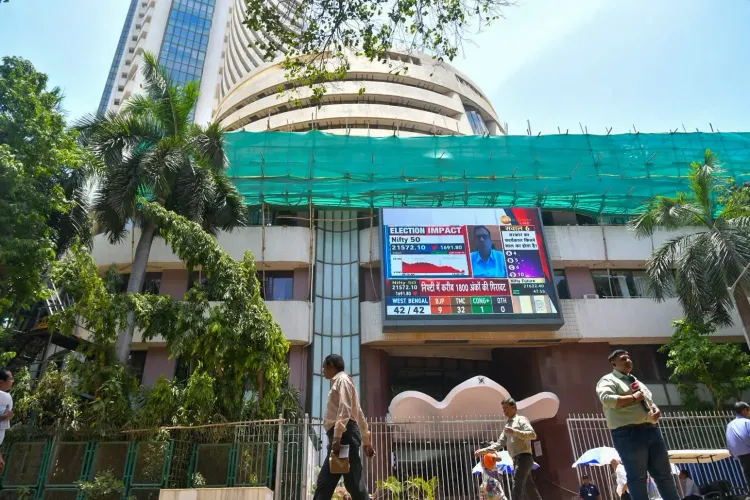
Mumbai, Jan 19 (NationPress) The Indian benchmark indices commenced the week on a negative note on Monday, influenced by weak global cues following an escalation in geopolitical trade tensions due to remarks from the US administration regarding additional tariffs on European nations.
By 9:30 AM, the Sensex had dropped by 449 points, equivalent to 0.54 percent, reaching 83,120, while the Nifty fell by 148 points, or 0.58 percent, settling at 25,546.
Main broadcap indices mirrored the trend of the benchmark indices, with the Nifty Midcap 100 decreasing by 0.42 percent, and the Nifty Smallcap 100 slipping 0.54 percent.
In sector performance, aside from Nifty FMCG, all indices were in the red. Notably, IT, media, and oil and gas sectors experienced declines of over 1 percent each.
Market analysts indicate that immediate support is positioned at the 25,600 and 25,450 levels, while resistance is noted at 25,875, followed by 26,000 and 26,100.
Experts foresee volatile trading days ahead for the stock markets due to increased geopolitical instability. They emphasized the impact of US President Donald Trump’s controversial policies on international trade and global economic stability.
"Should President Trump proceed with his plan to impose a 10 percent tariff on eight European countries by February 1st and escalate it to 25 percent by June 1st, a response from the European bloc is nearly inevitable," analysts warned.
Asian markets were largely down during the morning session as investors assessed crucial economic data from China and Trump’s threats regarding tariffs linked to Greenland.
China’s economic growth has notably slowed to its weakest level in almost three years during the fourth quarter, attributed to a drop in domestic demand.
In Asian market performances, China’s Shanghai index rose by 0.13 percent, while Shenzhen dipped by 0.01 percent. Japan's Nikkei index fell by 1.05 percent, and Hong Kong's Hang Seng Index decreased by 1 percent. Conversely, South Korea's Kospi gained 0.85 percent.
The previous trading session in the US ended unfavorably, with the Nasdaq slipping by 0.06 percent. The S&P 500 also lost 0.06 percent, and the Dow fell by 0.17 percent.
On January 16, foreign institutional investors (FIIs) sold net equities totaling Rs 4,346 crore, whereas domestic institutional investors (DIIs) bought equities netting Rs 3,935 crore.
aar/na
Point of View
It is crucial for us to provide an unfiltered view of the evolving financial landscape. The current volatility in the markets, driven by geopolitical tensions and policy changes, necessitates a well-informed approach for investors. Our commitment is to keep you updated with unbiased insights while navigating these turbulent times.
NationPress
19/01/2026
Frequently Asked Questions
What caused the decline in Sensex and Nifty?
The decline was primarily due to weak global cues and heightened geopolitical trade tensions following US tariffs on European countries.
What sectors were most affected?
Most sectors, except Nifty FMCG, were in the red, particularly IT, media, and oil and gas, which saw declines over 1 percent.
What are the immediate support and resistance levels?
Immediate support is at 25,600 and 25,450, while resistance levels are at 25,875, 26,000, and 26,100.
How did global markets react?
Global markets, particularly in Asia, largely traded with losses as investors reacted to the geopolitical tensions and economic data.
What is the outlook for the markets?
Analysts predict a volatile trading environment due to increased geopolitical risks and uncertainties in international trade.