Snabbit FY26 loss widens to ₹168 crore, nearly 29x jump in a year
Synopsis
Snabbit's losses exploded nearly 29-fold to ₹167.8 crore in FY26 — and its interest income from bank deposits actually exceeded what it earned from running its core business. The Mumbai startup is spending ₹15.92 for every rupee of operating revenue, yet claims burn per job is falling. The funding clock is ticking.
Key Takeaways
Snabbit posted a net loss of ₹167.8 crore in FY26 , up from ₹5.7 crore in FY25 — a near 29-fold increase.
Revenue from operations jumped 46-fold to ₹12.2 crore , but total expenses surged to ₹194.8 crore .
The company spent ₹15.92 to earn every ₹1 of operating revenue during the year.
Other income from bank deposit interest ( ₹14.76 crore ) exceeded core operating revenue.
Snabbit has raised over $112 million , including a $56 million Series D from Susquehanna VC, Mirae Asset and Bertelsmann India.
Burn per job reportedly fell by over ₹100 quarter-on-quarter to below ₹250 in Q1 FY27.
Instant househelp platform Snabbit posted a net loss of ₹167.8 crore in FY26, a near 29-fold surge from ₹5.7 crore in the previous fiscal year, as the Mumbai-based startup aggressively scaled its operations and customer acquisition engine in its first full year of business. The figures were sourced from financial statements filed with the Registrar of Companies.
Despite the widening losses, Snabbit's revenue from operations jumped 46-fold to ₹12.2 crore — a sign of rapid early-stage traction even as unit economics remain deeply negative.
Revenue Breakdown
The company's core platform services — covering on-demand cleaning, dishwashing and laundry — contributed ₹10.82 crore, accounting for roughly 88% of operating revenue. The remainder came from the sale of uniforms. Notably, Snabbit earned ₹14.76 crore as other income, primarily from interest on bank deposits — a figure that actually exceeded revenue from its core operations, highlighting how reliant the startup currently is on its cash reserves rather than business fundamentals.
Where the Money Went
Total expenses surged to ₹194.8 crore in FY26, up from ₹6.8 crore a year earlier. Expert service costs stood at ₹63 crore, employee benefit expenses reached ₹46 crore, and the company spent ₹48.7 crore on marketing and ₹23.8 crore on service fulfilment. Additional costs included recruitment, commissions, legal services, software maintenance and administration.
The result: Snabbit spent approximately ₹15.92 to generate every single rupee of operating revenue during the fiscal year — a burn rate that underscores the cost of building a hyperlocal, time-sensitive service network at scale.
Financial Health Indicators
Snabbit's key financial metrics reflected the pressure of rapid scaling. The startup reported a negative return on capital employed (ROCE) of 58.45% and an EBITDA margin of minus 1,481.63%. The company's net loss was nearly 14 times its operating revenue for the year.
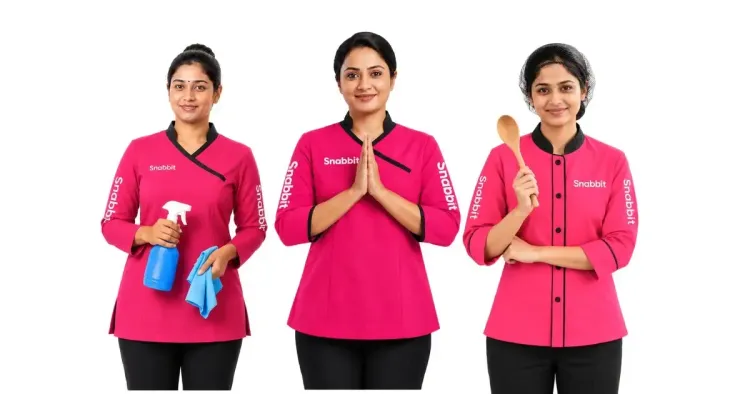
Founded in 2024 by Aayush Agarwal, Snabbit promises service delivery within 10 minutes through a network of trained professionals. The model bears resemblance to earlier hyperlocal services plays in India, many of which struggled to reach profitability without either raising prices significantly or cutting service quality.
Funding and Operational Milestones
Snabbit has raised more than $112 million from investors to date, including a $56 million Series D round backed by Susquehanna VC, Mirae Asset Venture Investments and Bertelsmann India Investments. The company says demand remains strong: it claims to have crossed 1,15,000 fulfilled jobs in a single day and completed four million househelp jobs in the first quarter of FY27. It also reported that burn per job declined by more than ₹100 quarter-on-quarter to below ₹250 — a metric investors will watch closely as a signal of path-to-profitability.
Whether the declining burn rate can translate into sustainable unit economics before the funding runway narrows will be the central question for Snabbit heading into the rest of FY27.
Point of View
As currently run, is not yet a self-sustaining commercial engine; it is an investor-funded experiment with a promising demand signal. The declining burn-per-job metric is the only green shoot here, and the company will need to sustain that trajectory sharply before its $112 million war chest thins. India's hyperlocal services graveyard is well-populated — UrbanClap's pivot to a premium model and the collapse of several 10-minute delivery players are instructive precedents. Snabbit's test is whether 10-minute househelp is a genuine mass-market habit or a metro novelty that cannot survive without heavy subsidies.
NationPress
16 Oct 2026
Frequently Asked Questions
How much did Snabbit lose in FY26?
Snabbit reported a net loss of ₹167.8 crore in FY26, up from ₹5.7 crore in FY25 — a nearly 29-fold increase. The surge was driven by aggressive spending on marketing, worker onboarding and service fulfilment as the company expanded in its first full year of operations.
What was Snabbit's revenue in FY26?
Snabbit's revenue from operations reached ₹12.2 crore in FY26, a 46-fold jump from the previous year. Core platform services accounted for ₹10.82 crore, or roughly 88% of operating revenue, with the rest coming from uniform sales.
How much has Snabbit raised from investors?
Snabbit has raised more than $112 million in total funding, including a $56 million Series D round backed by Susquehanna VC, Mirae Asset Venture Investments and Bertelsmann India Investments.
What is Snabbit and who founded it?
Snabbit is a Mumbai-based on-demand househelp platform founded in 2024 by Aayush Agarwal. It offers services such as cleaning, dishwashing and laundry, promising delivery within 10 minutes through a network of trained professionals.
Is Snabbit moving towards profitability?
Snabbit says its burn per job declined by more than ₹100 quarter-on-quarter to below ₹250 in Q1 FY27, and that it completed four million househelp jobs in the same quarter. However, its EBITDA margin stood at minus 1,481.63% in FY26, and the path to sustainable unit economics remains unclear.