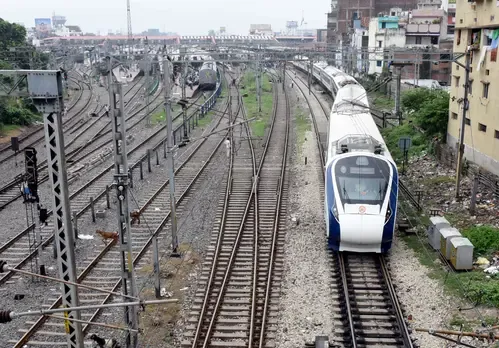
Vande Bharat Express Sees 34% Surge, Nearly 4 Crore Passengers in FY26
Synopsis
The Vande Bharat Express network has witnessed a remarkable surge in passenger numbers, with nearly 4 crore travelers in FY 2025–26 alone, achieving a 34% growth year-on-year. This growth emphasizes the train's role in enhancing connectivity across India.
Key Takeaways
Vande Bharat Express saw 4 crore passengers in FY 2025–26.
Passenger traffic grew by 34% year-on-year.
Train network has served over 9.1 crore passengers since 2019.
New Delhi–Varanasi remains the busiest route.
Vande Bharat Sleeper service launched in January 2026.
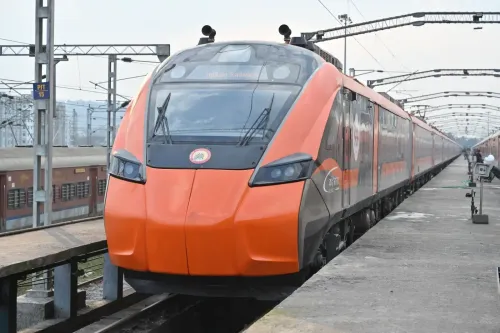
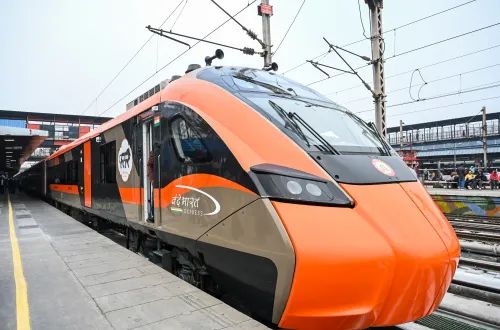
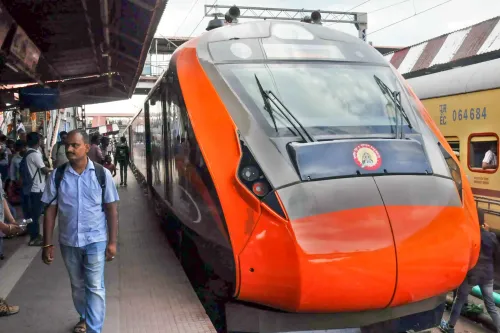
New Delhi, April 10 (NationPress) The network of Vande Bharat Express has experienced a significant increase in passenger numbers during the fiscal year 2025–26, with close to 4 crore passengers choosing these semi-high-speed trains. This growth represents an impressive 34 percent increase compared to the previous year, as reported by the Ministry of Railways on Friday.
Since its debut in February 2019 on the New Delhi–Varanasi route, the Vande Bharat Express has expanded into a comprehensive nationwide network, cumulatively accommodating over 9.1 crore passengers through more than one lakh trips.
“The Vande Bharat Express network has seen an extraordinary rise in passenger numbers, with approximately 3.98 crore travelers in FY 2025–26 alone, demonstrating a robust annual growth of nearly 34 percent from 2.97 crore in FY 2024–25,” stated the ministry.
These trains, developed and built domestically under the Make in India initiative, have become a hallmark of speed, efficiency, and self-sufficiency in India’s railway system.
Among the various routes, the New Delhi–Varanasi line remains the most frequented, serving over 73 lakh passengers to date.
The New Delhi–Shri Mata Vaishno Devi Katra route has provided service to nearly 56 lakh passengers, underscoring its significance for religious tourism.
In the southern region, the Secunderabad–Visakhapatnam route has catered to over 48 lakh passengers, while the Chennai–Mysuru corridor has recorded more than 36 lakh passengers, according to the ministry.
These trains have also been instrumental in enhancing tourism by improving access to key religious, cultural, and coastal sites, thereby aiding local economies and increasing visitor numbers.
In an effort to broaden its service offerings, Indian Railways launched the Vande Bharat Sleeper service in January 2026 to enhance long-distance connectivity.
Within just three months of its introduction, the service transported 1.21 lakh passengers across 119 trips and achieved an occupancy rate exceeding 100 percent, reflecting a strong demand for premium overnight travel.
Point of View
Enhancing connectivity and boosting local economies. This development presents an opportunity for further investment and innovation within the sector, aligning with national progress.
NationPress
19 Sept 2026
Frequently Asked Questions
What is the passenger growth rate for Vande Bharat Express in FY 2025–26?
The Vande Bharat Express experienced a growth rate of 34% in passenger numbers, with nearly 4 crore travelers.
When was the Vande Bharat Express launched?
The Vande Bharat Express was launched in February 2019.
How many passengers have traveled on the Vande Bharat Express since its launch?
The Vande Bharat Express has served over 9.1 crore passengers through more than 100,000 trips.
What routes are the busiest for Vande Bharat Express?
The New Delhi–Varanasi corridor is the busiest, followed by the New Delhi–Shri Mata Vaishno Devi Katra route.
What new service was introduced by Indian Railways in January 2026?
Indian Railways introduced the Vande Bharat Sleeper service to enhance long-distance travel connectivity.