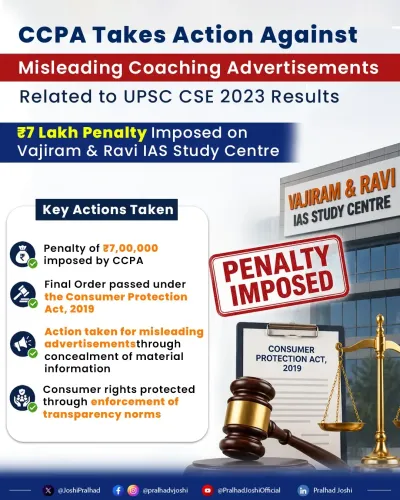
Did CCPA Fine Vision IAS Rs 11 Lakh for Misleading UPSC Result Ads?

Synopsis
The CCPA has taken a strong stance against misleading advertisements by coaching institutes, imposing a hefty fine on Vision IAS for falsely claiming its role in student successes in the UPSC exams. This marks a significant step in protecting consumer rights and ensuring transparency in educational advertising.
Key Takeaways
The CCPA fined Vision IAS Rs 11 lakh for misleading ads.
Only three out of 119 claimed successful candidates were actual students.
The ruling emphasizes the need for transparency in educational advertising.
This marks a precedent for penalties on repeat offenders under consumer protection laws.
57 notices have been issued to various coaching institutes for similar practices.
New Delhi, Dec 25 (NationPress) The Central Consumer Protection Authority (CCPA) has imposed a fine of Rs 11 lakh on the coaching institute Vision IAS for disseminating misleading advertisements concerning the performance of its students in the UPSC Civil Services Examination, as stated by the Ministry of Consumer Affairs, Food & Public Distribution on Thursday.
This marks the first instance of a penalty being levied for a repeat violation under consumer protection laws.
According to the CCPA's findings, Vision IAS, legally registered as AjayVision Education Private Limited, intentionally misled potential students by overstating its involvement in the achievements of UPSC toppers.
The authority discovered that the institution omitted essential details regarding the actual courses undertaken by successful candidates, misleadingly suggesting that all top scorers had participated in its costly foundation programs, each priced at several lakhs.
In its advertisements, Vision IAS asserted that it produced “7 in Top 10 and 79 in Top 100 selections in CSE 2023” and “39 in Top 50 selections in CSE 2022.”
These ads prominently featured the images, names, and ranks of successful candidates, implying that the institute was directly accountable for their achievements.
However, the investigation by the CCPA portrayed a different reality. Out of the 119 candidates that Vision IAS claimed were successful in the UPSC CSE 2022 and 2023, only three had genuinely registered for the institute's foundation courses.
The remaining 116 candidates had availed themselves of limited services such as preliminary and mains test series, one-time Abhyaas tests, or mock interview programs.
The authority pointed out that while Vision IAS explicitly indicated that Shubham Kumar, who achieved AIR 1 in UPSC CSE 2020, was a student of its GS Foundation Batch, it deliberately chose not to disclose similar information for other candidates featured in the same advertisements.
This selective disclosure, according to the CCPA, created a misleading impression that all highlighted candidates had undertaken the same premium course.
Given the repetitive nature of the infraction, the CCPA classified the case as a subsequent offense, warranting a more substantial penalty to safeguard consumer interests.
The authority emphasized that such practices mislead aspirants and their parents into believing that the institute significantly contributed to a candidate's success at every stage of the examination.
The CCPA determined that this constituted a misleading advertisement under the Consumer Protection Act, 2019.
To date, the authority has issued 57 notices to coaching institutes for misleading advertisements and unfair trade practices.
It has imposed fines totaling Rs 1.09 crore on 28 institutes and has ordered them to cease making such misleading assertions.
Point of View
The CCPA's actions underscore the necessity for accountability in educational advertising. The fine imposed on Vision IAS serves as a cautionary tale for other institutes, emphasizing that misleading claims will not be tolerated. Upholding consumer rights is crucial in maintaining trust in educational institutions, especially in competitive exams like the UPSC.
NationPress
25 Sept 2026
Frequently Asked Questions
What was the fine imposed on Vision IAS by CCPA?
The CCPA fined Vision IAS Rs 11 lakh for misleading advertisements related to UPSC results.
Why was Vision IAS penalized?
Vision IAS was penalized for exaggerating its role in the success of UPSC candidates and providing misleading information in their advertisements.
How many candidates actually attended Vision IAS?
Out of 119 candidates claimed to be successful, only three were enrolled in Vision IAS's foundation courses.
What does this ruling mean for other coaching institutes?
This ruling serves as a warning to other coaching institutes about the consequences of making false claims in their advertisements.
What does the Consumer Protection Act, 2019 entail?
The Consumer Protection Act, 2019 aims to protect consumer rights and ensure fair trade practices in India.