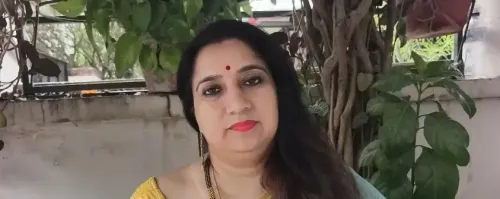
Devoleena Bhattacharjee defends women's right to celebrate Karwa Chauth
Synopsis
Devoleena Bhattacharjee used Karwa Chauth to make a pointed argument: stop projecting feminism onto someone else's celebration. The actress — who has never kept the fast herself due to her Bengali and Assamese roots — defended free choice loudly, drawing the line at unsolicited judgment of women who observe the festival voluntarily.
Key Takeaways
Devoleena Bhattacharjee posted a long note on X on 29 October 2026 defending women who choose to observe Karwa Chauth .
She clarified she has never kept the fast herself, as it is not part of Bengali or Assamese tradition.
She described the festival as a 'love language' for many couples, noting husbands increasingly fast alongside their wives.
Her husband Shaan , from a Muslim background, reportedly asks her every year if she will keep the fast.
She drew a parallel between health-driven fasting and fasting for a spouse, questioning why only the latter is labelled patriarchal.
She is currently breastfeeding and expressed hope to observe the fast 'next year.'
Television actress Devoleena Bhattacharjee on Thursday, 29 October 2026, shared a lengthy personal note on X defending the choice of women who observe Karwa Chauth, pushing back against those who frame the festival through a lens of patriarchy or forced tradition. The post sparked widespread engagement on social media.
What Devoleena Said
In her post, the actress — who hails from Bengali and Assamese cultural backgrounds — clarified that she has never personally kept the Karwa Chauth fast, as it is not part of her tradition. However, she firmly defended the right of those who choose to observe it. She wrote, 'Happy Karwa Chauth to all the beautiful ladies celebrating today. I've never kept a Karwa Chauth fast because, in Bengali and Assamese cultures, it isn't a tradition.'
She acknowledged being open to the idea herself, adding that she fasts every Monday and occasionally on Ekadashi, but described water fasting as 'a different story.' Notably, she is currently breastfeeding, which she cited as a reason she has not yet taken it up.
On Love, Choice and Personal Tradition
Bhattacharjee framed the festival as a 'love language' for many couples, noting that an increasing number of husbands now fast alongside their wives. She questioned why the act of voluntary fasting for a partner attracts more scrutiny than fasting for health goals such as intermittent fasting or a keto diet.
She wrote, 'As long as it's a personal choice and nobody is forced into it, let people celebrate love the way they want to.' She also referenced her husband Shaan, who comes from a Muslim family but reportedly asks her every year whether she will keep the fast — to which she says she hopes to do so 'next year.'
Her Core Argument: Let People Choose
The actress urged her followers to separate personal ideological positions from judgment of others' celebrations. 'You don't believe in it? Don't celebrate it,' she wrote, adding, 'Love is personal. Traditions are personal. Celebrations are personal. Let people choose what makes them happy.'
She also drew a parallel with mothers who fast for their children's wellbeing, arguing that fasting for a spouse deserves the same respect if it stems from free will.
Response and Context
The post resonated with many users who appreciated the nuanced take, particularly its acknowledgment of cultural diversity within India — where Karwa Chauth is primarily observed in North Indian communities, while traditions in eastern and southern states differ. This comes amid an annual social media debate around the festival, where opinions on feminism, tradition, and marital customs frequently clash. Bhattacharjee's personal and non-combative tone distinguished her commentary from more polarised takes.
As the debate around tradition and personal agency continues, her post is likely to remain a reference point in discussions around women's autonomy and cultural celebrations in India.
Point of View
Which makes her argument harder to dismiss than the usual culture-war positioning. The deeper tension she surfaces is real: social media increasingly treats women's religious and cultural choices as political statements requiring defence or condemnation, leaving little room for quiet personal expression. Her intermittent-fasting analogy is rhetorically effective, even if it sidesteps the structural inequalities that critics of the festival often cite. The annual Karwa Chauth debate is less about the ritual itself and more about who gets to define feminist agency — and whether that definition should be imposed on those who opt out of the argument entirely.
NationPress
29 Oct 2026
Frequently Asked Questions
What did Devoleena Bhattacharjee say about Karwa Chauth?
Devoleena Bhattacharjee posted a note on X on 29 October 2026 defending women who choose to observe Karwa Chauth, calling it a 'love language' and urging people not to bring 'feminism, patriarchy and judgment' into someone else's voluntary celebration. She clarified that she has never personally kept the fast due to her Bengali and Assamese cultural background.
Does Devoleena Bhattacharjee observe Karwa Chauth herself?
No, she has not kept the Karwa Chauth fast, explaining that it is not a tradition in Bengali or Assamese cultures. She is also currently breastfeeding and has said she hopes to observe it 'next year.'
Who is Devoleena Bhattacharjee's husband?
Her husband is named Shaan, who comes from a Muslim family. She revealed in her post that he asks her every Karwa Chauth whether she will keep the fast, to which she has so far said she will consider it the following year.
Why is the Karwa Chauth debate significant?
The festival sparks an annual debate on social media around feminism, tradition, and women's autonomy in India. Critics argue it reinforces patriarchal norms, while supporters say it is a voluntary expression of love. Bhattacharjee's post entered that debate by arguing personal choice should be respected regardless of ideological stance.
What cultural point did Devoleena make about Karwa Chauth?
She noted that Karwa Chauth is primarily a North Indian tradition and not observed in Bengali or Assamese communities, highlighting India's diverse regional customs. She used this context to argue that the absence of a tradition in one's culture is different from condemning it in others.