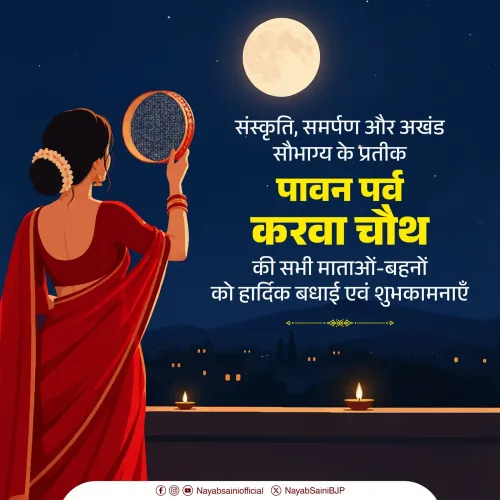
Karwa Chauth 2026: Key rituals, restrictions and customs explained

Synopsis
With Karwa Chauth falling on 29 October 2026, astrologer Pandit Shipra Sachdev has laid out the full arc of the fast — from the pre-dawn sargi meal to the Moon-sighting ritual — along with a clear list of traditional restrictions, including avoiding sharp objects and crossing rivers. Delhi's Lajpat Nagar was already buzzing with henna queues by morning.
Key Takeaways
Karwa Chauth 2026 is being observed on 29 October by married Hindu women across India.
Astrologer Pandit Shipra Sachdev advises women to avoid cutting, sewing, and using knives, scissors, or needles on the fast day.
The fast begins with 'sargi' — a pre-dawn meal — and is broken only after the Moon is sighted and 'arghya' is offered.
The Karwa Chauth puja is performed during Pradosh Kaal (around sunset), with Goddess Gauri as the central deity.
The 'bayana' ritual involves a ceremonial plate of offerings presented to the mother-in-law or an elderly married woman.
Women in Delhi's Lajpat Nagar Market were seen queuing for henna early in the morning, reflecting large-scale celebration.
Married Hindu women observing the Karwa Chauth fast on 29 October 2026 should avoid cutting, sewing, and handling sharp objects throughout the day, astrologer Pandit Shipra Sachdev has said, detailing the traditional customs and precautions associated with one of north India's most widely observed fasts.
What the fast involves
According to Pandit Sachdev, Karwa Chauth holds deep significance for married Hindu women, who observe the nirjala (waterless) fast — without food or water — for their husbands' longevity and a happy married life. The fast begins at dawn with 'sargi', a pre-dawn meal consumed before sunrise while stars are still visible, after which women take a vow to observe the fast for the rest of the day.
The fast is broken only after the Moon rises at night. Women sight the Moon, offer 'arghya' — a sacred offering of water — and then drink water offered by their husbands, completing the ritual observance.
Restrictions women must follow
Pandit Sachdev outlined several traditional restrictions for the day. Women are advised to avoid the use of knives, scissors, needles, and thread — essentially all cutting and sewing activities. She also cautioned that women should refrain from crossing rivers until the fast has been fully completed.
These restrictions, she explained, are rooted in longstanding customs associated with the sanctity of the fast and are observed across many families and regions, though practices can vary.
The puja and collective worship
The Karwa Chauth puja is traditionally performed during Pradosh Kaal, the auspicious period around sunset. Worshipping Goddess Gauri forms a central part of the ritual, with an image or representation of the deity installed for the ceremony. In several communities, groups of ten married women gather to listen to the Karwa Mata katha together, a practice considered particularly auspicious.
The bayana ritual explained
Pandit Sachdev also detailed the significance of the 'bayana' — a ceremonial plate containing a small earthen pot, fruits, dry fruits, and other offerings that is rotated as part of the ritual. The bayana is presented to the mother-in-law or another elderly married woman in the family, and is given to the recipient rather than consumed by the woman performing the observance herself.
Celebrations across Delhi
Reflecting the widespread observance of the festival, women in Delhi were seen gathering at Lajpat Nagar Market early in the morning to get henna applied. One woman said: 'We first visit the temple in the morning, and after that, we've come to get mehendi applied. Yesterday, we couldn't get our turn because of the huge crowd.' Karwa Chauth is observed across several parts of India, with rituals and customs varying by region and family tradition.
Point of View
And its social footprint — from packed henna markets to group kathas — reflects a lived cultural practice far beyond the merely religious. The guidance from astrologers like Pandit Sachdev plays a meaningful role in standardising observance for families navigating both tradition and modernity. What is notable, however, is that customs vary widely by region and household, meaning no single set of rules is universally binding. Media coverage of the festival tends to flatten this diversity into a uniform north Indian template — an important nuance that practitioners themselves often acknowledge.
NationPress
29 Oct 2026
Frequently Asked Questions
What is Karwa Chauth and who observes it?
Karwa Chauth is a one-day Hindu fast observed by married women for their husbands' longevity and a happy married life. It is widely observed across north India, with the fast kept without food or water from before sunrise until the Moon is sighted at night.
What activities should women avoid on Karwa Chauth?
According to astrologer Pandit Shipra Sachdev, women should avoid cutting, sewing, and using sharp objects such as knives, scissors, needles, and thread on the day of the fast. She also advises against crossing rivers until the fast has been completed.
What is the significance of 'sargi' in Karwa Chauth?
'Sargi' is the pre-dawn meal consumed by women before sunrise, while stars are still visible, marking the formal start of the Karwa Chauth fast. After eating the sargi, women take a vow to abstain from food and water for the rest of the day.
When is the Karwa Chauth puja performed and which deity is worshipped?
The Karwa Chauth puja is traditionally performed during Pradosh Kaal, the auspicious period around sunset. Goddess Gauri is the central deity worshipped, and an image or representation of the deity is installed for the ceremony.
What is the 'bayana' ritual in Karwa Chauth?
The 'bayana' is a ceremonial plate containing a small earthen pot, fruits, dry fruits, and other offerings that is rotated as part of the Karwa Chauth observance. It is then presented to the mother-in-law or another elderly married woman in the family, rather than consumed by the woman performing the ritual.