CM Majhi Thanks Amit Shah for Cyclone Arnab Aid Pledge

Synopsis
Odisha Chief Minister Mohan Charan Majhi thanked Union Home Minister Amit Shah on October 29, 2026, for assuring all possible central assistance to the state in the wake of Cyclone Arnab, activating India's federal disaster response framework ahead of the storm.
Key Takeaways
CM Mohan Charan Majhi publicly thanked Union Home Minister Amit Shah for assuring central support for Cyclone Arnab relief on October 29, 2026 .
The Union Home Ministry is India's nodal authority for coordinating NDRF deployments and releasing National Disaster Response Fund resources to affected states.
Odisha has a long history of Bay of Bengal cyclone impacts, including major storms in 1999, 2013, 2019 , and 2020 .
The Disaster Management Act 2005 established the federal framework under which central teams are routinely deployed to Odisha during cyclones.
Post-storm, joint state-central damage assessment reports will determine the scale of financial assistance released to Odisha .
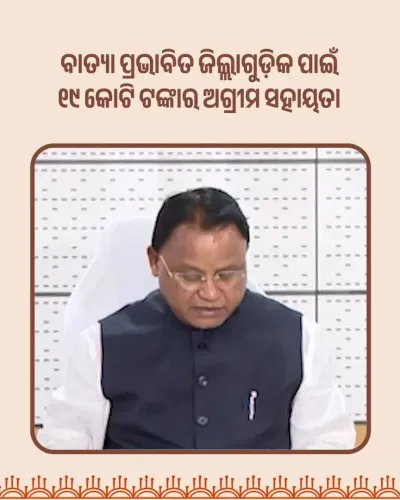
With Cyclone Arnab bearing down on Odisha's coastline, Chief Minister Mohan Charan Majhi publicly thanked Union Home Minister Amit Shah on Thursday, October 29, 2026, for personally assuring the state of all possible central assistance — a signal that New Delhi's disaster machinery is already in motion.
What Amit Shah's Assurance Means on the Ground
In his post, CM Majhi wrote that the Home Minister's support 'will strengthen our efforts to ensure the safety and well-being of every Odia.' That phrasing matters. Under India's federal disaster framework, the Union Home Ministry is the nodal authority for coordinating central relief — controlling National Disaster Response Force (NDRF) deployments, unlocking the National Disaster Response Fund, and fast-tracking inter-ministerial resources to affected states.
Odisha has navigated this coordination corridor before. After Cyclone Fani struck in May 2019 — one of the strongest cyclones to make landfall in India in decades — central teams, NDRF battalions, and emergency funds flowed into the state through precisely the kind of Home Ministry channel Shah has now activated for Arnab.
Odisha's Cyclone History and Why the Coast Stays Vigilant
Odisha's long Bay of Bengal coastline makes it one of India's most cyclone-exposed states, with major storms striking in 1999, 2013 (Phailin), 2019 (Fani), and 2020 (Amphan). Each event has sharpened the state's early-warning infrastructure and evacuation protocols — widely regarded as a model for coastal disaster preparedness.
The BJP government under CM Majhi, in office since June 2024, now faces its own test of that infrastructure. The Chief Minister's swift public acknowledgement of central support is itself a governance signal: it puts both New Delhi's commitment and the state's preparedness on record, ahead of what could be a difficult landfall.
What Comes Next: Funds, Teams, and Damage Assessments
With Shah's assurance now public, the immediate watchpoints are NDRF battalion deployments to vulnerable coastal districts, pre-positioning of relief material, and — once the storm passes — joint state-central damage assessment teams whose reports determine the scale of National Disaster Response Fund releases.
Every hour of advance coordination translates directly into lives protected. If the 2019 Fani response — where mass evacuations were credited with dramatically limiting casualties — is the benchmark, the early Central-State alignment Majhi has signalled is exactly the right first move.
Point of View
And each cyclone response either burnishes or dents the state-Centre relationship. With Majhi's government less than two years old, how this coordination plays out will shape perceptions of BJP's governance dividend in a coastal state that voted it in for the first time. The speed of NDRF deployment and fund disbursement after Arnab will be the real scorecard.
NationPress
29 Oct 2026
Frequently Asked Questions
What is Cyclone Arnab and where is it expected to hit?
Cyclone Arnab is a storm threatening Odisha 's Bay of Bengal coastline as of late October 2026 . Specific landfall details are under active monitoring by meteorological authorities.
What central help has Odisha been promised for Cyclone Arnab?
Union Home Minister Amit Shah has assured Odisha Chief Minister Mohan Charan Majhi of 'all possible assistance' from the Government of India, which can include NDRF deployment, emergency funds, and inter-ministerial resources.
How does India's central government help states during cyclones?
The Union Home Ministry , under the Disaster Management Act 2005 , coordinates NDRF battalion deployments, releases funds from the National Disaster Response Fund , and conducts joint damage assessments with state governments.
How has Odisha dealt with cyclones in the past?
Odisha has faced major cyclones including Phailin (2013) and Fani (2019) , and has developed strong early-warning and evacuation infrastructure, working closely with the central government each time for relief and reconstruction.
Who is Mohan Charan Majhi?
Mohan Charan Majhi is a BJP leader who became Chief Minister of Odisha in June 2024 after the party's victory in the state assembly elections.