CM Rekha Gupta Orders Year-Round Crackdown on Adulterated Food in Delhi
Synopsis
Delhi Chief Minister Rekha Gupta has issued a six-point directive to crack down on adulterated food year-round — ordering blacklisting, fines, licence cancellations, FIRs, public naming of violators, and accessible consumer helplines — under her #ViksitDelhi governance push.
Key Takeaways
Delhi CM Rekha Gupta issued a six-point food safety directive on October 29, 2026 .
The crackdown explicitly extends beyond the festive season to year-round enforcement.
Authorities have been directed to blacklist offending brands and cancel food licences .
FIRs can be registered against violators, raising enforcement to a criminal level.
Violators' names will be publicly disclosed through advertisements — a transparency measure beyond standard penalties.
Consumer helpline numbers will be made widely available to enable complaint-driven detection across Delhi .
Delhi's food safety enforcement just got a sharper edge — and a permanent mandate. Delhi Chief Minister Rekha Gupta on Thursday, October 29, 2026, laid out a sweeping six-point action plan to combat adulterated and unsafe food products across the capital, making clear that the crackdown will not be a seasonal exercise timed to festivals but a sustained, year-round operation.
Six directives, no exceptions
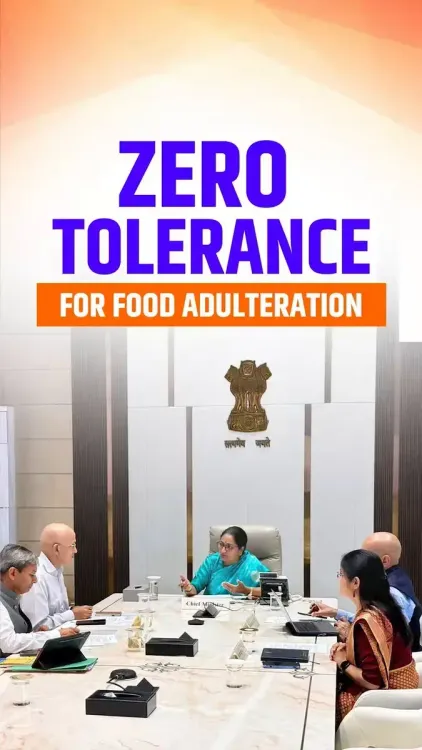
The Chief Minister posted the directive on X, listing specific instructions issued to food safety authorities: blacklist offending brands, impose heavy fines, cancel licences, register FIRs, publicly disclose violators' names through advertisements, and ensure consumer helpline numbers are widely accessible. The six-point framework is notable for combining punitive action with public transparency — naming and shaming violators through paid advertisements moves enforcement into the civic spotlight, beyond the usual bureaucratic notice.
'Delhiites' health is non-negotiable,' Gupta stated, anchoring the announcement under her ongoing #ViksitDelhi ('Developed Delhi') governance campaign. The message signals an intent to hold food businesses accountable not just during high-consumption periods like Diwali, but across every month of the year.
Why the festive-season framing matters
India's food adulteration problem has long followed a predictable calendar — enforcement spikes around Diwali and Holi, then fades. Sweets, dairy, edible oils, and spices have historically topped the list of adulterated products seized during festival-season raids by state food safety departments. The Food Safety and Standards Act, 2006, which established the Food Safety and Standards Authority of India (FSSAI), gives state governments robust powers to penalise violators, including licence cancellation and criminal prosecution — but consistent, year-round deployment of those powers has varied widely across states.
By explicitly framing the directive as 'not just during the festive season,' Gupta is positioning Delhi's approach as a structural shift rather than a periodic show of force — a distinction that will ultimately be tested by the enforcement data that follows.
What Delhi's consumers and businesses can expect
For Delhi's residents — a city of roughly 33 million people navigating one of India's densest and most complex urban food supply chains — the most immediately tangible element may be the public disclosure mechanism. Advertising violators' names creates reputational risk for brands that monetary fines alone do not always achieve. The consumer helpline provision, meanwhile, inverts enforcement from a top-down inspection model toward a complaint-driven one, effectively deputising residents as a first line of detection.
Food businesses and vendors operating in the capital now face a compliance environment where a single violation could trigger licence cancellation alongside a criminal case — a combination that raises the stakes considerably above a standard penalty notice.
Delhi's food safety authorities will be watched closely in the coming months: the question is whether this directive translates into published blacklists, visible FIR counts, and advertised disclosures — or remains a well-framed statement of intent.
Point of View
The BJP-led Delhi government is blending administrative pressure with reputational accountability, a combination that can move markets and brand behaviour faster than fines alone. The emphasis on 'year-round' also counters a persistent criticism of Indian food safety enforcement: that it is performative and seasonal. Whether the directive produces verifiable outcomes — published blacklists, FIR data, advertised disclosures — will determine whether it represents genuine institutional resolve or well-timed optics ahead of a high-visibility festival period.
NationPress
29 Oct 2026
Frequently Asked Questions
What action has Delhi CM Rekha Gupta taken against adulterated food?
CM Rekha Gupta has issued a six-point directive ordering Delhi food safety authorities to blacklist offending brands, impose heavy fines, cancel licences, register FIRs, publicly advertise violators' names, and make consumer helpline numbers widely available — with enforcement to continue year-round, not just during festivals.
Which law governs food safety enforcement in Delhi?
The Food Safety and Standards Act, 2006 established the FSSAI and gives state governments powers to penalise food adulteration through fines, licence cancellations, and criminal prosecution, which Delhi's authorities are directed to deploy.
Can a food brand be blacklisted in Delhi for adulteration?
Yes. Under CM Gupta's directive, offending brands can be blacklisted by Delhi food safety authorities, and their names publicly disclosed through advertisements — creating reputational consequences alongside legal penalties.
How can Delhi residents report adulterated food products?
The directive includes making consumer helpline numbers readily available to Delhi residents, enabling a complaint-driven enforcement model where citizens can directly report suspected food adulteration cases.
What is #ViksitDelhi?
#ViksitDelhi ('Developed Delhi') is the governance campaign hashtag used by Delhi Chief Minister Rekha Gupta to flag policy initiatives, including the latest food safety enforcement drive announced on October 29, 2026.