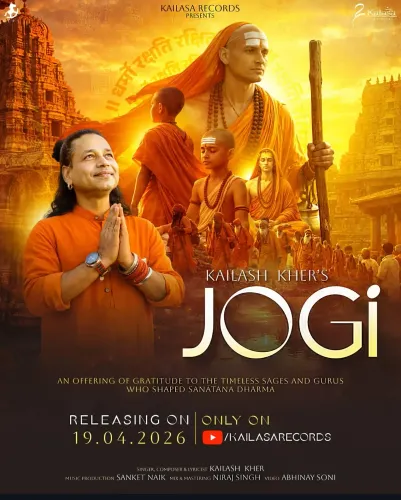
Kailash Kher on love songs: 'It should come from your soul'

Synopsis
Kailash Kher doesn't offer a formula — he offers a philosophy. In a candid interview around his new track 'Tham Jaa', the singer argues that a love song's power lies entirely in soulful authenticity, not technical craft. He also draws a sharp line: artists without sensitivity aren't artists at all.
Key Takeaways
Kailash Kher said a great love song must come 'from your soul' to truly resonate with listeners.
He was speaking in the context of his newly released romantic track 'Tham Jaa' .
Kher argued that an artist who lacks sensitivity is a 'slanderer,' not a creator.
He defined true artistry as the ability to feel others' pain and bring them happiness through one's work.
His remarks come amid wider debates in India's entertainment industry about artistic freedom and social responsibility.
Acclaimed Indian composer and singer Kailash Kher, who recently dropped his romantic track 'Tham Jaa', has shared his perspective on what elevates a love song from merely pleasant to genuinely unforgettable. Speaking in an exclusive interview in Mumbai on 12 September, Kher argued that true musical impact is born not from technical polish alone but from an artist's inner authenticity.
What makes a love song truly impactful
Asked whether it is the lyrics, a melodious voice, or a healing quality that defines a great love song, Kher offered a holistic view. 'Whenever something is genuinely good, as I said, if something comes from your soul, then every word, every sound, every melody, and every emotion within it touches you,' he said. 'When that happens, you even end up forgetting how many times you have listened to it on repeat. You just keep playing and become immersed in it.'
He described that state of deep immersion as being 'mesmerised' — a quality he believes separates timeless romantic tracks from forgettable ones. It is a philosophy that has arguably defined Kher's own career, from 'Allah Ke Bande' to 'Teri Deewani', songs that continue to resonate with listeners years after their release.
Sensitivity and the responsibility of an artist
The conversation moved beyond love songs to the broader question of how artists navigate sensitive social subjects. Kher was categorical: genuine artistry and sensitivity are inseparable. He stated that an artist who lacks sensitivity is, in his words, a 'slanderer' rather than a true creator.
'The stage exists to win people's hearts. Talking nonsense, making meaningless statements, or simply trying to entertain people without sensitivity can be a sign of being a slanderer,' Kher explained. He acknowledged, however, that even satire or provocative art can be considered a legitimate form of expression, noting that 'everyone has their own thoughts' but adding that his own creative instincts are 'directed towards purity.'
Art as empathy, not just entertainment
Kher went further, framing the identity of a true artist in terms of empathy and emotional generosity. 'If you genuinely have a good feeling, that feeling is meaningful only when your heart can feel sadness for someone else's pain, when you can make someone else happy while laughing, when your work can make someone else laugh and bring happiness to them. That is the identity of an artist,' he said.
This comes at a time when debates about artistic freedom versus social responsibility have intensified across India's entertainment industry. Kher's remarks offer a middle-ground perspective — championing creative expression rooted in emotional honesty rather than provocation for its own sake.
What's next for Kailash Kher
With 'Tham Jaa' already gaining traction among listeners, Kher's latest release appears to embody the very philosophy he articulated. The track leans into a soulful, stripped-back aesthetic consistent with his career-long commitment to music that prioritises feeling over formula. Fans and critics alike will be watching whether the song builds on the enduring appeal of his earlier romantic ballads.
Point of View
But they carry a quiet rebuke of the current Bollywood music machine — one increasingly driven by algorithmic virality and remake culture rather than original emotional depth. His insistence on 'purity' and sensitivity is notable at a moment when several high-profile artists have courted controversy with provocative content. Whether this translates into commercial staying power for 'Tham Jaa' remains to be seen, but Kher's career longevity itself is evidence that soulful authenticity retains a market.
NationPress
13 Sept 2026
Frequently Asked Questions
What did Kailash Kher say about what makes a great love song?
Kailash Kher said a great love song must come from the soul. He explained that when music is genuinely soulful, every word, melody, and emotion touches the listener so deeply that they forget how many times they have played it on repeat.
What is Kailash Kher's new song 'Tham Jaa' about?
'Tham Jaa' is a romantic track recently released by Kailash Kher. The song reportedly embodies his philosophy of soulful, emotionally authentic music, leaning into a stripped-back aesthetic.
What did Kailash Kher say about sensitivity and artists?
Kher stated that artists are sensitive by nature and that anyone calling themselves an artist without possessing sensitivity is a 'slanderer.' He emphasised that the stage exists to win hearts, not to make meaningless statements.
How does Kailash Kher define a true artist?
According to Kher, a true artist is someone whose heart can feel sadness for another's pain and whose work can bring happiness and laughter to others. He views empathy as the core identity of any genuine artist.
Why are Kailash Kher's comments relevant now?
His remarks come amid ongoing debates in India's entertainment industry about balancing creative freedom with social responsibility. Kher offers a middle-ground perspective, championing expression rooted in emotional honesty rather than provocation.