Rubina Dilaik on feminism: 'Man must let woman's identity bloom'

Synopsis
Rubina Dilaik reframes feminism not as opposition but as complementarity. In an exclusive interview, the actress argues that women's empowerment depends on men actively creating space for their identities to flourish — a philosophy she illustrates through the Shakti-Shiva duality and her own marriage dynamics with Abhinav Shukla.
Key Takeaways
Rubina Dilaik stated that feminism is incomplete unless men allow women's identities to bloom independently.
She drew parallels to Shakti and Shiva energies, framing gender dynamics as complementary rather than oppositional.
Dilaik cited her marriage to Abhinav Shukla as an example of cyclical support, where partners alternate in supporting each other's ambitions.
She is set to appear on Khatron Ke Khiladi season 15, filming in Cape Town, South Africa for 40 days.
The actress will be away from her twin daughters during the shoot, which she described as emotionally challenging.
Television superstar Rubina Dilaik has articulated a nuanced view of feminism, arguing that true gender equality requires men to actively create space for women to discover and build their own identities.
Speaking in an exclusive interview, Dilaik said, "Unless a man gives his woman's identity a chance to bloom, no matter how loudly we scream feminism, it's not possible." She drew a spiritual parallel to the interplay of Shakti and Shiva energies, framing the relationship dynamic as one of complementary rather than competing forces.
Masculine and feminine energies in balance
The actress emphasized that true equilibrium emerges when both energies operate in tandem. "The masculine and feminine energies have to work in duality for us to truly believe in balance," she explained. "When Shakti has to show her strength, Shakti will be seen. And when Shiva has to reflect masculinity, that will be seen. It is a beautiful balance between the two powers."
Partnership as cyclical support
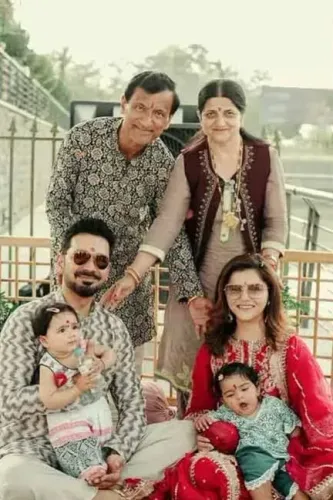
Drawing from her own marriage to Abhinav Shukla, Dilaik described how relationships evolve through phases of mutual support. "There will be phases in life where he will be building something and I will support him, and there will be phases where I am building my dreams and he will support me," she said. "When you acknowledge that, it creates a strong value system for the family."
Khatron Ke Khiladi stint and motherhood
Dilaik is set to participate in the reality television show Khatron Ke Khiladi season 15, with filming scheduled to take place in Cape Town, South Africa. The stint will require her to be away from her twin daughters for approximately 40 days — a separation she acknowledged will be emotionally taxing. "It is going to be extremely tough for her as a mother to stay away from their physical touches and hugs," she reflected on the challenge of balancing professional ambition with maternal presence.
Redefining feminism discourse
Her remarks arrive amid broader conversations in Indian entertainment about how feminism is framed and practiced within relationships. Dilaik's intervention suggests that empowerment discourse must move beyond adversarial framings to encompass interdependence and mutual enablement — a perspective that has resonated with segments of the audience who view gender equality as compatible with partnership dynamics.
Point of View
She attempts to legitimize interdependence as philosophically grounded rather than a capitulation to patriarchy. Whether this resonates or reads as a softening of feminist claims depends on one's view of whether equality requires symmetry or complementarity. What's notable is that a television personality with significant platform is using that space to argue for a particular vision of gender relations — one that prioritizes mutual enablement over individual assertion. That conversation matters, even when it's debatable.
NationPress
24 Sept 2026
Frequently Asked Questions
What did Rubina Dilaik say about feminism?
Rubina Dilaik argued that feminism is incomplete unless men actively give women the space to discover and build their own identities. She stated: "Unless a man gives his woman's identity a chance to bloom, no matter how loudly we scream feminism, it's not possible."
How did Rubina Dilaik explain masculine and feminine energies?
She drew a spiritual parallel to Shakti and Shiva, explaining that both energies must work in complementary duality for true balance. She said: "When Shakti has to show her strength, Shakti will be seen. And when Shiva has to reflect masculinity, that will be seen."
What example did she give from her own relationship?
Rubina Dilaik cited her marriage to Abhinav Shukla, describing how they take turns supporting each other's ambitions. She explained: "There will be phases where he will be building something and I will support him, and there will be phases where I am building my dreams and he will support me."
Why will Rubina Dilaik be away for 40 days?
She is participating in the reality television show Khatron Ke Khiladi season 15, with filming scheduled in Cape Town, South Africa. The actress acknowledged the challenge of being separated from her twin daughters during this period.