NITRD Delhi Achieves Historic 'Zero Waste to Landfill' Status
Synopsis
Delhi's NITRD hospital has become India's healthcare waste management benchmark by achieving Zero Waste to Landfill status — diverting 1.2 tons of daily waste from landfills through composting, recycling, and real-time monitoring. The model, executed under the Swachh Sankalp programme, could reshape how India's public hospitals handle waste ahead of the 2026 regulatory deadline.
Key Takeaways
NITRD Delhi has been officially recognised as a Zero Waste to Landfill institution, becoming a national benchmark in healthcare waste management.
The institute manages 1 to 1.2 metric tons of waste daily , including 500–650 kg of wet waste , across its 27-acre campus .
The transformation was executed by the Why Waste Wednesdays Foundation under the Swachh Sankalp programme , which conducted nearly 50 customised training sessions for hospital staff.
Infrastructure installed includes a Wet Waste Composting Centre , a Dry Waste Resource Centre , 40 Gaia composting bins , and 2 horticulture waste shredders .
NITRD achieved full compliance under the Bulk Waste Generator category of India's 2026 Solid Waste Management Guidelines ahead of the regulatory deadline.
The Ministry of Housing and Urban Affairs confirmed the achievement on April 22, 2025 , signalling potential policy scale-up to other government hospitals.
New Delhi, April 22: The National Institute of Tuberculosis and Respiratory Diseases (NITRD), located in Delhi, has made history by becoming the first major healthcare institution in India to earn official Zero Waste to Landfill recognition — setting a new national standard for environmentally responsible hospital waste management. The achievement, announced by the government on Wednesday, April 22, marks a significant milestone under India's evolving solid waste governance framework.
What 'Zero Waste to Landfill' Means for India's Healthcare Sector
The Zero Waste to Landfill designation signifies that NITRD now diverts virtually all waste it generates away from landfills through composting, recycling, and resource recovery. The institute manages approximately 1 to 1.2 metric tons of waste every day, including 500 to 650 kilograms of wet biodegradable waste alone — a volume that previously strained municipal systems.
The recognition was granted under the Bulk Waste Generator category as defined by the 2026 Solid Waste Management Guidelines, making NITRD one of the earliest large institutions to achieve full compliance ahead of the regulatory deadline. The Ministry of Housing and Urban Affairs confirmed the milestone in an official statement.
How the Transformation Was Executed
The overhaul was carried out by the Why Waste Wednesdays Foundation under its flagship Swachh Sankalp programme — a structured, multi-phase initiative designed to eliminate landfill dependency in large institutions. The programme began with a comprehensive waste audit and baseline survey across NITRD's sprawling 27-acre campus, mapping every waste stream and identifying operational gaps.
Following the diagnostic phase, the Foundation conducted nearly 50 customised awareness and capacity-building sessions targeting hospital staff, administrators, and support personnel. These sessions focused on best practices in waste segregation, composting, and recycling, embedding a culture of accountability across all levels of the institution.
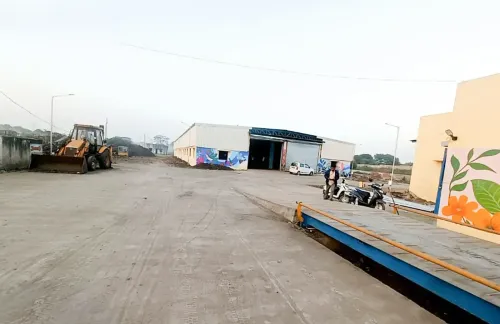
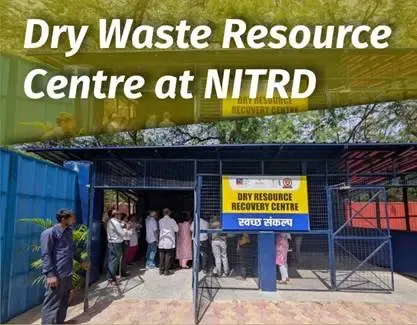
On the infrastructure side, a dedicated Wet Waste Composting Centre was established to process biodegradable material, while a Dry Waste Resource Centre was upgraded for efficient sorting and channelisation of recyclables. To further boost capacity, 40 Gaia composting bins and two horticulture waste shredders were installed, alongside dedicated Horticulture Waste Management Systems to handle garden and landscaping residues.
A real-time monitoring station was also set up to oversee daily waste operations, supported by a consumables management space that tracks and optimises resource usage across the campus.
Why This Achievement Matters Beyond NITRD
India generates an estimated 62 million tonnes of solid waste annually, according to government data, and hospitals represent one of the most complex and hazardous contributors to that figure. The success at NITRD demonstrates that even large, high-footfall healthcare institutions can achieve near-total waste diversion with structured planning and stakeholder engagement.
This comes amid growing pressure on urban local bodies across India to enforce the Solid Waste Management Rules more rigorously, particularly against bulk generators who have historically been the weakest link in the waste management chain. Critics have long argued that hospitals receive preferential leniency despite generating both biomedical and general solid waste at scale.
Notably, the Swachh Bharat Mission has been pushing institutions in the bulk generator category to adopt decentralised waste processing since 2016, but compliance rates among government hospitals have remained inconsistent. NITRD's achievement, therefore, is not just symbolic — it provides a replicable operational blueprint that other public health institutions can adopt.
Broader Implications and What Comes Next
The Ministry of Housing and Urban Affairs is expected to use NITRD's model as a reference case for scaling similar interventions to other government hospitals and medical colleges across India. With the 2026 Solid Waste Management Guidelines deadline approaching, institutions that fail to comply face regulatory action, making NITRD's early compliance strategically significant.
Environmental experts argue that the real test will be sustaining these systems beyond the project's active phase — a challenge that has historically undermined similar green initiatives in public institutions. The monitoring infrastructure installed at NITRD is designed to address exactly this concern by enabling ongoing oversight rather than one-time compliance.
As India accelerates its push toward sustainable urban development and circular economy principles, NITRD's Zero Waste to Landfill status could catalyse a broader policy shift, encouraging the Ministry of Health to embed waste management benchmarks into hospital accreditation criteria — a reform that healthcare governance advocates have been demanding for years.
Point of View
There is no credible excuse for the hundreds of larger government medical colleges still sending tonnes of hospital waste to open landfills daily. The real story here is not just NITRD's success — it's the systemic failure that made this success exceptional rather than routine.
NationPress
15 Sept 2026
Frequently Asked Questions
What is the Zero Waste to Landfill status achieved by NITRD Delhi?
Zero Waste to Landfill means that NITRD now diverts virtually all of its daily waste — about 1 to 1.2 metric tons — away from landfills through composting, recycling, and resource recovery. The recognition was granted under the Bulk Waste Generator category of India's 2026 Solid Waste Management Guidelines.
Which organisation helped NITRD achieve Zero Waste to Landfill status?
The transformation was executed by the Why Waste Wednesdays Foundation under its Swachh Sankalp programme. The Foundation conducted waste audits, staff training sessions, and established composting and recycling infrastructure across NITRD's 27-acre campus.
How much waste does NITRD generate daily and how is it managed?
NITRD generates approximately 1 to 1.2 metric tons of waste daily, including 500 to 650 kilograms of wet biodegradable waste. This is managed through a Wet Waste Composting Centre, a Dry Waste Resource Centre, 40 Gaia composting bins, and two horticulture waste shredders.
Why is NITRD's Zero Waste to Landfill achievement important for India?
India generates around 62 million tonnes of solid waste annually, and hospitals are among the most complex contributors. NITRD's success provides a replicable model for other public health institutions to achieve compliance with the 2026 Solid Waste Management Guidelines ahead of the regulatory deadline.
What are the 2026 Solid Waste Management Guidelines in India?
The 2026 Solid Waste Management Guidelines are updated regulations governing how bulk waste generators — including hospitals, institutions, and commercial establishments — must handle, segregate, and process the waste they produce. Non-compliance can attract regulatory action from urban local bodies.