Hindu sisters abducted, forcibly converted in Pakistan's Sindh: Rights body
Synopsis
Two Hindu sisters aged 13 and 14 were allegedly abducted, forcibly converted, and married off in Pakistan's Sindh — and a court sent them to a safe house instead of home, even as video showed them pleading to return to their parents. Rights data shows 421 such cases across Pakistan between 2021 and 2024, with Sindh accounting for 72 per cent of victims.
Key Takeaways
Roopi (13) and Seeta (14) were allegedly abducted from Ibrahim Colony, Tando Allahyar in Sindh , forcibly converted to Islam, and married to Amjad Solangi and Mansoor Solangi .
A court in Tando Allahyar sent the sisters to a safe house rather than returning them to their family; a video shows them pleading to go home.
VOPM has demanded an urgent, independent investigation and child-sensitive interviews free from pressure by alleged husbands or religious figures.
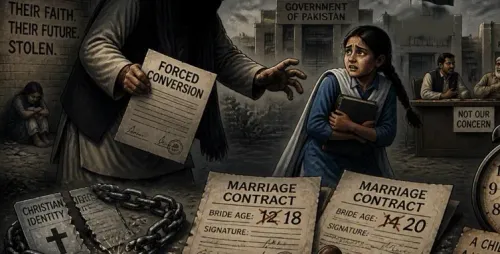
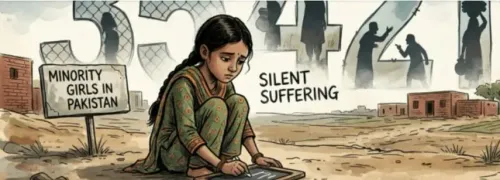
UK government data from the Centre for Social Justice recorded at least 421 cases of abduction, forced conversion and marriage of minority girls in Pakistan between 2021 and 2024 — 282 of the victims were Hindu, and 72% of cases were from Sindh .
In 2024 alone, at least 83 cases were officially recorded in Pakistan, with Hindu girls comprising 63% of victims.
UN experts warned in 2026 that nearly 80% of such cases in 2025 occurred in Sindh, with roughly 75% of victims being Hindu.
A prominent minority rights organisation has raised grave concern over the alleged abduction, forced conversion, and marriage of two minor Hindu sisters in Pakistan's Sindh province, warning that the case lays bare the persistent dangers faced by Hindu girls across the country. The incident, reported on 19 September 2026, has drawn sharp attention to a documented pattern of violence against religious minorities in Pakistan.
What Happened to Roopi and Seeta
According to Voice of Pakistan Minority (VOPM), the family of the two sisters — Roopi, aged 13, and Seeta, aged 14 — alleged that the girls were abducted from Ibrahim Colony in Tando Allahyar district of Sindh. They were reportedly forcibly converted to Islam and compelled to marry two Muslim men identified as Amjad Solangi and Mansoor Solangi.
Authorities subsequently produced the sisters before a court in Tando Allahyar in connection with an abduction case. The court, rather than immediately returning the girls to their family, sent them to a safe house. According to VOPM, the sisters appeared visibly distressed outside the court and were heard repeatedly pleading to be allowed to go home. A video circulating online reportedly showed the girls saying, 'Let us go to our parents' and 'We want to go home.'
Rights Groups Call for Independent Probe
VOPM has issued an urgent call for an independent and transparent investigation, demanding that Pakistani authorities interview Roopi and Seeta in a child-sensitive environment — away from the alleged husbands, religious figures, intermediaries, or anyone capable of exerting pressure on them.
'The state must interview Roopi and Seeta in a child-sensitive environment, away from alleged husbands, religious figures, intermediaries or anyone who could pressure them. Officials must allow the girls to speak freely and must provide them independent legal support and protection,' VOPM said in a statement.
The organisation also noted the broader communal anxiety triggered by the case: 'This case has caused deep anxiety among Hindu communities in Sindh. Sindh hosts Pakistan's largest Hindu population, particularly in rural districts where many Hindu families face poverty, caste discrimination and weak access to legal help.'
The Wider Pattern: Data and Documentation
This case is not an isolated incident, according to rights groups, which have documented a continuing pattern of alleged abduction, forced conversion, and marriage involving minority girls across Pakistan.
VOPM cited data from the UK government's Centre for Social Justice, which recorded at least 421 cases of abduction, forced conversion, and marriage involving minority girls and women between 2021 and 2024. Of these, 282 victims were Hindu, and 72 per cent of cases were reported from Sindh.
In 2024 alone, Pakistani authorities recorded at least 83 such cases, with Hindu girls accounting for 63 per cent of victims. UN experts have further warned that in 2026, nearly 80 per cent of reported cases involving alleged forced conversion through marriage in Pakistan during 2025 occurred in Sindh, while approximately 75 per cent of victims were Hindus.
Sindh's Hindu Community Under Pressure
Sindh is home to Pakistan's largest Hindu population, concentrated largely in rural districts where economic marginalisation, caste discrimination, and limited access to legal recourse leave families particularly vulnerable. Rights organisations argue that structural inequities — rather than isolated criminal acts — are enabling what they describe as a systemic targeting of minority girls.
This is not the first time such cases have made international headlines. Several previous incidents from Sindh have drawn condemnation from human rights bodies and diaspora organisations, yet activists contend that institutional accountability within Pakistan remains weak.
What VOPM Is Demanding
Beyond an immediate investigation, VOPM has called for the girls' protection, dignity, and freedom to be placed above all other considerations. The organisation's statement concluded: 'Roopi and Seeta's reported call to return home demands attention. Their protection, age, dignity, and freedom must come before every other consideration.'
With the case now before the court and the sisters held in a safe house, pressure is mounting on Pakistani authorities to act transparently — and the international community will be watching closely.
Point of View
And one that Pakistani institutions have repeatedly failed to disrupt. The court's decision to send Roopi and Seeta to a safe house, rather than their family home, raises serious questions about whether the legal system is protecting the girls or managing an inconvenient case. Sindh's rural Hindu communities sit at the intersection of poverty, caste marginalisation, and legal inaccessibility — conditions that make abduction and forced conversion low-risk crimes for perpetrators. Until Pakistan institutes enforceable safeguards, age-verification in marriage proceedings, and genuinely independent judicial oversight in such cases, the data will keep climbing and the international community's condemnations will remain without consequence.
NationPress
19 Sept 2026
Frequently Asked Questions
What happened to the two Hindu sisters in Pakistan's Sindh?
Roopi, aged 13, and Seeta, aged 14, were allegedly abducted from Ibrahim Colony in Tando Allahyar district of Sindh, forcibly converted to Islam, and compelled to marry two Muslim men named Amjad Solangi and Mansoor Solangi. The case was reported by minority rights body VOPM on 19 September 2026.
What did the court in Tando Allahyar decide?
The court produced the sisters in connection with the abduction case but sent them to a safe house rather than returning them to their family. The girls were reportedly visibly distressed and were seen on video pleading to be allowed to go home to their parents.
How widespread is forced conversion of Hindu girls in Pakistan?
Data cited by VOPM from the UK government's Centre for Social Justice recorded at least 421 cases of abduction, forced conversion, and marriage of minority girls in Pakistan between 2021 and 2024, of which 282 victims were Hindu and 72 per cent of cases came from Sindh. UN experts have warned that this trend continued into 2025 and 2026.
What is VOPM demanding from Pakistani authorities?
Voice of Pakistan Minority (VOPM) is calling for an urgent, independent, and transparent investigation. It specifically demands that Roopi and Seeta be interviewed in a child-sensitive environment, free from the presence of their alleged husbands, religious figures, or intermediaries, and that the girls receive independent legal support and protection.
Why is Sindh particularly affected by forced conversions?
Sindh is home to Pakistan's largest Hindu population, concentrated in rural districts where many families face poverty, caste discrimination, and weak access to legal help. Rights groups say these structural vulnerabilities make Hindu girls in rural Sindh especially susceptible to abduction and forced conversion. UN experts noted that nearly 80 per cent of such cases in 2025 were reported from Sindh.