Aditya-L1 unlocks fresh clues to Sun's corona mystery, IIA study finds
Synopsis
India's Aditya-L1 solar mission has produced its first major peer-reviewed breakthrough — new observational data that edges scientists closer to solving the decades-old mystery of why the Sun's corona is millions of degrees hotter than its surface. Led by IIA's Prof. R. Ramesh, the study also tackles how the corona replenishes energy lost to daily solar eruptions.
Key Takeaways
Aditya-L1 observations have yielded new insights into the Sun's coronal heating mystery, published in the Astrophysical Journal Letters .
The study was led by Prof.
Ramesh of the Indian Institute of Astrophysics (IIA) .
The Sun's corona reaches up to 40 million degrees Celsius , far exceeding the photosphere's 5,500 degrees Celsius .
The Sun produces two to three CMEs per day at solar minimum and ten or more at peak activity in its 11-year cycle .
The findings address both coronal heating and the energy replenishment mechanism that prevents the corona from cooling.
Observations from India's Aditya-L1 solar mission have yielded critical new insights into one of astrophysics' most enduring puzzles: why the Sun's outer atmosphere, or corona, remains millions of degrees hotter than its visible surface — and how it sustains that heat despite continuously losing vast energy through solar eruptions. The findings, published in the Astrophysical Journal Letters, were led by Professor R. Ramesh of the Indian Institute of Astrophysics (IIA), and were announced on 14 August from New Delhi.
The Corona Heating Mystery
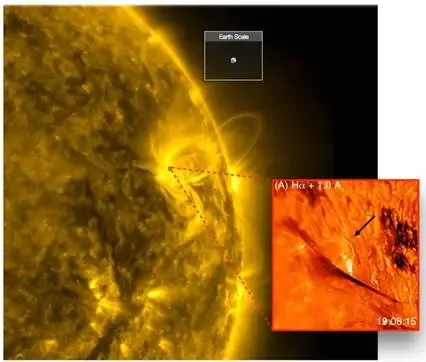
The temperature structure of the Sun has baffled solar physicists for decades. The Sun's core burns at nearly 15 million degrees Celsius, while its visible surface — the photosphere — is a comparatively cool 5,500 degrees Celsius. Yet the corona, located far above the surface, routinely reaches around 2 million degrees Celsius and can spike to as high as 40 million degrees Celsius during active periods.
This counterintuitive temperature inversion — where the atmosphere grows hotter as it moves farther from the heat source — defies conventional thermodynamic expectations and has remained one of the most contested open questions in solar science.
What Aditya-L1 Data Reveals
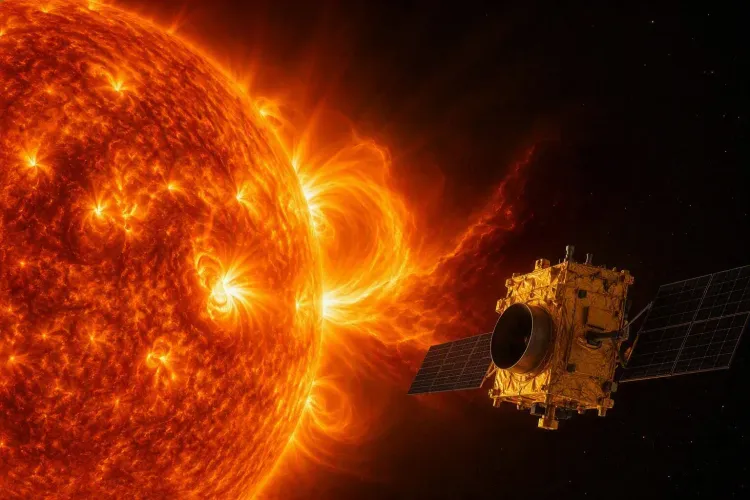
India's Aditya-L1, the country's first dedicated solar observation mission, has provided a fresh observational vantage point to study coronal dynamics. According to the research team, the mission's data sheds new light on the mechanisms that both heat the corona and replenish energy lost during powerful solar eruptions such as solar flares and coronal mass ejections (CMEs).
The study, according to the researchers, addresses not just the heating question but also the related problem of energy replenishment — how the corona maintains its extreme temperatures despite the constant drain of eruptions.
Solar Eruptions and Their Scale
The corona is the origin point of extreme space weather events. During a CME, the Sun ejects enormous quantities of energy and charged particles into space. According to Prof. Ramesh, the Sun typically generates two to three CMEs per day during periods of low solar activity. At the peak of its 11-year solar cycle, that rate can climb to ten or more eruptions daily.
These events carry significant consequences for Earth. While they can produce spectacular auroras, they also pose serious risks to power grids, communication networks, satellite systems, and navigation infrastructure through geomagnetic storms.
Why Energy Replenishment Matters
Scientists have long questioned how the corona sustains its extreme temperatures in the face of such frequent and massive energy losses. If the energy expelled through CMEs and flares were not continuously replenished, the corona would gradually cool — an outcome that would have cascading effects across the solar system. The Aditya-L1 findings, according to the IIA team, bring researchers meaningfully closer to understanding the replenishment mechanism.
Notably, this is among the first major peer-reviewed outputs from the Aditya-L1 mission, signalling that the spacecraft's instruments are delivering scientifically significant data. As the mission continues its observations from the Sun-Earth Lagrange Point 1, further findings are expected to refine the current models of coronal heating.
Point of View
And it arrives at a moment when India's space science credibility is under close international scrutiny. The corona heating problem has resisted resolution for over 70 years despite contributions from SOHO, STEREO, and the Parker Solar Probe — so any incremental advance is genuinely noteworthy. What the coverage tends to underplay is the replenishment angle: understanding how the corona recovers energy after CMEs may matter more for space weather forecasting than the heating question alone. India's ability to contribute to that frontier, not just observe it, is the real benchmark for Aditya-L1's success.
NationPress
29 Sept 2026
Frequently Asked Questions
What has Aditya-L1 discovered about the Sun's corona?
Aditya-L1's observations have provided new clues into why the Sun's corona remains millions of degrees hotter than its surface and how it replenishes energy lost through solar eruptions. The findings were published in the Astrophysical Journal Letters, led by Prof. R. Ramesh of the Indian Institute of Astrophysics.
Why is the Sun's corona hotter than its surface?
The Sun's visible surface, the photosphere, sits at around 5,500 degrees Celsius, while the corona far above it can reach 2 million to 40 million degrees Celsius. This temperature inversion defies conventional physics and has been one of the most studied unsolved problems in solar science for decades.
What is a coronal mass ejection and why does it matter?
A coronal mass ejection (CME) is a large expulsion of plasma and magnetic energy from the Sun's corona. The Sun produces two to three CMEs per day at low activity and ten or more at solar cycle peak. CMEs can disrupt Earth's power grids, satellites, communication networks, and navigation systems through geomagnetic storms.
What is the significance of this study for India's space programme?
This is among the first major peer-reviewed scientific outputs from Aditya-L1, India's first dedicated solar observation mission. It demonstrates that the spacecraft's instruments are generating data capable of contributing to frontier solar physics research at an international level.
Where is Aditya-L1 positioned and what does it observe?
Aditya-L1 operates from the Sun-Earth Lagrange Point 1, a gravitationally stable position that allows continuous, unobstructed observation of the Sun. From this vantage point, it monitors solar activity including coronal dynamics, flares, and CMEs.