OpenAI CEO Sam Altman: AI compresses 3 months of startup work to 17 minutes
Synopsis
OpenAI CEO Sam Altman's claim that Codex can do three months of startup work in 17 minutes is not a product pitch — it is a structural argument about who gets to build companies. If he is right, the capital and expertise barriers that have historically concentrated entrepreneurship among the privileged few are dissolving fast.
Key Takeaways
Sam Altman said OpenAI's Codex can compress three months of startup work into 17 minutes .
He predicted AI will produce the greatest boom in entrepreneurship and small-business creation in history.
Altman cited a laundromat owner as an early ChatGPT adopter who used it for marketing, legal contracts, and vendor management.
2025 saw a marked acceleration in AI use through coding agents and white-collar work agents, according to Altman.
He told G20 representatives that every economy must adopt AI to remain competitive, regardless of regulatory approach.
Altman previously led Y Combinator , giving him direct experience with the resource barriers facing early-stage founders.
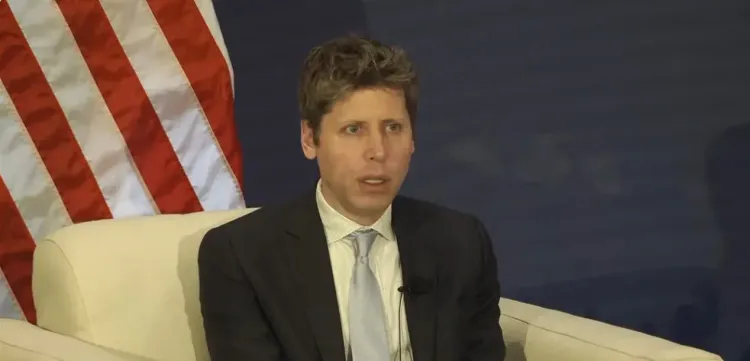
OpenAI Chief Executive Sam Altman declared at a fireside chat in Chapel Hill, North Carolina on 2 September that artificial intelligence has collapsed the startup development cycle from three months to as little as 17 minutes, predicting the technology will trigger the largest wave of entrepreneurship the world has ever witnessed.
The 17-Minute Claim
Speaking alongside US Commerce Secretary Howard Lutnick, Altman pointed specifically to Codex — OpenAI's coding agent — as the tool reshaping the economics of early-stage company building. 'The work that we expected a startup to accomplish in three months is now probably doable in, like, 17 minutes with Codex,' he said. He added that the broader world had not yet grasped the scale of what this shift would mean: 'This is just amazing. The world is not caught up with what this is going to mean.'
Barriers That AI Is Dismantling
Altman, who previously served as president of Y Combinator — the Silicon Valley accelerator behind companies such as Airbnb and Stripe — argued that promising ideas had long been strangled by resource constraints. 'If you had a great idea, but you didn't have the resources or the ability to get enough capital together or hire experts to work on it or to figure out what it's gonna take to invent new science or manage a complex supply chain, you can do that with AI,' he said. The implication is direct: the traditional gatekeepers of startup success — venture capital access, technical hiring, scientific expertise — are losing their grip.
The Laundromat That Started It All
To illustrate AI's real-world reach beyond Silicon Valley, Altman recalled an early ChatGPT user: a laundromat operator who used the tool to draft marketing materials, navigate legal contracts, and manage vendor relationships. 'He was really the first person I met that had figured out how to use AI to effectively run a business,' Altman said. The anecdote is notable because it predates the current generation of far more capable models, suggesting the productivity gains Altman describes today are compounding on an already-elevated baseline.
2025 Acceleration and What Comes Next
Altman noted that 2025 marked a visible inflection point: 'In 2025, we saw a real acceleration of this with coding agents and white collar work agents.' He predicted the next frontier would be long-term AI agents — persistent virtual colleagues capable of working continuously alongside individuals and organisations, rather than responding to one-off prompts. He framed this not merely as a productivity upgrade for large corporations and governments, but as a structural democratisation: 'It could enable more people to build independent businesses instead of becoming small parts of large corporations.'
Global Policy Dimension
Addressing G20 representatives at the same event, Altman acknowledged that countries could adopt different regulatory postures toward AI and choose whether to build their own data centres or lease computing capacity. However, he was unequivocal that participation was not optional: every economy would need to deploy the technology to remain competitive and sustain business growth. This comes amid intensifying geopolitical competition over AI infrastructure, with the US, China, and the European Union each pursuing distinct regulatory and investment strategies.
Point of View
But the harder constraints on startups — market timing, distribution, regulatory compliance, and founder judgment — are not yet compressible by any AI agent. The laundromat anecdote is compelling precisely because it involves a non-technical operator, but scaling that example to deep-tech or capital-intensive sectors is a significant leap. What Altman is really describing is a collapse in the cost of prototyping, not necessarily a collapse in the cost of building durable businesses. The distinction matters enormously for how policymakers, investors, and aspiring founders calibrate expectations around this technology.
NationPress
18 Oct 2026
Frequently Asked Questions
What did Sam Altman mean when he said AI can do three months of work in 17 minutes?
Altman was referring to OpenAI's Codex coding agent, which he says can complete the development tasks a startup would typically spend three months on in roughly 17 minutes. He made the claim during a fireside chat with US Commerce Secretary Howard Lutnick in Chapel Hill, North Carolina on 2 September.
What is OpenAI Codex?
Codex is an AI-powered coding agent developed by OpenAI that can write, review, and execute code autonomously. Altman cited it as a key tool enabling the dramatic compression of startup development timelines he described at the event.
Why is Sam Altman's prediction about entrepreneurship significant?
Altman argued that AI removes the traditional barriers to starting a business — lack of capital, technical expertise, and supply chain complexity — potentially opening entrepreneurship to a far wider population. Given his background running Y Combinator, one of the world's most influential startup accelerators, the prediction carries notable weight.
What role did ChatGPT play in early small-business AI adoption?
Altman recalled a laundromat owner who used ChatGPT shortly after its release to handle marketing, legal contracts, and vendor management — describing him as the first person he met who had genuinely figured out how to run a business with AI. The example predates current, more capable models, illustrating how rapidly the baseline has shifted.
What did Altman tell G20 representatives about AI regulation?
Altman told G20 representatives that countries could choose their own regulatory frameworks and decide whether to build or rent AI infrastructure, but that adopting the technology was not optional — every economy would need it to stay competitive and help businesses grow.