How Does Art and Film on Capitol Hill Highlight the Hindu Refugee Crisis in Pakistan?
Click to start listening
Synopsis
An impactful art exhibition and documentary on Capitol Hill sheds light on the overlooked Hindu refugee crisis in Pakistan. By showcasing poignant stories of forced conversions and abductions, activists call for urgent action from US lawmakers. This exhibition serves as a vital platform for raising awareness and advocating for the rights of persecuted communities.
Key Takeaways
- The exhibition showcases the **silent refugee crisis** faced by minorities in Pakistan.
- It features impactful installations and visual storytelling.
- Activists emphasize the need for greater awareness among policymakers.
- The event highlights the **resilience** of women and communities affected by persecution.
- Documentaries and films accompany the exhibition to illustrate harsh realities.
Washington, Jan 17 (NationPress) An engaging art exhibition and documentary presentation on Capitol Hill has highlighted the struggles faced by Hindu and other minority groups from Pakistan, focusing on forced conversions, abductions, and a growing refugee crisis that the organisers claim has largely been overlooked in global discussions.
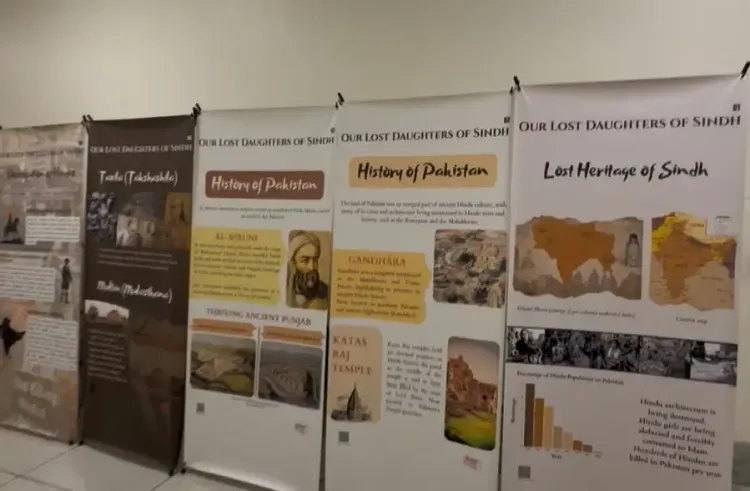
Entitled Seven Decades and backed by HinduAction, the exhibition merges photography, large-scale visual installations, quilts, and film to portray what the organisers term a silent refugee crisis.
The initiative aimed to raise awareness among US lawmakers and congressional staff regarding what activists describe as pervasive and systemic abuses experienced by minorities, particularly Hindus, in Pakistan, along with the narratives of refugees who have sought asylum in India.
Kiran Chukkapalli, the founder of the Refugee Aid Project, stated that the exhibition captures the realities of refugees who have escaped persecution and are currently residing in camps across India.
"We manage approximately 92 refugee camps throughout India, accommodating around 383,000 Hindu, Sikh, and Buddhist refugees," he explained, characterising the display of monochrome photographs, extensive visual panels, and textile art as an effort to bring their stories to light.
"This is what we term the silent refugee crisis," Chukkapalli continued, emphasising that such communities are rarely included in mainstream global discussions about displacement.
An outstanding installation, the Goddess Quilt, was described as a representation of the strength of women who have rebuilt their lives after facing persecution.
Additional sections, referred to as the absence series, centre on loss and silencing, illustrating abandoned homes and disrupted cultural practices.
The exhibition has been previously showcased in cities such as Sydney, Melbourne, London, New York, and Mumbai, but its presentation in Washington holds special significance.
"This issue should be at the forefront of discussions… their voices must be acknowledged," he asserted.
Complementing the exhibition, a short film and documentary screenings addressed the issues of forced conversions and abductions occurring in Pakistan.
Rahul Sharma, the founder of the humanitarian organisation Indus Valley Minorities, noted that his group works closely with victims and their families, representing them in police stations, courts, and hospitals.
"We actively engage on the ground… we conduct rescue operations as needed," Sharma stated, detailing instances where minor Hindu and Christian girls are abducted, sexually assaulted, forcibly converted, and married, often making it nearly impossible for them to return to their families.
Sharma reported that his organisation receives "approximately one case per week" involving what he termed brutal crimes. He added that the short film he created in Mumbai aimed to assist lawmakers in truly visualising the realities of such situations, calling it a hard-hitting portrayal of forced conversions.
An interactive walkthrough included in the exhibition recreated domestic spaces and testimonial narratives to illustrate what organisers described as an orchestrated system of abuse involving traffickers, clerics, political figures, and complicit officials.
The accompanying documentary explored the processes of abduction, rapid conversion, and marriage, as well as the role of poverty and vulnerability in targeting minority girls.
Utsav Chakraboty from HinduAction indicated that the goal was also to bring attention to the status of Hindus in Pakistan.
Stating that Hindus constitute "only about one and a half percent of the population" in Pakistan, he noted that they are persecuted, abducted, and forcibly converted, highlighting similar issues arising in Bangladesh as the political influence of Islamist groups grows.
Event organisers called for heightened awareness and involvement from US lawmakers, asserting that ignorance has contributed to inaction. "As Hindus in America, we believe we have a responsibility to ensure that our lawmakers… understand the ongoing situation," Chakraboty remarked.
The Capitol Hill exhibition signifies an increasing effort by diaspora organisations to utilise art, film, and testimonies to elevate these issues into international policy discussions, framing the act of documentation as a means of resistance and remembrance.
Point of View
We recognize the importance of addressing the plight of minority communities facing persecution. Highlighting these issues through art and film not only raises awareness but also encourages action from policymakers. We stand firm in our commitment to promote dialogue and foster understanding around these critical humanitarian concerns.
NationPress
17/01/2026
Frequently Asked Questions
What is the focus of the Capitol Hill exhibition?
The exhibition highlights the struggles of Hindu and other minority communities in Pakistan, particularly forced conversions and abductions.
Who organized the event?
The event was organized by HinduAction and supported by the Refugee Aid Project.
What is the aim of this exhibition?
The aim is to raise awareness among US lawmakers regarding the ongoing abuses faced by minorities in Pakistan.
How many refugee camps are mentioned?
There are approximately 92 refugee camps across India housing about 383,000 Hindu, Sikh, and Buddhist refugees.
What significance does the exhibition hold?
It serves as a platform to amplify unheard voices and advocate for the rights of persecuted communities.