Ayushman Bharat cited as global blueprint for equitable health systems
Synopsis
A Kuwait-based report has flagged India's Ayushman Bharat as a scalable model for the Global South — combining ₹5 lakh insurance cover, 863 million digital health accounts, and 426 million teleconsultations in a single rights-based framework. For cash-strapped governments chasing UHC, India's decade of health reform may be the closest thing to a replicable playbook.
Key Takeaways
Ayushman Bharat is increasingly cited as a reference model for Universal Health Coverage (UHC) among low- and middle-income nations in the Global South .
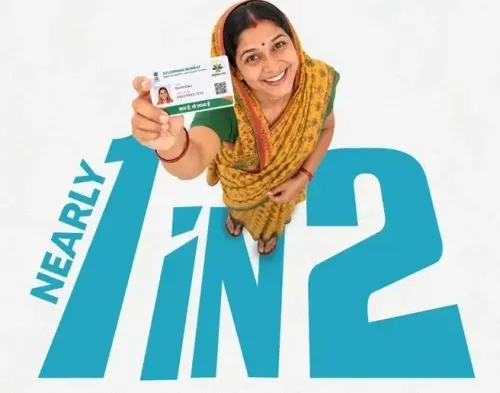
PMJAY , the world's largest publicly funded health assurance scheme, has facilitated over 7.8 crore hospital admissions since 2018 , offering up to ₹5 lakh cover per family per year.
Coverage has been extended to all citizens aged 70 and above , regardless of income.
Over 426 million teleconsultations were conducted through Ayushman Arogya Mandirs in 2025 ; the Ayushman Bharat Digital Mission has set up more than 863 million digital health accounts.
Schemes including PMBJP and AMRIT pharmacies have reduced medicine prices for millions of households.
Experts, according to the report, describe the model as a structural shift combining decentralised primary care, large-scale insurance, and digital health infrastructure.
India's Ayushman Bharat programme is gaining recognition as a reference model for nations seeking to build equitable, financially sustainable health systems, according to a report by Kuwait-based The Times Kuwait. A decade of reforms has positioned India as a leading example in the global pursuit of Universal Health Coverage (UHC), with the programme increasingly viewed as a scalable framework for low- and middle-income countries across the Global South.
What Ayushman Bharat Covers
Ayushman Bharat integrates four pillars: financial protection, strengthened primary healthcare, digital innovation, and pharmaceutical self-reliance. At its core is the Pradhan Mantri Jan Arogya Yojana (PMJAY), described as the world's largest publicly funded health assurance scheme. PMJAY provides health insurance coverage of up to ₹5 lakh per family per year for secondary and tertiary care. Since its launch in 2018, the scheme has facilitated more than 7.8 crore hospital admissions. Coverage has recently been extended to all citizens aged 70 and above, regardless of income level.
Primary Care and Digital Infrastructure
Healthcare infrastructure has been scaled up through Ayushman Arogya Mandirs (AAMs), which deliver a comprehensive range of preventive, promotive, curative, rehabilitative, and palliative care services, bringing healthcare closer to communities. Digital integration has been central to expanding access: over 426 million teleconsultations were conducted through AAMs in 2025, while the Ayushman Bharat Digital Mission has created more than 863 million digital health accounts, enabling secure and interoperable health records.
Mental Health and Medicine Affordability
India has also launched the Tele Mental Health Assistance and Networking Across States (Tele MANAS) initiative, offering round-the-clock tele-mental health services to ensure equitable access to quality mental healthcare. On the affordability front, schemes such as the Pradhan Mantri Bhartiya Janaushadhi Pariyojana (PMBJP) and AMRIT pharmacies have reduced medicine prices, improving access for millions of households.
Why the Global South Is Watching
According to the report, experts believe Ayushman Bharat represents a structural shift in healthcare governance — combining decentralised primary care, large-scale insurance coverage, and digital health infrastructure within a unified, rights-based framework. This integrated model is increasingly cited as a reference point for governments balancing limited resources against growing healthcare demands. The report notes that India's approach demonstrates UHC can be achieved even in resource-constrained settings, provided there is strong political commitment and system-wide reform.
As the model gains traction internationally, the emphasis on prevention, affordability, and inclusivity positions Ayushman Bharat as a potential policy template for the Global South — and a case study in what scaled public health ambition can look like when anchored in both technology and rights.
Point of View
But the report's framing deserves scrutiny. Citing a single overseas publication as evidence of global validation is thin ground for a sweeping 'blueprint' claim — the more credible signal would be formal adoption or study by WHO, World Bank, or peer governments. That said, the underlying numbers are substantive: 7.8 crore admissions and 863 million digital health accounts are not cosmetic. The harder question mainstream coverage sidesteps is quality and outcomes — insurance enrolment and hospital admissions do not automatically translate into health gains. India's public health expenditure as a share of GDP remains among the lower tiers globally, and out-of-pocket costs, while reduced, have not been eliminated. The model is promising; the proof will be in longitudinal health outcome data, not admission counts.
NationPress
24 Sept 2026
Frequently Asked Questions
What is Ayushman Bharat and why is it being called a global blueprint?
Ayushman Bharat is India's flagship health initiative integrating insurance coverage, primary care expansion, digital health infrastructure, and medicine affordability. It is being described as a global blueprint because experts, as cited in a report by The Times Kuwait, believe its rights-based, technology-driven model offers a scalable path to Universal Health Coverage for low- and middle-income countries.
What is PMJAY and how many people has it covered?
Pradhan Mantri Jan Arogya Yojana (PMJAY) is the insurance component of Ayushman Bharat, providing up to ₹5 lakh per family per year for secondary and tertiary care. It has facilitated more than 7.8 crore hospital admissions since its launch in 2018 and has recently been extended to all citizens aged 70 and above regardless of income.
How has digital technology been used under Ayushman Bharat?
The Ayushman Bharat Digital Mission has created over 863 million digital health accounts enabling secure, interoperable health records. Additionally, more than 426 million teleconsultations were conducted through Ayushman Arogya Mandirs in 2025, significantly expanding remote access to healthcare.
What is Tele MANAS and what does it offer?
Tele MANAS — Tele Mental Health Assistance and Networking Across States — is an initiative providing 24x7 tele-mental health services across India. It aims to make mental healthcare equitable, accessible, affordable, and of consistent quality, particularly for underserved populations.
Why is the Ayushman Bharat model relevant for the Global South?
Governments across the Global South face the challenge of delivering healthcare with limited fiscal resources. According to the report, Ayushman Bharat demonstrates that UHC is achievable in resource-constrained settings through strong political commitment, decentralised primary care, large-scale insurance, and digital infrastructure — making it a potential policy template for similar economies.