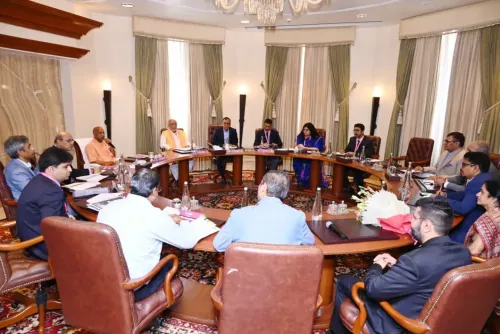
Bangladesh ADP implementation hits 53-year low at 67.5% in FY2025-26

Synopsis
Bangladesh's development execution has hit a 53-year floor — two consecutive years below 68%, after three years above 80%. The numbers point to something more troubling than a bad fiscal year: a public investment system that works in good times but buckles under political transition, fiscal stress, and procurement gridlock simultaneously.
Key Takeaways
Bangladesh implemented just 67.5 per cent of its revised ADP in FY 2025-26 — the lowest rate in 53 years .
The previous year, FY 2024-25 , also ended at a near-identical 67.85 per cent , marking two consecutive years of sub-68% execution.
Implementation stood at 92.79 per cent in FY 2021-22 , highlighting the severity of the two-year decline.
Key causes include the August 2024 political transition , foreign exchange shortages, procurement delays, and weak inter-agency coordination.
Domestic revenue mobilisation and external financing have both come under pressure, tightening fiscal space for development spending.
Bangladesh's Annual Development Programme (ADP) implementation rate fell to just 67.5 per cent of the revised outlay in FY 2025-26 — the lowest in 53 years, according to data cited by Dhaka-based The Daily Star. The figure marks the second consecutive year of exceptionally weak execution, raising serious questions about the structural resilience of Bangladesh's development governance.
A Two-Year Slide After Years of Strength
The decline is stark when viewed against recent history. Bangladesh achieved 92.79 per cent ADP implementation in FY 2021-22, followed by 84.16 per cent in FY 2022-23 and 80.63 per cent in FY 2023-24. The trajectory then deteriorated sharply, with implementation dropping to around 68 per cent in each of the last two fiscal years.
The previous fiscal year, FY 2024-25, closed at 67.85 per cent, according to figures from the country's Implementation Monitoring and Evaluation Division (IMED). Analysts note that a single year of underperformance can often be attributed to exceptional shocks — but two consecutive years of comparable weakness following three strong years demands a more structural explanation.
What Drove the Collapse in Execution
The analysis in The Daily Star attributes the poor showing to a confluence of factors. The political transition of August 2024 disrupted administrative continuity at a critical juncture, while mounting macroeconomic pressures — including foreign exchange shortages and tightening fiscal conditions — placed Bangladesh's public investment system under exceptional strain.
Beyond the external shocks, systemic weaknesses within the delivery architecture compounded the problem. These include prolonged procurement delays, unresolved land acquisition disputes, repeated design revisions, weak inter-agency coordination, and insufficient project management capacity — all of which slowed disbursement even where funds were nominally available.
The Financing Constraint at the Core
Recent fiscal trends reveal a deeper structural bind. Domestic revenue mobilisation has remained under persistent pressure, external financing has grown less predictable, and overall fiscal space has tightened considerably. These conditions directly constrain development spending, making it harder for implementing agencies to maintain momentum even when project pipelines are intact.
Notably, this is not merely a spending problem — it is a question of institutional design. When public investment systems falter precisely at the moment financing becomes constrained or administrative priorities shift, the vulnerability is systemic, not incidental.
What It Reveals About Development Governance
The broader implication, as the analysis observes, is whether Bangladesh's development ambitions are underpinned by institutions resilient enough to sustain them through disruption. A system that achieves over 92 per cent implementation in favourable conditions but drops below 68 per cent when conditions deteriorate points to a governance architecture that has yet to be stress-tested and hardened.
Unless structural reforms address procurement bottlenecks, land acquisition delays, and inter-agency coordination failures, the risk of another weak year in FY 2026-27 remains real — regardless of the size of the revised ADP outlay.
Point of View
And one that exposes a fundamental fragility in Bangladesh's development architecture. The system delivered above 92% as recently as FY2021-22, which means the institutional capacity exists; what is missing is resilience to disruption. The August 2024 political transition was a foreseeable shock, yet procurement pipelines stalled, land acquisition disputes went unresolved, and coordination broke down. If Bangladesh's public investment machinery cannot absorb a political transition without losing a quarter of its annual development spend, the country's infrastructure and social investment targets are hostage to political stability — a precarious foundation for any emerging economy.
NationPress
26 Sept 2026
Frequently Asked Questions
What is Bangladesh's Annual Development Programme (ADP) and why does its implementation rate matter?
The ADP is Bangladesh's annual public investment budget covering infrastructure, social services, and development projects. Its implementation rate measures how much of the approved outlay is actually spent in a fiscal year — a low rate means planned projects stall, delaying growth and public service delivery.
How low did Bangladesh's ADP implementation fall in FY2025-26?
Bangladesh implemented only 67.5 per cent of its revised ADP in FY2025-26, the lowest rate in 53 years according to IMED data. The previous year also ended at 67.85 per cent, making it two consecutive years of historically weak execution.
What caused Bangladesh's ADP implementation to fall so sharply?
The decline is attributed to the political transition of August 2024, mounting macroeconomic pressures, foreign exchange shortages, and tightening fiscal conditions. Structural issues such as procurement delays, unresolved land acquisition, repeated design revisions, and weak inter-agency coordination also played a significant role.
How does FY2025-26 compare to Bangladesh's recent ADP performance?
Bangladesh achieved 92.79 per cent ADP implementation in FY2021-22, 84.16 per cent in FY2022-23, and 80.63 per cent in FY2023-24. The drop to around 68 per cent over the last two fiscal years represents a dramatic reversal from that period of strong execution.
What are the broader implications for Bangladesh's development goals?
The back-to-back weak years raise questions about whether Bangladesh's institutions are resilient enough to sustain development ambitions during periods of fiscal stress or political disruption. Without structural reforms to procurement, land acquisition, and coordination systems, analysts warn the country's long-term infrastructure and social investment targets remain at risk.