Is Today the Birth of a New Bangladesh? Yunus Votes in General Elections
Synopsis
As Bangladesh's interim Chief Advisor, Muhammad Yunus, casts his vote in the parliamentary elections, he proclaims a new era for the nation. Find out how these elections unfold against the backdrop of political unrest and rising tensions.
Key Takeaways
Yunus declares election day as the birth of a new Bangladesh.
Over 127 million voters are expected to participate.
Significant increase in female voter registration.
Security measures include deployment of nearly 1 million personnel.
Ongoing concerns about political fairness and representation.
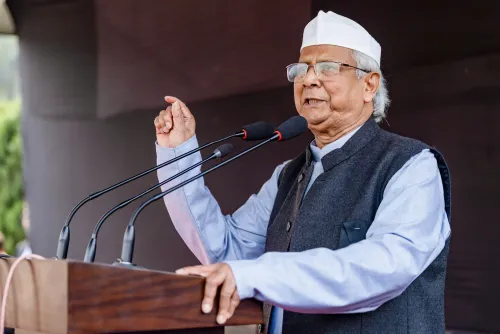
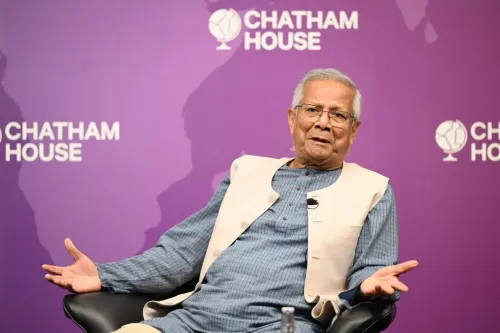
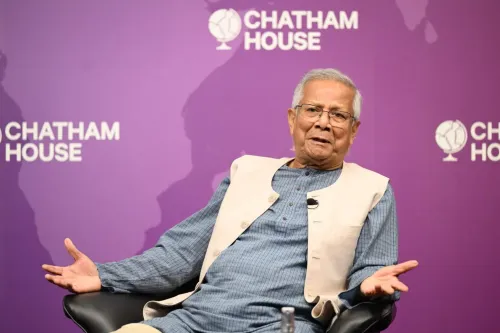
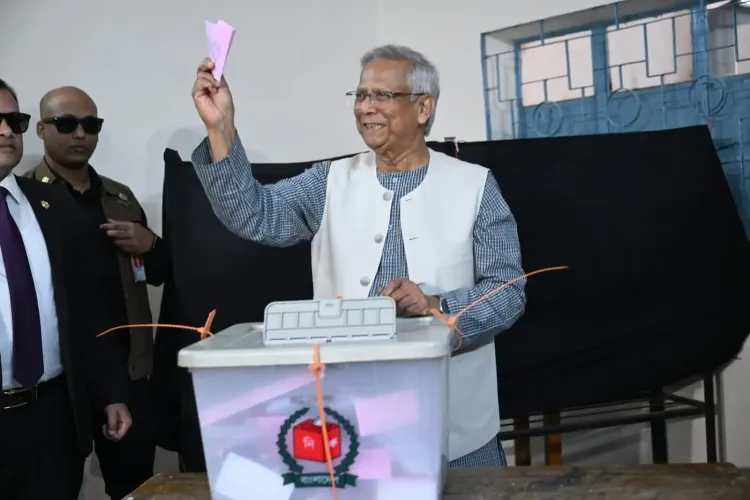
Dhaka, Feb 12 (NationPress) The Chief Advisor of Bangladesh's interim government, Muhammad Yunus, exercised his voting rights in the 13th parliamentary elections on Thursday, characterizing the occasion as a moment of "great joy" and dubbing it "the birthday of the new Bangladesh", as reported by local media.
Speaking to reporters after casting his ballot at Gulshan Model High School and College in Dhaka, Yunus encouraged the populace to participate actively in both the parliamentary elections and the referendum.
In a nationwide address delivered the day prior to the elections, Yunus referred to this election as a "critical moment" in the political timeline of the country.
"This landmark referendum and national parliamentary election will be viewed as a unique and significant chapter in the political history of Bangladesh," Yunus was quoted as saying by bdnews24.
Bangladesh conducted its parliamentary elections on Thursday, approximately 18 months post the termination of former Prime Minister Sheikh Hasina's 15-year administration, which ended following widespread protests.
The nation has since been led by an interim government under Yunus, during which time Bangladesh has experienced ongoing protests, the emergence of extremist Islamic factions, and heightened violence against minority groups.
Numerous international human rights organizations have criticized the Yunus-led interim administration, citing a complete breakdown of law and order, a lack of noticeable reforms, and increasing instability in Bangladesh.
As reported by The Dhaka Tribune, over 127 million voters are anticipated to participate in the parliamentary elections, coinciding with a nationwide referendum that could profoundly impact Bangladesh's constitutional structure.
Out of the 127.7 million registered voters, 62.88 million are women. Interestingly, around 2.7 million women have registered as first-time voters, significantly outpacing the 1.87 million newly registered male voters.
Despite the rising voter engagement, women remain underrepresented among candidates, with only 83 female candidates — 63 nominated by political parties and 20 running as independents — representing approximately four percent of total candidates.
To ensure security during the elections, authorities have deployed around 958,000 security personnel nationwide, with heightened presence in sensitive and high-risk areas.
Additionally, more than 100,000 army personnel have been stationed to uphold law and order and ensure the smooth conduct of polling.
As polling progresses in Bangladesh for the 13th parliamentary elections, participating political parties are exhibiting confidence in their ability to form a government amidst a backdrop of violence, while acknowledging potential compromises in the fairness of the voting.
Meanwhile, the Awami League has reached out to the international community, urging them to intervene to prevent the country from descending into chaos, labeling the elections as a "sham".
The party asserted that this "staged exercise" aims not only to marginalize the Awami League but also to exclude various political factions that oppose radical ideologies and advocate for a liberal Bangladesh.
Bangladesh's elections are unfolding amidst rising political turmoil, with critics cautioning that a shift in power could amplify Islamist extremism.
Point of View
It is crucial to reflect on the significance of these elections. While hope for a new beginning is palpable, the concerns regarding fairness and representation must not be overlooked. As the nation moves forward, it is essential to uphold democratic values and ensure that every voice is heard.
NationPress
2 Oct 2026
Frequently Asked Questions
What is the significance of the 13th parliamentary elections in Bangladesh?
The 13th parliamentary elections are seen as a critical juncture in Bangladesh's political history, marking a potential transition toward a new governance era under the interim administration led by Muhammad Yunus.
How many voters are participating in the elections?
Over 127 million voters are expected to cast their ballots in the parliamentary elections, with a notable increase in female participation.
What challenges does the interim government face?
The interim government has faced criticism regarding law and order, with ongoing protests and concerns about the fairness of the elections.
What measures are in place to ensure election security?
Authorities have deployed approximately 958,000 security personnel and over 100,000 army personnel to maintain law and order during the elections.
What impact could these elections have on Bangladesh's future?
These elections may significantly influence Bangladesh's political landscape and could either stabilize or exacerbate existing tensions within the country.