Will Bangladesh's February Election Change the Power Dynamics?
Synopsis
As Bangladesh prepares for its February 12 election, the implications for power dynamics remain uncertain. Despite potential parliamentary changes, a report indicates that the interim government led by Muhammad Yunus is likely to maintain control, raising questions about the future of democratic governance in the country.
Key Takeaways
The February 12 election may not significantly change Bangladesh's power dynamics.
Unelected authority under Muhammad Yunus is likely to persist.
The newly elected representatives may not form a government immediately.
The interim government retains control during a critical constitutional reform period.
Political parties must navigate a complex landscape shaped by the 'July Charter.'
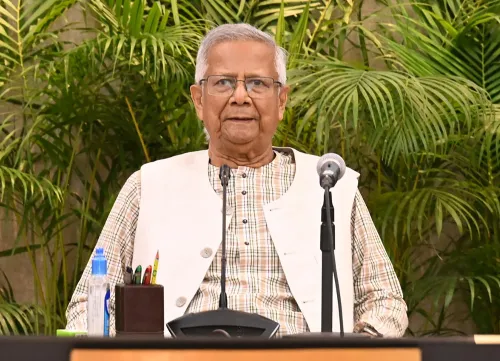
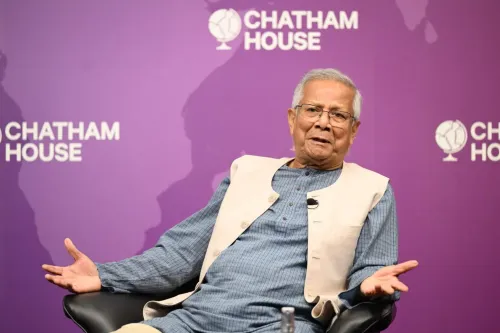
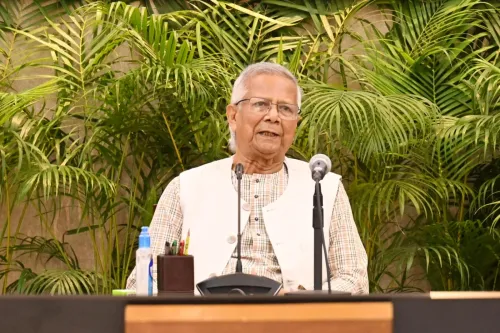
Dhaka, Jan 27 (NationPress) The upcoming election on February 12 in Bangladesh might modify the parliamentary landscape, yet it is improbable that it will transform the nation's power dynamics in the near future. The abolition of the current constitution via a referendum, the postponement of the inauguration of elected officials, and the concentration of significant authority within a revolutionary framework all contribute to the persistence of an "unelected power" under the interim government led by Muhammad Yunus, masquerading as a democratic process, according to a report released on Tuesday.
"As Bangladesh approaches the national election on February 12, it carries the familiar promise of restoration: ballots, representatives, and a return to constitutional order following reforms. However, the reality is much less comforting. Even with a smooth election and a potential victory for a party like the BNP, Muhammad Yunus is unlikely to be succeeded by an elected government anytime soon," the Eurasia Review report elaborated.
The report states that the underlying issue is not about voter calculations but rather a "meticulously crafted post-election framework" that reshapes authority, delays accountability, and transforms an interim setup into a permanent establishment.
"The initial indication is procedural, almost bureaucratic. According to the current narrative, the newly elected parliamentary members will not immediately establish a government. Instead, they will convene as a constitutional reform council or ‘Constituent Assembly’ (often referred to as Gonoporishod) with a six-month mandate to revise parts of the constitution and enact foundational laws. Throughout this 180-day period, the administration led by Yunus will remain firmly in control," it continued.
The report emphasizes that elections will not facilitate a transfer of executive power in Bangladesh, but will rather entrench a transitional phase where unelected authorities govern alongside elected individuals stripped of authentic power.
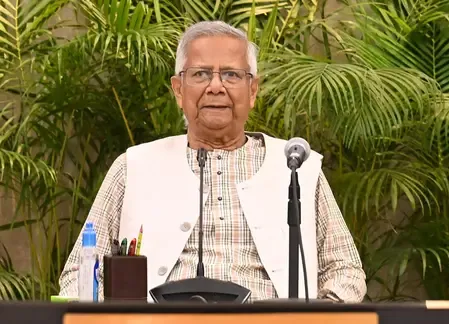
Within this arrangement, it noted, the Chief Advisor of the interim government, Muhammad Yunus, would extend his interim role to become the central authority overseeing a Constituent Assembly responsible for executing the July Charter.
"Once finalized, a so-called ‘revolutionary government’ would emerge, endowed with extensive powers. While a Parliament and a Prime Minister may still exist, these institutions would primarily serve as ceremonial or rubber-stamp entities, while actual power ascends to a supreme arbiter. Although comparisons to Iran’s Supreme Leader or North Korea’s political structure may seem exaggerated, the logic of unchecked authority justified by revolutionary necessity is strikingly familiar," the report underscored.
It pointed out the surprising lack of attention this blueprint has garnered from many political parties participating in the elections.
"The BNP, despite being a significant contender, seems insufficiently aware of the trap embedded within the process. By endorsing the draft of the July Charter, it may have already forfeited the legal foundation upon which any future challenge could rely. In contrast, Jamaat-e-Islami is fully cognizant— and supportive— perceiving this arrangement as an opportunity to advance its ideological objectives," the report observed.
Point of View
It is crucial to approach the upcoming elections in Bangladesh with a balanced understanding of the underlying dynamics. While the promise of restoration and democratic governance is appealing, the realities presented in recent reports suggest a complex landscape where unelected powers may continue to influence the political sphere significantly.
NationPress
24 Sept 2026
Frequently Asked Questions
What is the significance of the February 12 election in Bangladesh?
The February 12 election is significant as it has the potential to alter the parliamentary composition in Bangladesh, but reports suggest it may not lead to a change in the power structure dominated by unelected authorities.
Who is leading the interim government in Bangladesh?
The interim government in Bangladesh is led by Muhammad Yunus, who is expected to maintain significant control even after the elections.
What does the report say about the future of democracy in Bangladesh?
The report indicates that despite the elections, the structure of governance may remain unchanged, preserving an unelected power framework that could undermine true democratic processes.
How might the election process affect political parties in Bangladesh?
The election process may expose political parties like the BNP to challenges within a framework that could limit their ability to contest the legitimacy of the interim government's authority.
What implications does the 'July Charter' have for the election?
The 'July Charter' could significantly influence the election by establishing rules that may constrain the newly elected representatives, potentially limiting their power and reinforcing the interim government's authority.