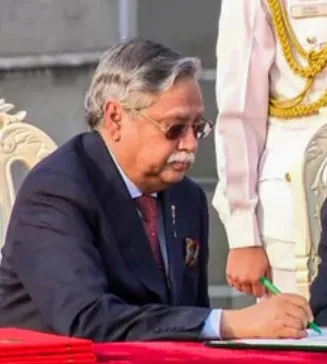
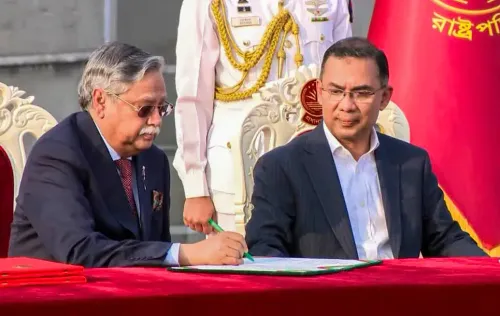
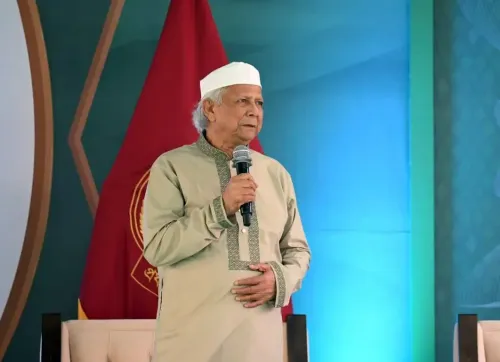
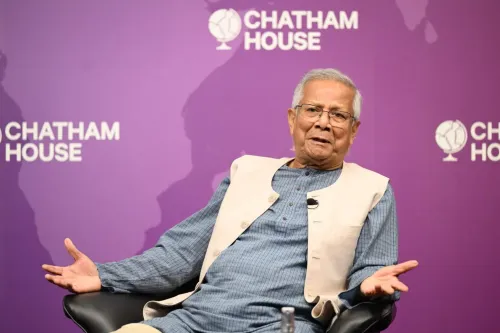
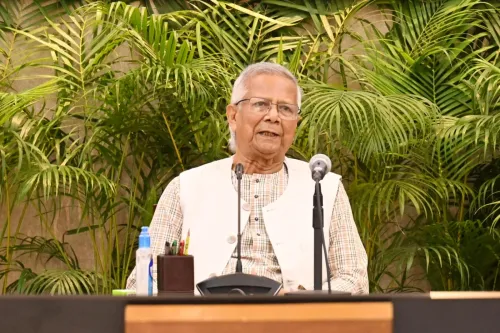
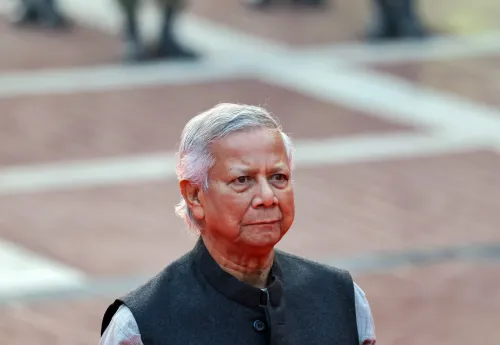
Bangladesh President Accuses Yunus-led Interim Government of Conspiracy to Oust Him
Synopsis
In a startling revelation, President Mohammed Shahabuddin claims he was left out of crucial discussions during the Yunus-led interim government and faced numerous conspiracies aimed at destabilizing his presidency and the nation.
Key Takeaways
President Shahabuddin claims exclusion from discussions during Yunus-led interim government.
Alleges conspiracies aimed at destabilizing his presidency.
Criticizes the issuance of 133 ordinances without proper consultation.
Highlights the importance of constitutional obligations in government.
Expresses concerns over being kept in the dark regarding state agreements.
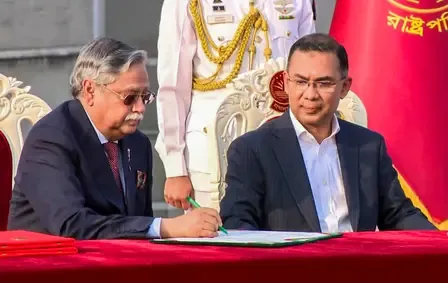
Dhaka, Feb 23 (NationPress) Bangladesh’s President Mohammed Shahabuddin claimed that he was sidelined from significant discussions throughout the one-and-a-half-year period of the interim government led by Muhammad Yunus. He accused this administration of plotting against him, asserting that there were efforts to undermine national stability and establish a constitutional vacuum.
In a conversation with the Bangladeshi Bengali daily Kaler Kantho at his official residence, Bangabhaban, in Dhaka, the President expressed, “During that one and a half years, I was excluded from any discussions, yet numerous conspiracies were devised against me. There were several attempts aimed at permanently disrupting the peace and order of our nation, as well as creating a constitutional void.”
When questioned about the success of these efforts, he stated, “I remained resolute in my stance. Therefore, no conspiracy was successful. Particularly, the many attempts to remove the President through unconstitutional means have not succeeded. Consequently, the experience of my tenure at Bangabhaban has not been favorable. I wonder if anyone else could have withstood the challenges I faced.”
In response to inquiries regarding whether the former chief advisor consulted him on state matters, including the issuance of 133 ordinances, Shahabuddin remarked that while some ordinances may have been necessary, there was no reason for such a high number to be issued.
Shahabuddin went on to claim that despite the former chief advisor's several international trips, he neither visited the President upon return nor provided any written reports, which he described as a “constitutional obligation”.
“The Chief Advisor disregarded any constitutional provisions. The Constitution mandates that following any foreign trip, he must meet with the President and inform me of the outcomes. He is required to provide written communication detailing discussions, agreements made, and other relevant information. He must have traveled abroad 14 to 15 times without informing me. He never approached me,” he told Kaler Kantho.
Shahabuddin indicated that he was left “entirely in the dark” throughout the interim government's duration and alleged that two of his proposed foreign trips—to Kosovo and Qatar—were obstructed.
When asked if he was aware of the last agreement made with the United States by the interim government prior to the elections, the President stated he had no knowledge of it, emphasizing that such developments should have been communicated to him formally.
“No, I am unaware of any such agreement. Any state agreement should have been communicated to me. Whether significant or trivial, previous government heads ensured the President was informed. This is a constitutional duty. However, this was not done; I received no verbal or written communication. He didn’t even visit!” the President conveyed to Kaler Kantho.
Point of View
It's crucial to analyze the President's claims of exclusion and conspiracy. His statements reflect significant dissatisfaction with the interim government's approach, raising questions about constitutional adherence and the functioning of state governance. A careful examination of these allegations is necessary for public understanding and accountability.
NationPress
21 Sept 2026
Frequently Asked Questions
What allegations did President Shahabuddin make against the Yunus-led interim government?
President Shahabuddin accused the Yunus-led interim government of conspiring to overthrow him and attempting to create a constitutional vacuum.
Why does the President feel sidelined?
He claims he was excluded from important discussions and decision-making processes during the interim government's tenure.
What constitutional obligations did Shahabuddin mention?
He highlighted that the chief advisor is constitutionally required to inform the President about the outcomes of foreign trips and significant agreements.
How did Shahabuddin respond to questions about the interim government’s decisions?
He expressed that while some decisions may have been necessary, the sheer number of ordinances issued was unjustified.
What were the implications of the President's claims?
His allegations raise serious concerns about the governance and constitutional adherence of the Yunus-led interim government.