Why Are Cultural Groups and Journalists in Bangladesh Protesting Against an Attack on Liberation War Ideals?
Synopsis
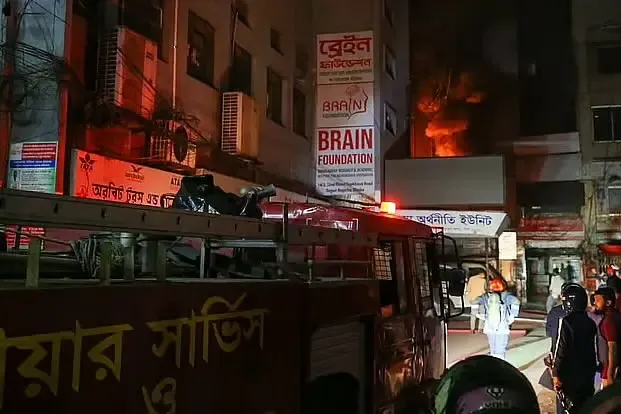
On December 20, members of Bangladesh Udichi Shilpigoshthi rallied in Dhaka to protest an arson attack on their central office, which they see as a direct assault on the nation's cultural heritage and ideals derived from the Liberation War. This incident has raised alarms concerning freedom of expression and the preservation of cultural memory in Bangladesh.
Key Takeaways
Bangladesh Udichi Shilpigoshthi protested against an arson attack on their office.
The attack destroyed cultural archives spanning 55 years.
Protestors linked the incident to a larger threat to freedom of expression .
The event has raised concerns regarding the role of the current government.
Continued protests aim to ensure accountability for the attack.
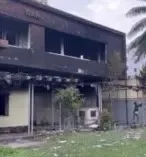
Dhaka, Dec 20 (NationPress) Members of Bangladesh Udichi Shilpigoshthi, a significant cultural organization, took to the streets of Dhaka on Saturday to protest and denounce the arson attack on its central office in the capital, as reported by local media.
The organization stated that this attack obliterated 55 years of cultural archives, striking at the heart of the nation's progressive movement.
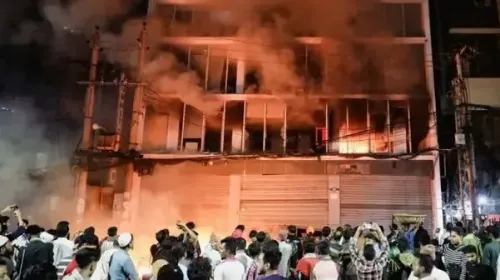
The turmoil erupted following the death of Sharif Osman Hadi, the spokesperson for the radical group Inqilab Mancha, during which multiple media offices, cultural institutions, and diplomatic missions were targeted across the South Asian country.
Reports indicate that artists, cultural workers, journalists, and supporters joined the march, carrying placards and chanting slogans, asserting that the assault on Udichi was part of a larger threat to freedom of expression.
The protestors proclaimed the arson attack as not merely an isolated event but rather part of a comprehensive assault on the principles of the country’s 1971 Liberation War against Pakistan and its traditional cultural resistance.
During the rally, Udichi's General Secretary Amit Ranjan Dey, who led the procession, emphasized that the attack mirrored a familiar and disturbing trend.
"Our office was vandalized, looted, and set ablaze in a manner reminiscent of attacks on The Daily Star, Prothom Alo, and Chhayanaut. These are not random incidents; they signify a calculated threat to freedom of expression and democratic rights," quoted Dey as reported by The Daily Star.
Characterizing the destruction of Udichi's archives as a cultural disaster, Dey remarked that decades of documentation—including songs, scripts, photographs, and records of resistance—were eradicated overnight.
"This is not just an attack on a building; it aims to obliterate memory," he stated.
The organization reiterated in a statement during the rally that the arson represented a direct assault on the progressive cultural movement, cautioning that ongoing inaction would further empower extremist factions.
At the rally, Udichi urged Bangladeshi authorities to promptly identify, apprehend, and prosecute those accountable for the attack.
Leaders questioned the role of the Muhammad Yunus-led interim government, contending that its inability to safeguard cultural and media institutions endangers the democratic foundations of Bangladesh.
The program concluded with Udichi members reaffirming their commitment to protest until accountability is achieved.
"This procession is not the conclusion; we will persist in our protests until justice prevails," Dey declared.
Amid rising violence across the country, Dhaka remained tense on Saturday, with police and members of Border Guard Bangladesh (BGB) stationed at critical locations to maintain order during Hadi's funeral.
Point of View
It is crucial to acknowledge the significance of cultural preservation in Bangladesh and the alarming implications of this recent attack on Udichi Shilpigoshthi. The incident not only represents an attack on a cultural institution but also raises concerns about the broader landscape of freedom of expression in our society. Upholding democratic values and protecting our cultural heritage must remain a priority for both the government and civil society.
NationPress
4 Oct 2026
Frequently Asked Questions
What was the reason for the protest in Dhaka?
The protest was held in response to an arson attack on the central office of Bangladesh Udichi Shilpigoshthi, which destroyed decades of cultural archives.
Who is Amit Ranjan Dey?
Amit Ranjan Dey is the General Secretary of Bangladesh Udichi Shilpigoshthi and was a key figure leading the protest.
What does the arson attack signify?
The arson attack is seen as a broader assault on freedom of expression and the cultural ideals established during Bangladesh's Liberation War in 1971.
How did the authorities respond to the protest?
During the protest, Udichi called on the authorities to identify and prosecute those responsible for the attack.
What impact does this incident have on democracy in Bangladesh?
This incident raises serious concerns about the protection of cultural and media institutions, which are vital to maintaining democratic foundations in Bangladesh.