Is the Lowest Participation of Women Candidates in Bangladesh Elections a Shameful Reality?
Synopsis
Bangladesh faces a troubling milestone as it prepares for an election that will witness the lowest number of women candidates in 54 years. This alarming trend has sparked outrage among former leaders, who are calling for accountability and change. Will this election mark a turning point for women in Bangladeshi politics?
Key Takeaways
Bangladesh faces a historic low in women candidates for upcoming elections.
Former leaders express deep concern over political representation .
Statistics show only 4.24% of candidates are women.
Organizational leaders advocate against reserved seats .
Calls for accountability from political parties are growing.
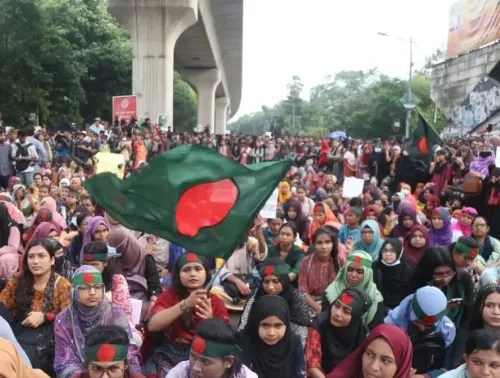
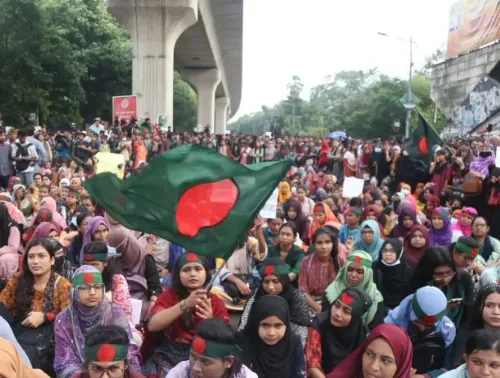
Dhaka, Jan 14 (NationPress) In just a few weeks, Bangladesh will experience an election marked by the lowest representation of women candidates in its 54-year history. Former leaders have voiced their astonishment and dismay regarding this situation under the current interim government led by Mohammad Yunus, labeling it a “matter of shame” for the entire political framework of the South Asian nation.
This week, Dhaka's local media reported on a gathering titled ‘Nomination Crisis of Women Candidates: Gap between Parties’ Commitments and Implementation and the Accountability of the Election Commission’, where numerous speakers pointed out that while the election commission frequently espouses the ideal of a “gender-inclusive election”, the actual conditions tell a different story.
According to UNB, representatives from various organizations, including Gonoshasthaya Abhijan, Durbaar Network Foundation, Nagorik Coalition, Nari Udyog Kendra (NUK), Narigrantha Probortona, Nari Sanghati, Nari Pokkho, Narir Dake Rajniti, Feminist Alliance of Bangladesh (FAB), Bangladesh Nari Mukti Kendra, and Voice for Reform, participated in the event.
Participants emphasized their opposition to reserved seats for women, advocating instead for women to compete directly in elections and gain representation based on merit.
“If political parties do not honor their own pledges and manifestos, how can they expect women to trust them in future elections?” one speaker was quoted as saying by UNB.
Forum leader Samina Yasmin pointed out that women voters represent nearly 50 percent, or even more, of the electorate in the nation.
“Is it feasible to gain power by excluding 51 percent of the population while depending solely on the remaining 49 percent? This is a critical question,” she stated.
Earlier this month, Bangladesh's Election Commission released statistics revealing a stark contrast; despite women comprising half the population, they are significantly underrepresented among candidates.
Out of 2,568 candidates aspiring for the February 12 polls, only 109 (or 4.24 percent) are women, with 72 nominated by political parties and the rest being independents, according to the leading newspaper, The Daily Star.
Reports indicate that the radical Islamist party Jamaat-e-Islami presented 276 candidates without including a single woman, followed by Islami Andolan Bangladesh with 268.
The Bangladesh Nationalist Party (BNP), which was led by a woman for over four decades, has only nominated 10 women out of 328 aspirants for 300 seats.
Many parties, including Bangladesh Khilafat Majlis with 94 candidates, Khilafat Majlis with 68, and the Bangladesh Islami Front (BIF) with 27, have excluded women entirely, fielding only male candidates.
Point of View
I find it crucial that we address the glaring disparity in political representation for women in Bangladesh. This situation underscores the urgent need for parties to honor their commitments and engage women in the political process. The voices of women are essential for a truly representative democracy.
NationPress
23 Sept 2026
Frequently Asked Questions
What is the significance of women's participation in elections?
Women's participation in elections is vital for ensuring that diverse perspectives are represented in governance, promoting equality, and fostering a more inclusive political environment.
How many women candidates are contesting in the upcoming elections?
In the upcoming elections, only 109 out of 2,568 candidates are women, representing just 4.24 percent of the total.
What actions are organizations taking to address this issue?
Various organizations are advocating for increased representation of women in politics, emphasizing the need for political parties to fulfill their commitments to gender equality.
What do the statistics reveal about women's representation in Bangladeshi politics?
The statistics reveal a significant underrepresentation of women in Bangladeshi politics, with many major parties failing to nominate female candidates.
Why is it important for women to contest directly in elections?
Direct participation allows women to compete on merit, challenging stereotypes and promoting equality in political representation.