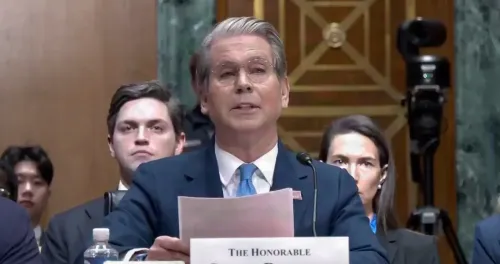
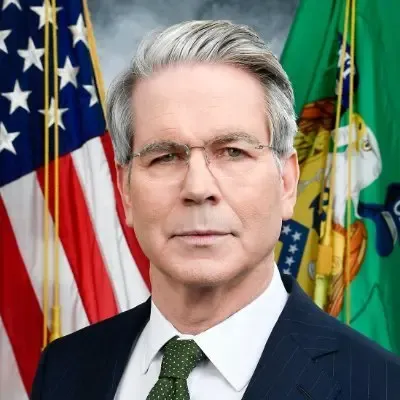
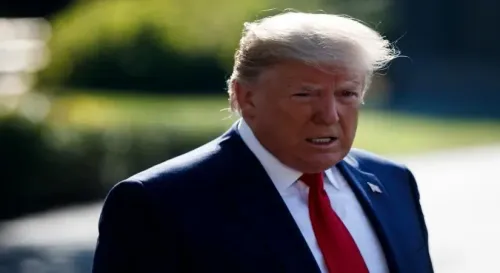
US Treasury Secretary Bessent Critiques Refund Focus as Trump Administration Shifts Tariff Strategy
Synopsis
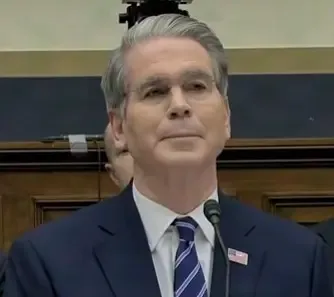
In a recent interview, US Treasury Secretary Scott Bessent downplayed the importance of potential refunds from invalidated emergency tariffs, emphasizing a shift towards new tariff authorities. He stressed that the Supreme Court's ruling was narrowly focused, allowing the administration to maintain its revenue forecasts.
Key Takeaways
Supreme Court ruling is narrow , focusing on presidential authority under IEEPA.
Refunds are uncertain and await lower court decisions.
Section 232 and Section 301 tariffs remain active tools for the administration.
Section 122 tariffs introduced temporarily for 150 days.
Trade deficits have seen a significant reduction, particularly with China.
Washington, Feb 23 (NationPress) US Treasury Secretary Scott Bessent has shifted focus from the potential refund of nearly $134 billion collected under the now-invalidated emergency tariffs, emphasizing that the Supreme Court's verdict was "very narrow". He stated that the administration is promptly moving towards new tariff authorities, ensuring that the revenue forecasts for 2026 remain "unchanged".
In a recent CNN interview, Bessent dismissed the notion that refunds are the primary concern following the Supreme Court's 6-3 decision against President Donald Trump's invocation of the International Emergency Economic Powers Act (IEEPA) for implementing extensive tariffs.
He remarked: "Let’s clarify this. The Supreme Court's ruling is a very confined interpretation of the President's IEEPA authority regarding tariffs."
He pointed out that alternative mechanisms are still in place.
"We possess other tariff authorities that are operational, including Section 232 and Section 301 tariffs," he noted.
The CNN interviewers persistently inquired whether importers would receive refunds.
Bessent maintained that the Trump administration would await judicial guidance before proceeding.
"The Supreme Court did not even rule on that," he explained, adding that the case has been "remanded... back to a lower court" and that it could take "weeks or months" for a resolution.
"It’s not a decision for the administration," Bessent stated, insisting that "it is for the lower court to decide".
When the CNN referenced earlier Justice Department advice indicating that refunds might follow if tariffs were deemed unlawful, Bessent responded: "Once more, I’m not going to speculate ahead of the court's ruling. We will adhere to the court’s direction."
He reiterated that the broader agenda of the US administration remains intact.
"The President and the administration are resolute in bringing back American manufacturing and addressing significant trade imbalances," Bessent affirmed, adding, "We will immediately implement Section 122 tariffs, and the revenue forecasts for the US Treasury for 2026 remain unchanged."
President Trump has proposed a global tariff under Section 122 of the Trade Act of 1974, starting at 10 percent and later increased to 15 percent.
Bessent characterized the Section 122 initiative as temporary.
"This Section 122 authority is effective for 150 days," he mentioned.
During this period, the Treasury Secretary expressed confidence that the Commerce and US Trade Representative Departments would develop more permanent tariffs under alternative authorities.
"During this phase, we will conduct a study on Section 232... and Section 301," Bessent said, adding: "It is very probable that these studies will lead to increased 232 and 301 tariffs, allowing us to revert to previous tariff levels."
He also indicated that the new global tariff serves as a "bridge" rather than a long-term policy requiring Congressional approval for continuation.
"The 122 is likely a five-month bridge... and I firmly believe it is highly likely that those tariffs will escalate and that the 122 tariffs could cease after five months," Bessent concluded.
Bessent contested CNN's interpretation of the Supreme Court's message regarding executive authority.
"What the Supreme Court ruled is that the President cannot utilize the IEEPA.... to achieve this," Bessent remarked, adding that "the President still has other authorities available."
He found it "very intriguing" that the court limited tariff revenue collection yet preserved broader Presidential powers.
"It is fascinating that the Supreme Court stated the President cannot collect even a dollar in revenue through tariffs, yet he retains the ability to impose a full embargo," Bessent commented.
"They reaffirmed his capacity to halt all trade, while he cannot accept any revenue from it."
Claiming successes from the US administration’s trade policies, Bessent said: "We have witnessed a 17 percent decrease in the goods sector deficit with our trading partners."
He continued: "Our bilateral deficit with China has significantly reduced," and noted that the United States is "witnessing trillions in investments returning to the US due to the tariffs."
Point of View
The comments made by Treasury Secretary Bessent reflect a strategic pivot by the Trump administration in handling tariffs and trade policies. The emphasis on new tariff authorities alongside clarifications regarding refunds indicates a proactive approach in reshaping economic strategies, prioritizing long-term objectives over immediate concerns.
NationPress
27 Sept 2026
Frequently Asked Questions
What did the Supreme Court ruling entail?
The Supreme Court ruled against President Trump's use of the IEEPA for imposing extensive tariffs, providing a narrow interpretation of presidential authority regarding tariffs.
Will importers receive refunds for the tariffs?
Treasury Secretary Bessent indicated that the decision on refunds is contingent upon the lower court's ruling, and the administration will not act without judicial guidance.
What are Section 232 and Section 301 tariffs?
Section 232 and Section 301 tariffs are alternative tariff authorities that the administration plans to utilize to address trade imbalances and protect American industries.
How long will the Section 122 tariffs last?
The Section 122 tariffs are set to be effective for 150 days, during which further studies and assessments will be conducted.
What has been the impact of the tariffs on trade deficits?
According to Bessent, the goods sector deficit with trading partners has decreased by 17%, and there has been a notable reduction in the bilateral deficit with China.