Is Jamaat Distorting History Ahead of the Elections in Bangladesh?
Synopsis
As political tensions rise in Bangladesh ahead of the February 12 elections, the BNP accuses Jamaat-e-Islami of historical distortion. This article explores the claims and counterclaims between parties, shedding light on the potential implications for the nation.
Key Takeaways
The BNP accuses Jamaat of historical manipulation.
Political tensions are escalating in Bangladesh.
Controversial remarks on women's rights spark national outrage.
The upcoming elections are a focal point for these disputes.
Power struggles among political parties intensify as the election date nears.
Dhaka, Feb 3 (NationPress) As political disputes escalate in the lead-up to Bangladesh's February 12 elections, the Bangladesh Nationalist Party (BNP) has accused the radical Islamist organization Jamaat-e-Islami of manipulating historical facts. They cautioned that Jamaat might eventually claim that Ghulam Azam, the former leader of Jamaat, was the one who declared the nation's independence, according to local media.
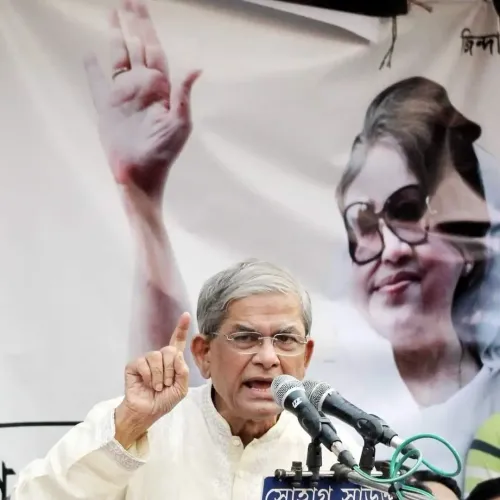
During an event in Dhaka, BNP Senior Joint Secretary General Ruhul Kabir Rizvi raised concerns about Jamaat's intentions behind discussing the country's independence declaration.
“When the Pakistani forces committed atrocities against our mothers and sisters, you (Jamaat) failed to label those actions as oppression. You did not even recognize those brutalities as crimes. Instead, you endorsed and supported them,” quoted the BNP leader by Bangladeshi media outlet UNB.
In response to remarks made by Jamaat chief Shafiqur Rahman regarding the 1971 independence declaration in Chattogram, Rizvi stated, “Soon, you may even claim that Ghulam Azam himself proclaimed independence. You can say that too, as you never hesitate to fabricate lies.”
The BNP leader suggested that Shafiqur Rahman's focus on the independence declaration was an attempt to divert attention from his controversial and derogatory comments about women, which have provoked national outrage.
On the previous day, BNP Chairman Tarique Rahman vehemently criticized Jamaat for its disparaging remarks about women, stating that such views threaten women's safety and fundamental rights in the nation, as reported by local media.
This controversy arose after Shafiqur Rahman recently posted on the social media platform X, asserting that women forced out of their homes in the name of modernity face exploitation, moral decay, and insecurity, labeling it as “another form of prostitution,” which ignited widespread condemnation.
“Those who disrespect the women of our country and use derogatory language against them cannot be considered patriotic or people-oriented. A political party aims to confine mothers and sisters to their homes prior to the elections, making scandalous comments about their employment. The people of this country are at risk from those who cannot even respect their own women,” quoted Bonik Barta, a Bengali daily, with Tarique addressing a rally in Khulna.
Bangladesh is currently experiencing rising political tensions as the February 12 election approaches.
Parties that previously collaborated with the interim government's Chief Advisor Mohammad Yunus to unseat the democratically elected government of the Awami League, led by Sheikh Hasina, are now engaged in a fierce power struggle for the upcoming election.
Point of View
It is crucial to remain impartial while reporting on the escalating political tensions in Bangladesh. The accusations between BNP and Jamaat are significant, reflecting deeper societal issues and the challenges faced by the nation as it prepares for its upcoming elections. This situation warrants close attention as it unfolds.
NationPress
20 Sept 2026
Frequently Asked Questions
What accusations has the BNP made against Jamaat-e-Islami?
The BNP has accused Jamaat-e-Islami of distorting history, specifically claiming that they might assert Ghulam Azam declared Bangladesh's independence.
What was the context of Jamaat's comments on women's issues?
Jamaat's chief made derogatory remarks regarding women, which were criticized by BNP leaders for threatening women's rights and safety.
What are the political implications of these accusations?
These accusations highlight the intense political rivalry in Bangladesh and could influence voter sentiment ahead of the February 12 elections.