South Korea FM Cho Hyun seeks bipartisan support before exit
Synopsis
Outgoing South Korean Foreign Minister Cho Hyun used what may be his last parliamentary appearance to plead for bipartisan support for President Lee Jae Myung's summit diplomacy. His successor, security official Lim Woong-soon, now awaits a confirmation hearing amid a broader five-post reshuffle that also brings in a new spy chief.
Key Takeaways
Foreign Minister Cho Hyun urged bipartisan support for South Korea's foreign policy on 26 November 2026 .
The remarks came at the National Assembly's foreign affairs and unification committee , possibly his final appearance there.
Lim Woong-soon , second deputy director of the National Security Office, has been nominated as his successor; his confirmation hearing date is yet to be set.
President Lee Jae Myung 's reshuffle on Monday also named Kang Kum-sil as NIS chief, Hong Ihk-pyo as unification minister, Han Jun-ho as interior minister and Kang Yu-jung as culture minister.
Cho took office in July last year as the administration's first foreign minister.
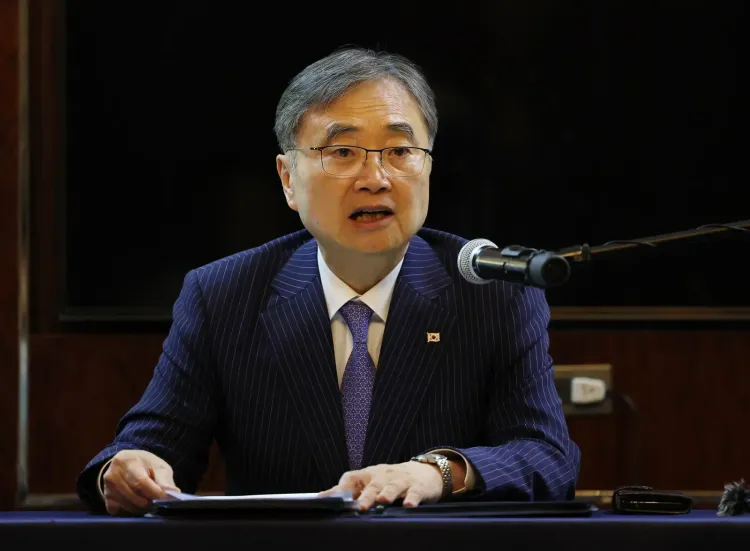
South Korean Foreign Minister Cho Hyun on Thursday, 26 November 2026, urged lawmakers across party lines to keep backing the government's foreign policy, in what could be his final appearance before a parliamentary panel in Seoul. His remarks came days after President Lee Jae Myung nominated Lim Woong-soon, second deputy director of the National Security Office, as his successor.
Cho's Farewell Appeal to Lawmakers
Cho spoke during a plenary session of the National Assembly's foreign affairs and unification committee. He reflected on his tenure as the first top diplomat of the current administration.
“I feel greatly honoured to have been able to contribute to the development of South Korea's diplomacy as the first foreign minister of the (Lee Jae Myung) administration,” Cho said.
Citing an increasingly challenging international environment, Cho called on committee members to continue offering bipartisan support for the administration, according to reports. He singled out its summit diplomacy, which he said had recently been delivering significant results.
Cho took office in July last year and has served as South Korea's top diplomat since then.
Successor Prepares for Confirmation Hearing
Lim, the foreign minister nominee, was scheduled to begin work at a designated office on Thursday to prepare for his confirmation hearing. The date of that hearing has yet to be set.
Notably, the nomination places a senior national security official at the helm of the foreign ministry. This signals continuity between the presidential security apparatus and the country's diplomatic establishment.
Wider Cabinet Reshuffle by President Lee
On Monday, President Lee named Lim as foreign minister and former Justice Minister Kang Kum-sil as the new chief of the National Intelligence Service (NIS). The reshuffle also affected three other ministerial posts, the president's chief of staff told a press briefing.
Lee tapped former lawmaker Hong Ihk-pyo as unification minister, ruling Democratic Party Representative Han Jun-ho as interior minister, and senior presidential spokesperson Kang Yu-jung as culture minister.
What the Presidential Office Said
Chief of staff Lim Kwang-hyun said the changes were aimed at renewing the government's energy and improving delivery.
“This reshuffle was centred on injecting vitality into state affairs through new and fresh leadership for the future, and enhancing the speed and execution of state affairs, as well as the degree to which it is felt by the people,” he said.
“In a rapidly changing international order, we will seek to attain maximum results from pragmatic diplomacy and take the lead on opening the path to peaceful coexistence on the Korean Peninsula, while firmly protecting the people's safety and swiftly pushing for grand transformations felt by the people, including growth led by regions and a leap toward a cultural powerhouse,” he added.
Why It Matters
Cho's appeal for bipartisan backing underscores how central summit diplomacy has become to the Lee administration's agenda. A change at the foreign ministry, combined with a new spy chief and a new unification minister, reshapes the team handling South Korea's external and inter-Korean affairs at once.
All eyes now turn to Lim's confirmation hearing, where lawmakers are expected to scrutinise how he plans to carry forward the administration's pragmatic diplomacy agenda.
Point of View
Which may speed decisions but narrows independent ministerial voice. Swapping the foreign minister, spy chief and unification minister together is a significant reset of the team handling the Korean Peninsula. For India, which is deepening ties with Seoul, the continuity of that pragmatic line under Lim is worth watching closely.
NationPress
26 Nov 2026
Frequently Asked Questions
Who is replacing Cho Hyun as South Korea's foreign minister?
Lim Woong-soon, second deputy director of the National Security Office, has been nominated by President Lee Jae Myung to succeed Cho Hyun. His confirmation hearing date has not yet been set.
What did Cho Hyun say in his likely final parliamentary appearance?
Cho called on lawmakers to continue providing bipartisan support for the government's foreign policy, especially its summit diplomacy. He said he felt greatly honoured to have served as the first foreign minister of the Lee Jae Myung administration.
Which other posts changed in President Lee Jae Myung's reshuffle?
Former Justice Minister Kang Kum-sil was nominated as NIS chief, Hong Ihk-pyo as unification minister, Han Jun-ho as interior minister and Kang Yu-jung as culture minister. The reshuffle was announced on Monday.
Why did the South Korean government carry out the reshuffle?
Chief of staff Lim Kwang-hyun said the reshuffle aimed to inject vitality into state affairs through new leadership and improve the speed and execution of policy. He also cited pursuing pragmatic diplomacy and peaceful coexistence on the Korean Peninsula.
When did Cho Hyun become South Korea's foreign minister?
Cho Hyun took office in July last year. He served as the first foreign minister under President Lee Jae Myung's administration.