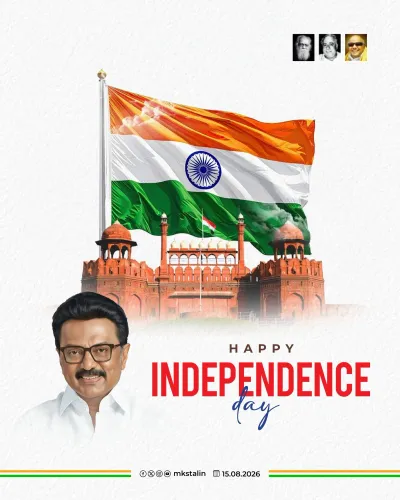
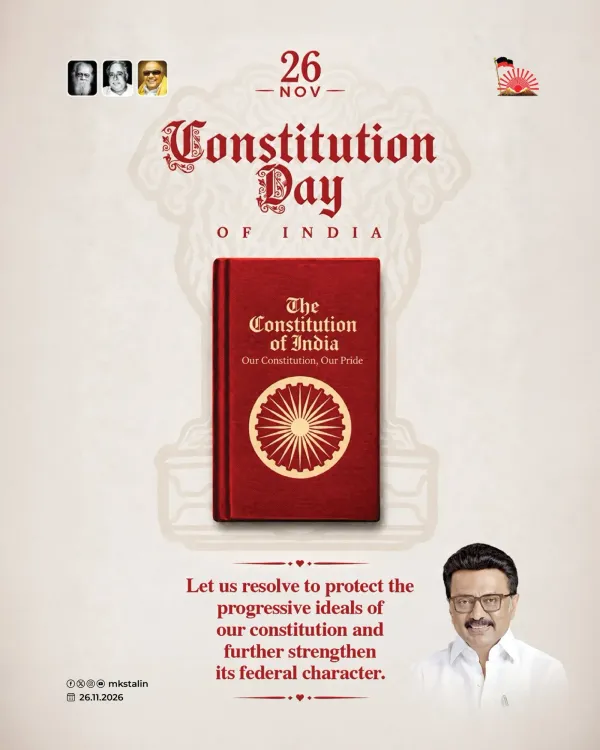
DMK president Stalin seeks federal review on Constitution Day
Synopsis
On Constitution Day, DMK president M. K. Stalin invoked Ambedkar's living Constitution and demanded a comprehensive review to make India truly federal. He said the High-Level Committee on Union-State Relations headed by Justice Kurian Joseph was disbanded, but the DMK's fight for State autonomy would continue.
Key Takeaways
Stalin on 26 November 2026 marked Constitution Day by calling for a comprehensive review to make India truly federal.
He said India adopted a progressive Constitution on 26 November 1949 that guaranteed equality and laid the foundation for social justice.
Stalin cited Babasaheb Dr.
Ambedkar 's vision of the Constitution as a living document that evolves with society.
He said the Dravidian Model government set up a High-Level Committee on Union-State Relations headed by retired Supreme Court Justice Kurian Joseph .
He said present rulers had chosen to disband the committee and pledged that the DMK's crusade for State autonomy and genuine federalism would continue.
The demand continues a DMK line that includes the 1969 Rajamannar Committee on Centre-State relations.
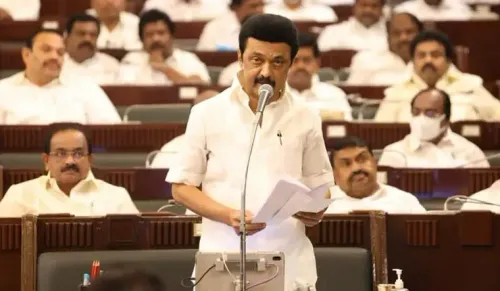
On Constitution Day, DMK president M. K. Stalin turned a 26 November ritual into a federalism argument: after 75 years, he said, India still needs a comprehensive review of its charter to become truly federal. In a post on 26 November 2026, he recalled the 1949 adoption of a progressive Constitution, invoked Babasaheb Dr. B.R. Ambedkar, and said Tamil Nadu's High-Level Committee on Union-State Relations had been disbanded even as the DMK's crusade for State autonomy would continue.
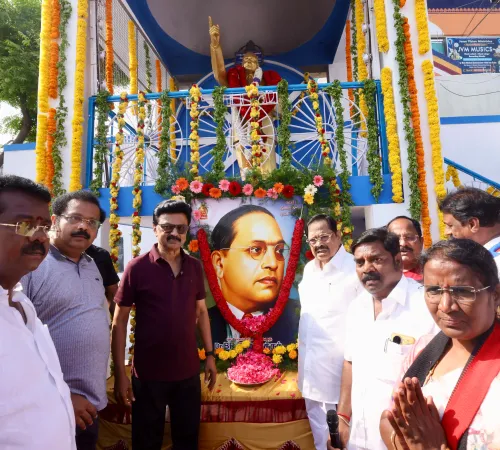
Stalin wrote that on this day in 1949, India adopted a remarkably progressive Constitution that guaranteed equality and laid the foundation for social justice in a society riddled with centuries of inequalities. Ambedkar, he said, envisioned the Constitution as a living document, evolving with the changing needs and aspirations of society.
A living document, and a demand to review it
That living-document claim is the lever. After 75 years of the constitutional journey, Stalin argued, a comprehensive review is imperative to make India truly federal. Equality and social justice, in this telling, are incomplete without a more genuine federal Union.
He said it was with this objective that the Dravidian Model government constituted the High-Level Committee on Union-State Relations, headed by retired Supreme Court Justice Kurian Joseph. He then drew a sharp line: 'Though the present rulers have chosen to disband the Committee, the DMK's crusade for State autonomy and genuine federalism will continue.'
Justice Kurian Joseph and the Union-State panel
The committee, as Stalin described it, was a state-level instrument to examine Union-State relations. He did not specify when it was set up or when it was wound up. What he put on the public record is the political charge — that present rulers chose to disband it — and the pledge that the campaign for State autonomy survives the panel.
On this Constitution Day, he asked the country to resolve to protect the progressive ideals of the Constitution and further strengthen its federal character. The anniversary, in his framing, is a test of whether the charter's federal promise is still being honoured.
The Rajamannar thread from 1969
This is not a new DMK refrain. In 1969, a Tamil Nadu government constituted the Rajamannar Committee to review Centre-State relations and suggest greater autonomy for states. That inquiry became a reference point for regional parties that have long argued India's constitutional design leans too far toward the Centre.
Stalin's 2026 message places that older demand inside Ambedkar's language. If the Constitution is a living document, the argument runs, then Centre-State balance can be revisited without betraying 1949. State governments and regional parties remain the core audience for that claim; tensions over the distribution of powers have been a recurring feature of Indian politics.
Constitution Day comes every 26 November. The DMK has now tied the anniversary, once again, to an unfinished fight over who holds power in the Union.
Point of View
Not a breach of 1949. Naming the Kurian Joseph committee and charging that present rulers disbanded it keeps the fight specific and unfinished. The through-line from the 1969 Rajamannar exercise remains the party's claim that India's design is still too centralised for genuine federalism.
NationPress
26 Nov 2026
Frequently Asked Questions
What did MK Stalin say on Constitution Day 2026?
DMK president M. K. Stalin said India still needs a comprehensive constitutional review to become truly federal, invoked Ambedkar's living document, and pledged that the DMK's fight for State autonomy would continue after what he called the disbanding of a Union-State relations committee.
When did India adopt its Constitution?
India adopted its Constitution on 26 November 1949, the date now marked each year as Constitution Day. Stalin's 2026 message treated that anniversary as the moment to demand a federal review after 75 years of the constitutional journey.
Who headed Tamil Nadu's High-Level Committee on Union-State Relations?
Stalin said the committee was headed by retired Supreme Court Justice Kurian Joseph. He described it as a body set up by the Dravidian Model government to examine Union-State relations and push genuine federalism.
What is the Rajamannar Committee?
The Rajamannar Committee was constituted by a Tamil Nadu government in 1969 to review Centre-State relations and suggest greater autonomy for states. It remains a reference point for the DMK's longer campaign on federalism.
Why is the DMK demanding more federalism?
The DMK has argued since the 1960s that India's constitutional framework is overly centralised and that states need greater autonomy. Stalin linked that demand to Ambedkar's idea of a living Constitution that should evolve with society's needs.