Shivraj Singh Chouhan: Modi govt redefined Indian agriculture
Synopsis
Union Agriculture Minister Shivraj Singh Chouhan on 13 June 2026 shared a Jagran News article contending that under the Modi government, Indian agriculture has expanded beyond production to encompass farmer prosperity, risk protection, nutrition security, green technology, and rural development — anchored by schemes such as PM-KISAN and PMFBY.
Key Takeaways
Union Agriculture Minister Shivraj Singh Chouhan shared a Jagran News article on 13 June 2026 reframing Indian agriculture under the Modi government.
He argued agriculture now covers farmer prosperity, risk protection, nutrition security, green technology, and rural development — not just production.
PM-KISAN provides ₹6,000 per year in direct income support to eligible farmer families since February 2019 .
Pradhan Mantri Fasal Bima Yojana (PMFBY) , launched in 2016 , offers crop insurance against weather and yield losses.
Other pillars include the Soil Health Card scheme (2015), e-NAM (2016), and nutrition-linked programmes such as Poshan Abhiyan .
The post signals a narrative-consolidation phase ahead of upcoming Union Budget discussions on agriculture allocations.
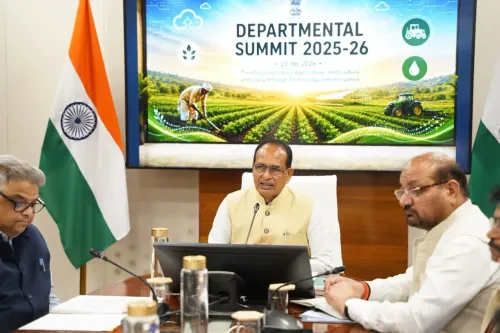
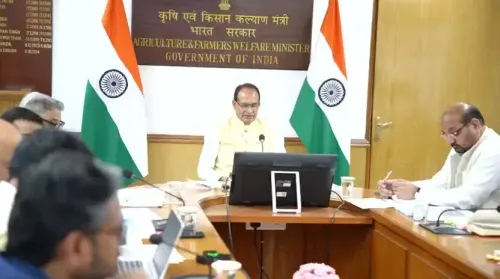
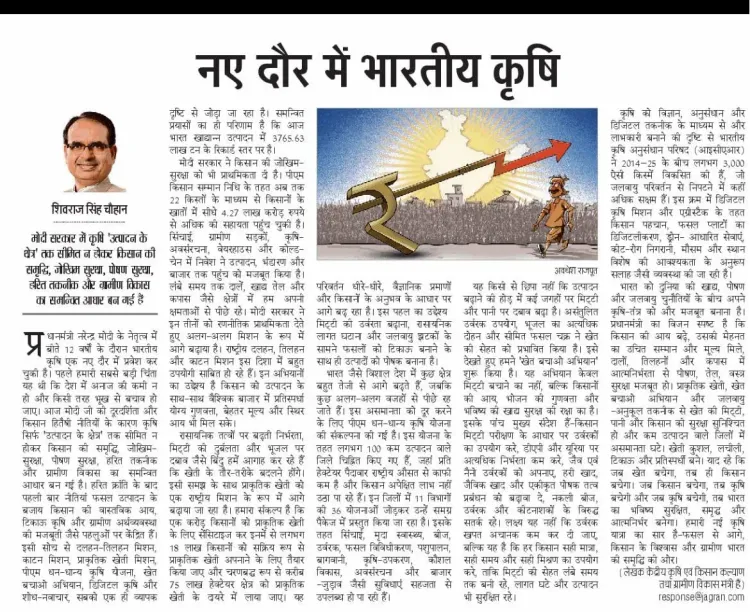
Union Agriculture Minister Shivraj Singh Chouhan on Saturday, 13 June 2026, shared an article published in the Hindi daily Jagran News, arguing that under the Modi government, Indian agriculture has evolved well beyond a mere production sector into an integrated framework encompassing farmer welfare, risk protection, nutrition security, green technology, and rural development.
Context
In his post, Chouhan wrote — 'मोदी सरकार में कृषि उत्पादन क्षेत्र तक सीमित न होकर किसान की समृद्धि, जोखिम सुरक्षा, पोषण सुरक्षा, हरित तकनीक और ग्रामीण विकास का समन्वित आधार बन गई हैं' — translating to: 'Under the Modi government, agriculture has not remained confined to the production sector but has become a coordinated foundation for farmer prosperity, risk protection, nutrition security, green technology, and rural development.' He urged followers to read the full article in Jagran News.
The post reflects a broader communication effort by the Ministry of Agriculture and Farmers Welfare to frame the government's farm-sector record ahead of upcoming budget discussions. Chouhan, a four-term former Chief Minister of Madhya Pradesh, has consistently positioned agriculture as central to the BJP's rural outreach since assuming charge of the ministry.
Policy Backdrop
The argument Chouhan amplifies rests on a cluster of flagship schemes launched since 2014. The Pradhan Mantri Kisan Samman Nidhi (PM-KISAN), rolled out in February 2019, provides an annual direct income support of ₹6,000 to eligible farmer families, addressing welfare beyond yield metrics. The Pradhan Mantri Fasal Bima Yojana (PMFBY), introduced in 2016, offers crop insurance against weather and yield shocks, directly targeting the risk-protection dimension Chouhan highlights.
Earlier interventions include the Soil Health Card scheme launched in 2015 to promote balanced fertiliser use and sustainable farming, and the e-NAM platform introduced in 2016 to integrate agricultural mandis into a single national electronic trading network. Together these schemes operationalise the 'coordinated foundation' framing the minister invokes.
The government has also linked farm-level programmes to nutrition outcomes through initiatives such as Poshan Abhiyan, and has pushed green-technology adoption as part of a climate-resilience agenda — both pillars explicitly named in Chouhan's post.
Stakeholders and Impact
Small and marginal farmers, who constitute the overwhelming majority of India's agricultural households, are the primary intended beneficiaries of this policy architecture. Direct cash transfers under PM-KISAN and subsidised insurance premiums under PMFBY are designed to reduce the financial vulnerability of this segment in particular.
Rural households more broadly stand to benefit from the rural-development dimension — encompassing infrastructure, market linkages, and nutrition programmes — that the minister's framing explicitly includes within the agriculture policy umbrella. Critics and opposition parties have, in other forums, questioned whether on-ground income gains have kept pace with scheme outlays, though Chouhan's post does not address those debates.
What's Next
Attention will now turn to the next Union Budget allocations for agriculture and allied schemes, where the government will be expected to back its welfare-first narrative with spending commitments. Parliamentary discussions on updated mission-mode programmes for climate-resilient and nutrition-sensitive farming are also anticipated.
Chouhan's decision to amplify a newspaper article — rather than announce a new policy — signals a phase of consolidation and narrative-setting, suggesting the ministry is building a public case for its record as the budget cycle approaches.
Point of View
Using an op-ed platform to cement the BJP's 'welfare-first agriculture' brand before parliamentary scrutiny of scheme allocations intensifies. By cataloguing five distinct policy pillars — prosperity, risk, nutrition, green tech, rural development — the minister is effectively widening the scorecard on which the government's farm record will be judged, making a pure production-yield critique harder to land. The move also reinforces Chouhan's own ministerial identity as a farmer-champion, drawing on his long political capital from Madhya Pradesh's agricultural belt. Whether the framing translates into fresh budgetary commitments or remains rhetorical will be the real test in the months ahead.
NationPress
29 Jul 2026
Frequently Asked Questions
What did Shivraj Singh Chouhan say about agriculture under the Modi government?
Chouhan shared a Jagran News article on 13 June 2026 arguing that under the Modi government, Indian agriculture has moved beyond mere production to become a coordinated foundation for farmer prosperity, risk protection, nutrition security, green technology, and rural development.
What is PM-KISAN and how does it help farmers?
PM-KISAN (Pradhan Mantri Kisan Samman Nidhi) is a scheme launched in February 2019 that provides ₹6,000 per year in direct income support to eligible farmer families, aiming to supplement farm income and reduce financial distress.
What is the Pradhan Mantri Fasal Bima Yojana?
The Pradhan Mantri Fasal Bima Yojana (PMFBY) is a crop insurance scheme introduced in 2016 that protects farmers against financial losses caused by weather events and yield shortfalls, addressing risk protection for agricultural households.
Who is Shivraj Singh Chouhan?
Shivraj Singh Chouhan is the Union Minister of Agriculture and Farmers Welfare and Rural Development in the Modi government. He is a senior BJP leader and served four terms as Chief Minister of Madhya Pradesh before joining the Union Cabinet.
What schemes has the Modi government launched for farmers?
Key schemes include PM-KISAN (₹6,000 annual direct transfer, 2019), Pradhan Mantri Fasal Bima Yojana for crop insurance (2016), the Soil Health Card scheme for sustainable farming (2015), and e-NAM for electronic mandi trading (2016).