Was There Really a Disagreement Over the Tariff War in the Trump Administration?
Synopsis
In a revealing series of interviews, Chief of Staff Susie Wiles discusses the significant disagreements within the Trump administration regarding the tariffs war. Despite pushback from advisers, Trump moved forward, leading to unforeseen consequences. Wiles sheds light on the internal conflicts, revealing the complex dynamics of governance during this contentious period.
Key Takeaways
Internal Disagreement: Significant conflicts existed among Trump's advisors regarding tariffs.
Economic Impact: The tariffs led to unexpected economic consequences.
Advisors' Pushback: Key advisors attempted to prevent Trump from moving forward with tariffs.
Future Speculation: Wiles dismisses the notion of Trump running for a third term.
Critique of Musk: Wiles expressed strong opinions about Elon Musk's influence on government policies.
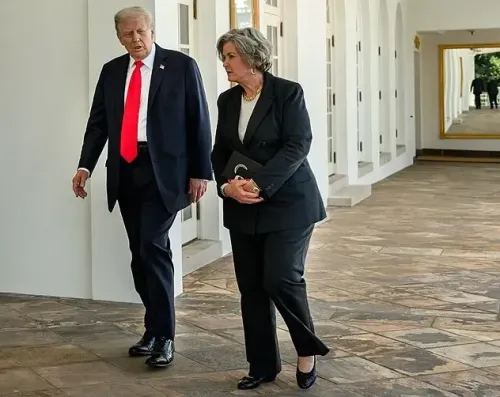
New York, Dec 17 (NationPress) According to Chief of Staff Susie Wiles, a significant disagreement in the Trump administration cast a shadow over the tariffs war initiated by US President Donald Trump, and neither she nor Vice President JD Vance could deter him from proceeding. Wiles noted that the tariffs war lacked proper planning, and Trump’s assertions that it would bolster the nation’s finances without burdening consumers were merely speculative thoughts, as she expressed candidly in interviews with Vanity Fair published on Tuesday.
She acknowledged it was “more painful than anticipated”.
Wiles revealed that there was a significant divide among Trump’s advisors regarding the efficacy of the tariffs, yet Trump chose to move forward anyway. As he prepared to announce tariffs, ranging from 10% to 100% on April 2, which he dubbed “Liberation Day,” Wiles stated that she and Vice President Vance attempted to slow him down.
“We advised Donald Trump, ‘Hey, let’s not discuss tariffs today. Let’s wait until our team is fully united before proceeding’,” she recounted.
However, Trump ignored their counsel and moved ahead with what he termed reciprocal tariffs, only pausing for 90 days when the stock market plummeted, causing turmoil in the bond market.
While some viewed the tariffs as a potential solution, others feared they would lead to disaster, according to the magazine.
Trump then reinstated the tariffs, imposing a 25% tariff on India and an additional punitive tariff of 25% for purchasing Russian oil.
Another rift in the administration exists between mercantilists, who prioritized treasury gains, and geostrategists, who were concerned about the political and diplomatic repercussions.
For instance, regarding India, while Trump’s trade advisor Peter Navarro, Treasury Secretary Scott Bessent, and Commerce Secretary Howard Lutnick criticized the nation and exacerbated the tariff standoff, the departments led by War Secretary Pete Hegseth and Secretary of State Marco Rubio maintained close defense and diplomatic cooperation, particularly with the looming presence of China.
Wiles expressed her belief that a balanced approach on tariffs would ultimately prevail.
In a series of 11 interviews conducted over several months, her candid remarks regarding individuals and policies were notably unusual for a Chief of Staff and cabinet member.
While she did not dispute the accuracy of the quotes in the articles, she mentioned in a post on X that they were presented without full context, aiming to create “an overwhelmingly chaotic and negative narrative” about Trump and his administration.
Trump has hinted at a possible third term run, which is constitutionally prohibited.
Wiles dismissed this notion, stating that “100 percent” he will not run again, suggesting he is merely “having fun” discussing it and “driving people crazy.”
Wiles also criticized Elon Musk, the eccentric billionaire brought in by Trump for government efficiency.
She described him as “an odd, odd duck” and noted his use of the mind-altering drug ketamine.
Additionally, she expressed her shock at Musk's abrupt closure of USAID, the international aid organization of the US government that she claimed did “very good work.”
“No rational person could believe the USAID shutdown was justified,” she stated.
Wiles attempted to prevent Trump from granting pardons to individuals convicted of violence during the January 6, 2021, Capitol riot, where his supporters claimed the 2020 elections were “stolen.”
Despite her efforts, Trump proceeded with the pardons.
She also sought to moderate Trump’s actions against political adversaries.
“We had a loose agreement that retribution would cease before the first 90 days were over,” she stated.
However, some instances of retribution extended beyond that timeframe.
She acknowledged that there “may be an element” of retribution at times, adding, “Who could blame him? Not me.”
Point of View
Susie Wiles' insights provide a rare glimpse into the internal dynamics of the Trump administration. Her candid comments reflect the complexity of policy-making in a highly charged political environment, showcasing the challenges faced by leaders in balancing various interests and the implications of their decisions. This narrative underscores the importance of open dialogue and consensus in governance.
NationPress
2 Oct 2026
Frequently Asked Questions
What was the main disagreement in the Trump administration regarding tariffs?
There was a significant divide among Trump's advisors on whether the tariffs were a good idea, as revealed by Chief of Staff Susie Wiles.
Did Trump follow his advisors' recommendations on tariffs?
Despite advice from Wiles and Vice President JD Vance to postpone the announcement, Trump proceeded with the tariffs.
What were the consequences of the tariffs imposed by Trump?
The tariffs led to economic challenges, including stock market declines and concerns over their long-term impact on international relations.
How did Wiles react to Trump's decision-making process?
Wiles expressed frustration and noted that the tariffs were more painful than anticipated, indicating significant internal disagreement.
What did Wiles say about Trump potentially running for a third term?
Wiles stated that Trump is '100 percent' not running again and is merely enjoying the speculation.