Ulle Madise sworn in as Estonia's president, succeeding Alar Karis
Synopsis
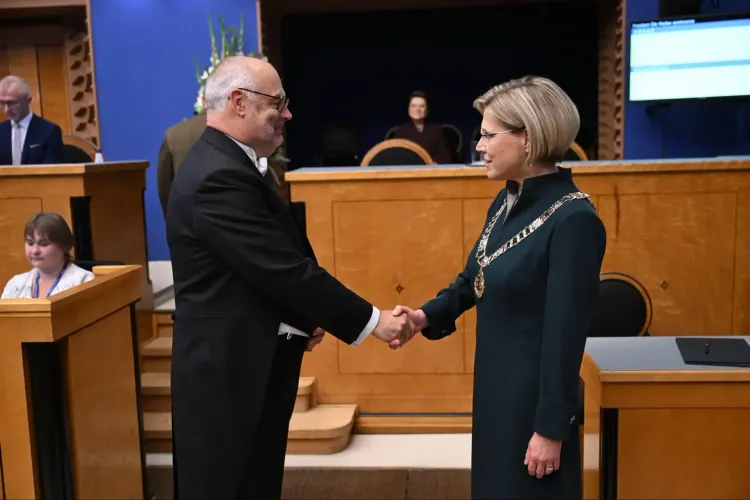
Estonia has a new president: Ulle Madise, a legal scholar and long-serving Chancellor of Justice, was sworn in on 12 October in Tallinn, becoming the country's second female head of state. Her inaugural address struck a firm note on national defence, continued Ukraine support, and Baltic-Nordic alliance solidarity — signalling foreign policy continuity in a region on high alert.
Key Takeaways
Ulle Madise was sworn in as Estonia's president on 12 October 2026 at the Riigikogu in Tallinn .
She succeeds Alar Karis and is Estonia's sixth president since independence and its second female president .
Madise was elected on 2 September with 71 votes , clearing the constitutional minimum of 68 out of 101 members.
She previously served as Chancellor of Justice since 2015 and as a legal adviser to the Estonian president.
Her inaugural address called for stronger national defence , continued Ukraine support , and closer ties with Baltic, Nordic, and Polish allies.
Estonia's newly elected President Ulle Madise was sworn into office on Monday, 12 October 2026, at the Riigikogu building in the capital Tallinn, succeeding Alar Karis as the country's head of state. The ceremony marks a historic moment: Madise becomes Estonia's second female president and the country's sixth president since the restoration of independence.
Election and Constitutional Threshold
Madise, 51, was elected president on 2 September after securing 71 votes in the Estonian parliament, clearing the constitutional requirement of at least two-thirds of the 101-member Riigikogu — a minimum of 68 votes. Prior to her election, she had served as a legal adviser to the Estonian president and held the post of Chancellor of Justice since 2015.
Key Themes of the Inaugural Address
In her inaugural speech, Madise said every person in Estonia should feel valued for who they are and for their lives, work, and creativity. She stressed that all people should feel they belong in the country, regardless of their interests, views, lifestyles, tastes, or native languages — a notably inclusive framing in a nation with a substantial Russian-speaking minority.
She argued that Estonia's ability to preserve its national identity and continue developing would depend on mutual trust, hope for the future, and courage.
Security, Ukraine, and Regional Alliances
Against the backdrop of ongoing global instability, Madise called for calm, stronger national defence, and continued support for Ukraine. She underscored the importance of closer cooperation with allies in the Baltic and Nordic countries, as well as Poland — signalling continuity with Estonia's firmly Atlanticist foreign policy posture under her predecessor.
She warned against allowing fear and pessimism to take hold, stating that fear clouds judgment and leads to unwise decisions. She urged the public to recognise and wisely seize major opportunities in times of uncertainty, framing the future as something people shape themselves rather than a predetermined bleak outcome.
About Estonia's Presidency and Parliament
The Riigikogu is Estonia's unicameral parliament, comprising 101 members directly elected by the people every four years through proportional representation. Under the Estonian constitutional system, the president is primarily a ceremonial head of state, though the office carries significant weight in shaping national discourse and foreign policy messaging. Estonia is a member of both NATO and the European Union, and its presidency has historically been closely watched by Baltic neighbours and Western allies alike.
Madise's assumption of office comes at a time of heightened security concerns in Northern Europe, and her emphasis on defence and alliance solidarity is expected to define the early months of her term.
Point of View
But carries outsized influence in shaping how the country narrates its place in a contested neighbourhood. Her emphasis on inclusion, particularly around language and identity, is a quiet but significant domestic signal in a country where Russian-speaking residents have long occupied an uneasy political space. Whether that rhetoric translates into policy momentum under the cabinet will be worth watching.
NationPress
12 Oct 2026
Frequently Asked Questions
How was Ulle Madise elected as president of Estonia?
Madise was elected on 2 September by the Riigikogu, Estonia's 101-member parliament, receiving 71 votes — above the constitutional minimum of 68, or two-thirds of parliament. Under Estonia's constitution, the president is chosen by parliament rather than by direct popular vote.
Who did Ulle Madise succeed as Estonia's president?
Madise succeeded Alar Karis as Estonia's head of state. Karis had served as president since 2021.
What did Madise say in her inaugural address?
Madise called for every person in Estonia to feel valued and to feel they belong, regardless of language or lifestyle. She also stressed the need for stronger national defence, continued support for Ukraine, and closer cooperation with Baltic, Nordic, and Polish allies, while warning against fear and pessimism clouding national judgment.
Why is Madise's election historically significant?
Madise is Estonia's second female president and the country's sixth head of state since the restoration of independence. Her election also comes at a heightened moment of regional security concern in Northern Europe, giving her inaugural foreign policy statements added weight.