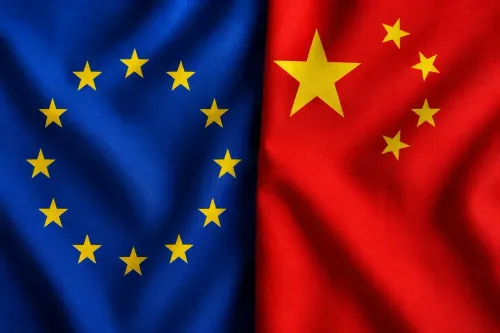
EU scraps duty-free exemption on cheap China imports, flat €3 charge from July

Synopsis
The EU has quietly ended a decades-old customs loophole that let billions of low-value parcels — mostly from China — enter duty-free. A flat €3 charge per declaration line now applies, and with full standard tariffs coming in 2028, the era of €5 hauls from Chinese platforms landing at European doors for nothing is effectively over.
Key Takeaways
The EU has abolished the customs duty-free exemption for goods valued up to €150 , effective July 2025 .
A flat €3 duty per declaration line now applies to all B2C distance sales, regardless of item value.
A €6 order with three products can now cost up to €15 after the flat charges are applied.
Greece's AADE has confirmed implementation; couriers may pass the charge to consumers at delivery.
Product Identifier Codes (PID) are being introduced to curb false declarations on parcel contents.
The flat duty is temporary — from 1 July 2028 , standard EU tariff rates apply to all e-commerce goods.
The European Union has abolished the customs duty-free exemption on low-value imported goods worth up to €150, replacing it with a flat €3 duty per declaration line on all business-to-consumer distance sales. The measure, which took effect starting Wednesday, July 2025, directly targets the surge in low-cost parcels from countries including China and aims to rationalise cross-border e-commerce imports while improving customs transparency.
What the New Duty Means for Shoppers
Under the previous framework, goods valued below €150 entered the EU without attracting any customs duty, a loophole widely exploited by Chinese e-commerce platforms. The new flat-rate duty of €3 per declaration line applies regardless of the item's value, fundamentally altering the economics of low-ticket purchases.
The impact is already visible. A €6 order comprising three different products, for instance, now attracts an additional €9 in flat-rate charges — one €3 levy per declaration line — pushing the total to €15. According to reports, many consumers are cancelling orders upon seeing the revised cost at checkout, indicating an immediate deterrent effect on impulse cross-border purchases.
Who Bears the Responsibility
Responsibility for accurate duty payment rests with the declarant — typically the platform, the seller, or a designated customs representative. Courier companies may pass the €3 charge on to the end consumer, acting as direct or indirect customs representatives. Authorities have clarified that each parcel is treated as a separate shipment for duty purposes.
Notably, where the Import One-Stop Shop (IOSS) system is used for VAT collection at the point of purchase, the process remains simpler: no new liability arises upon delivery, reducing friction for compliant sellers.
Greece and the AADE Announcement
In Greece, the Independent Authority for Public Revenue (AADE) formally announced the change, confirming that customs authorities and economic operators across the EU are already implementing the new framework. Consumers who placed orders before the measure came into force may still face additional charges if their parcels clear customs after 1 July, as couriers may levy the duty at the point of delivery.
Combating False Declarations with Product Identifiers
To address the persistent problem of misdeclared parcel contents — a common tactic used to undervalue shipments — customs authorities are introducing Product Identifier Codes (PID). These codes enable more precise checks and ensure end-to-end traceability of goods. The system will scan codes listed on platforms and in warehouse inventories, according to reports.
Timeline and What Comes Next
The flat €3 duty is a temporary measure, set to remain in force until 1 July 2028. After that date, all e-commerce goods — irrespective of value — will be subject to standard EU tariff rates. The transition is seen as a stepping stone toward full tariff normalisation of the cross-border e-commerce sector, which has grown exponentially on the back of ultra-low-cost Chinese platforms such as Shein and Temu.
Point of View
Not for platforms shipping hundreds of millions of parcels annually. The €3 flat rate is modest enough to avoid a political backlash but significant enough to change consumer behaviour on sub-€10 purchases — precisely the sweet spot of Chinese fast-commerce. The real test comes in 2028, when full standard tariffs kick in; until then, this is a calibrated pressure valve, not a full reckoning.
NationPress
5 Oct 2026
Frequently Asked Questions
What is the new EU customs duty on low-value imports from China?
The EU has replaced the previous duty-free exemption for goods under €150 with a flat €3 duty per declaration line on all B2C distance sales. The measure applies across EU member states and directly affects purchases from countries like China.
When did the new EU flat-rate customs duty come into effect?
The flat €3 duty took effect from Wednesday, July 2025. Orders that clear customs after 1 July are subject to the charge, even if the original purchase was made before the measure was announced.
How does the €3 flat duty affect the cost of cheap online orders?
The duty applies per declaration line, meaning a single order with three different products attracts three separate €3 charges — a total of €9 extra. A €6 order, for example, can end up costing €15 in total.
Is the new EU customs charge permanent?
No. The flat €3 duty is a temporary measure valid until 1 July 2028. After that date, all e-commerce imports will be subject to standard EU tariff rates regardless of their declared value.
What are Product Identifier Codes (PID) and why are they being introduced?
PIDs are unique codes being introduced by EU customs authorities to combat false declarations about parcel contents — a common tactic used to undervalue shipments. The system scans codes listed on platforms and in warehouse inventories to ensure accurate checks and goods traceability.