Anthropic exec Tom Brown: Friends' AI warning sparked a career shift
Synopsis
A casual warning from friends in 2014 — that human-level AI could arrive within 50 years — pulled Tom Brown out of engineering and into the AI race. By 2019, scaling-law research convinced him the timeline was under a decade, not half a century. That realisation directly triggered the founding of Anthropic, now one of the world's most prominent AI safety companies.
Key Takeaways
Tom Brown , a senior executive at Anthropic , says a 2014 conversation with friends about human-level AI prompted him to leave conventional engineering.
Brown joined OpenAI as one of its first 20 employees , initially drawn by personal connections with the founding team.
Groundbreaking AI scaling-law research in 2019 compressed his projected timeline for transformative AI from 50 years to under 10 years .
Anthropic was founded in 2021 by former OpenAI researchers including siblings Dario and Daniela Amodei , with an explicit safety-first mandate.
The company develops the Claude family of AI models from its base in San Francisco .
OpenAI ’s release of ChatGPT in late 2022 accelerated global competition in generative AI, the field Anthropic now operates in.
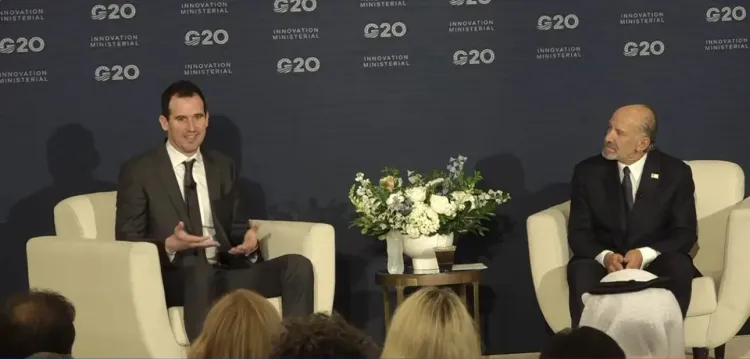
Tom Brown, a senior executive at Anthropic, says a candid conversation with friends in 2014 set him on a path that would take him from conventional engineering to the frontlines of the global artificial intelligence race — through OpenAI and ultimately to the founding of one of AI's most closely watched safety-focused companies. Brown shared the account during a fireside chat with US Commerce Secretary Howard Lutnick in Chapel Hill, North Carolina.
The Conversation That Changed Everything
Brown recalled that friends approached him with a proposition that initially struck him as implausible: that machines could reach human-level intelligence within their lifetimes — potentially within the next 50 years. “A few of my friends came to me and they were like, ‘Tom, it seems like we might end up getting human level intelligence from AI within our lifetimes, so in the next 50 years,’” he said.
Despite his scepticism, Brown found the implications impossible to dismiss. “I was like, ‘Wow, that, like, seems kinda crazy, but if it does happen, like, that would be the biggest, most important thing that ever happens to humanity,’” he said. The exchange prompted him to reflect on what fundamentally defines human beings — and why a machine capable of replicating the mind would dwarf even the industrial revolution in consequence.
“The industrial revolution transformed all of society, but really it was, like, the second most important thing about humans is our bodies,” he said. “The main thing is our minds.”
From Engineering to Self-Study in AI
Persuaded by the argument, Brown stepped away from mainstream engineering and began teaching himself about artificial intelligence. “That got me to think, like, okay, maybe I’ll switch from engineering to try to help out learning about AI,” he said. “And so I did. I started doing kind of self study on that.”
OpenAI was founded roughly a year after Brown began his self-directed AI education. Already acquainted with several of the people involved, he reached out to explore whether he could contribute. “I went to see if I could help out in some way,” he said, adding that he joined as one of the first 20 employees to carry out engineering work.
The Scaling Laws Breakthrough That Accelerated Everything
A pivotal shift in Brown’s thinking came in 2019, when research into AI scaling laws examined how specific combinations of computing power, data volume, and model size governed a model’s capabilities. Until that point, researchers broadly understood that larger models with more compute tended to perform better — but the precise relationship remained opaque.
The scaling studies produced what Brown described as a recipe: a systematic method for determining “what exact combinations of compute, data, and model size resulted in a given level of intelligence.” The findings compressed his earlier timeline dramatically. What had seemed like a 50-year horizon suddenly looked far closer. “That gave us kind of the confidence that this stuff would continue to advance at the rapid rate that it has been, which ended up leading to the founding of Anthropic,” he said. The researchers concluded the breakthrough could arrive “not in 50 years but in, on the order of under 10 years.”
Anthropic’s Mission and Its OpenAI Roots
Anthropic was founded in 2021 by former OpenAI researchers, including siblings Dario Amodei and Daniela Amodei. The San Francisco-based company develops the Claude family of AI models and has positioned itself explicitly around safety and broad societal benefit. “Anthropic is focused on making sure that as we go through this very rapid kind of a, like, AI revolution, things go well for everyone,” Brown said.
This comes amid an intensifying global race in generative AI. OpenAI, established in 2015 as a research organisation, brought AI into mainstream public consciousness with the release of ChatGPT in late 2022, triggering a wave of investment and competition among technology companies developing advanced models. Anthropic is among the most prominent challengers in that field.
What This Signals for the AI Industry
Brown’s account underscores how a small circle of researchers, galvanised by a shared conviction about AI’s trajectory, seeded two of the most influential companies in the field. The scaling-laws research he referenced has since become foundational to how the industry thinks about model development and resource allocation. As AI capabilities continue to accelerate, the question of whether safety-first organisations like Anthropic can keep pace — and keep the technology’s risks in check — remains one of the defining challenges of the decade.
Point of View
It changed the entire risk calculus, and Anthropic’s founding was a direct consequence. What mainstream coverage often misses is that the split between OpenAI and the Anthropic founders was fundamentally a disagreement about speed versus safety — a tension that has only grown sharper as capabilities have outpaced governance. Whether a company built on that safety-first premise can remain competitive against better-capitalised rivals is the question the industry has not yet answered.
NationPress
18 Oct 2026
Frequently Asked Questions
Who is Tom Brown and what is his role at Anthropic?
Tom Brown is a senior executive at Anthropic, the San Francisco-based AI safety company that develops the Claude family of models. He was previously one of the first 20 employees at OpenAI, where he contributed to foundational engineering and scaling-law research.
What conversation changed Tom Brown’s career path?
In 2014, friends suggested to Brown that machines could reach human-level intelligence within 50 years. Though initially sceptical, he concluded the potential consequences were too significant to ignore, and he pivoted from conventional engineering to studying AI through self-directed learning.
What were the AI scaling laws Brown discovered at OpenAI?
In 2019, Brown and colleagues researched how specific combinations of computing power, data, and model size determined a model’s capabilities. The findings produced a systematic framework — effectively a recipe — for predicting intelligence levels from resource inputs, and convinced researchers that transformative AI could arrive in under 10 years rather than 50.
Why was Anthropic founded and how does it differ from OpenAI?
Anthropic was founded in 2021 by former OpenAI researchers, including Dario and Daniela Amodei, with an explicit focus on AI safety and ensuring the technology’s benefits are broadly shared. Brown has described its mission as making sure ‘things go well for everyone’ during a period of rapid AI advancement.
What is the Claude AI model and who makes it?
Claude is a family of large language models developed by Anthropic. The models are among the most widely used AI assistants globally and are designed with safety considerations central to their development, reflecting Anthropic’s founding mandate.