Sacks Warns Industry to Watch Anthropic on Open Source AI
Synopsis
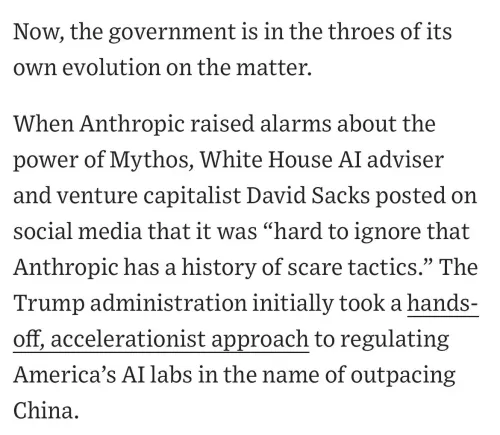
White House AI and Crypto Czar David Sacks publicly accused Anthropic of pursuing a step-by-step regulatory strategy that would kneecap open-source AI, calling on the rest of the tech industry — which he says is nearly unanimously pro-open-source — to monitor the company's lobbying efforts closely.
Key Takeaways
White House AI and Crypto Czar David Sacks posted on July 27, 2026 warning that Anthropic is the sole major tech company opposing open-source AI.
Sacks accused Anthropic of 'gaslighting' the industry with incremental restrictions — on users, contributors, model power, and guardrail removal — that collectively amount to a ban.
The open-source AI debate has been active since at least October 2023 , when the Biden administration issued its AI safety executive order.
Meta's Llama 2 release in July 2023 intensified the split between safety-focused firms and the broader Silicon Valley open-access coalition.
Sacks urged the 'rest of the industry' to 'watch these guys like a hawk,' signalling an active political and lobbying battle ahead.
Congressional hearings on AI model access and export controls are expected to be a key arena where this debate plays out.
White House AI and Crypto Czar David Sacks escalated his public criticism of Anthropic on Sunday, July 27, 2026, accusing the AI safety company of pursuing a regulatory strategy that would, in effect, cripple open-source artificial intelligence development — even as virtually every other major player in the technology industry has aligned behind open-source AI.
Context
Sacks posted a pointed warning on X, stating that the 'entire tech industry (save for Anthropic) has come out in favor of open source AI' and urging the rest of the industry to 'watch these guys like a hawk.' His post catalogued what he described as a pattern of incremental restrictions dressed in neutral language — limiting who can use open-source models, who can contribute to them, how powerful they can be, and whether safety guardrails can be removed.
The thrust of his argument is that these individually framed limits add up to a de facto ban on open-source AI, and that the industry should not be lulled by assurances that 'nobody is trying to ban open source.' Sacks used the term 'gaslighting' to characterise what he sees as Anthropic's public messaging strategy.
Policy Backdrop
The open-source AI debate has been a live fault line in Washington since at least October 2023, when the Biden administration issued an executive order on AI safety and risk mitigation. That order set the stage for ongoing regulatory discussions around model access, compute thresholds, and safety evaluations.
Meta's release of its Llama 2 open-source model in July 2023 sharpened the divide between safety-first organisations — which argue that unrestricted model access raises catastrophic-risk concerns — and a broader Silicon Valley coalition that views open access as essential to innovation, competition, and national competitiveness. Anthropic, the developer of the Claude family of AI models, has consistently positioned itself on the safety-and-oversight end of that spectrum and has been active in policy advocacy in Washington.
Sacks, who joined the Trump administration as AI and Crypto Czar, has been a vocal champion of pro-innovation AI policy and has previously pushed back against what he characterises as regulatory capture by incumbents seeking to lock in their market positions through legislation.
Stakeholders and Impact
The stakes are significant for a wide range of actors. Independent developers, academic researchers, and smaller AI startups depend on open-source models to build products and conduct research without the cost and access barriers of proprietary APIs. Restrictions on who can use or modify such models could concentrate AI capability in the hands of a handful of well-capitalised companies.
For Anthropic, which has raised billions of dollars and competes directly with OpenAI, Google DeepMind, and Meta, the policy environment is commercially consequential. Safety-oriented guardrails that apply to open-source models but not to closed, API-gated systems could tilt the competitive landscape in favour of companies like Anthropic that operate primarily through controlled access. Critics of such regulation, including Sacks, argue this dynamic is not incidental.
The post arrives at a moment when Congressional committees are actively examining AI model access and export controls, meaning Sacks's public framing of the debate could shape how legislators and other executive-branch officials approach forthcoming hearings and draft legislation.
What's Next
Whether Anthropic responds publicly to Sacks's characterisation remains to be seen. The company has not, as of this post, issued a statement addressing his specific claims. Congressional action on AI model access rules is expected to be a priority in the months ahead, and the White House AI office under Sacks is likely to play a central role in shaping the administration's position.
The broader industry coalition backing open-source AI — which Sacks frames as nearly unanimous — will be watching whether that consensus translates into coordinated lobbying pressure or whether safety-oriented voices succeed in carving out regulatory space for restrictions. The outcome will have lasting consequences for who gets to build, use, and benefit from the next generation of AI models.
Point of View
He is building a rhetorical coalition ahead of what are likely to be consequential Congressional hearings on AI model access. The 'gaslighting' framing is strategically designed to pre-empt incremental regulatory proposals by labelling them as bad-faith from the outset. This fits a broader pattern in the Trump administration's AI posture: prioritise innovation and access over precautionary restriction, and cast safety-oriented regulation as incumbent protection. Whether Anthropic can effectively rebut the 'kneecapping open source' characterisation will determine how much political oxygen it has in the next legislative cycle.
NationPress
25 Oct 2026
Frequently Asked Questions
Why is David Sacks criticising Anthropic over open source AI?
Sacks argues that Anthropic, alone among major tech companies, is lobbying for restrictions on open-source AI that would collectively function as a ban, even if each individual restriction sounds modest on its own.
What is open source AI and why does it matter?
Open-source AI refers to AI models whose weights and code are publicly released, allowing anyone to use, modify, and build on them. It matters because it lowers barriers for developers, researchers, and startups who cannot afford proprietary access.
What restrictions on open source AI is Sacks warning about?
Sacks listed limits on who can use open-source models, who can contribute to them, how powerful they can be, and whether safety guardrails can be removed — arguing these add up to an effective ban.
What is Anthropic's position on AI safety regulation?
Anthropic has consistently advocated for safety-oriented AI oversight, including guardrails and access controls, as part of its mission to develop AI responsibly. It has been active in Washington policy discussions.
What happens next in the US open source AI policy debate?
Congressional hearings on AI model access and export controls are expected in the coming months, and the White House AI office under Sacks is likely to play a central role in shaping the administration's stance.