Sacks Backs Open-Weight AI, Slams Closed-Model Lobbying

Synopsis
White House AI and Crypto Czar David Sacks on July 25, 2026 publicly backed open-weight AI models and accused an unnamed proprietary AI company of lobbying to undermine the open model ecosystem, signalling the Trump administration's stance ahead of any formal AI licensing framework.
Key Takeaways
White House AI and Crypto Czar David Sacks posted on July 25, 2026 defending the right to release open-weight AI models.
Sacks accused an unnamed company of 'incessant machinations to kneecap the open model ecosystem.' He drew a clear distinction between open-source software and open-weight AI model releases.
The Trump administration has consistently signalled support for reducing regulatory friction on AI development.
The post has direct implications for Indian developers and start-ups that rely on open-weight models for regional AI applications.
Formal White House policy guidance on AI model licensing is expected from Sacks's office.
White House AI and Crypto Czar David Sacks on Saturday, July 25, 2026 publicly defended open-weight artificial intelligence models and sharply criticised what he called a company's 'incessant machinations to kneecap the open model ecosystem,' signalling the Trump administration's continued alignment with open AI development.
Context
Sacks posted on X: 'Nobody is saying that all software has to be open source. What they're saying is that open-weight AI should be allowed. By implication, they're rejecting your company's incessant machinations to kneecap the open model ecosystem. Read the room.' The post appears to be a direct reply to a representative or account of a proprietary AI developer, though the specific company was not named in the post itself.
The distinction Sacks draws is precise: open-weight models release the trained model weights publicly, allowing developers to run, fine-tune and build on them, without necessarily making the underlying training code or data open source. This is the model adopted by Meta with its Llama series, beginning with Llama 2 in 2023, which turbocharged the global debate over how AI should be distributed.
Policy Backdrop
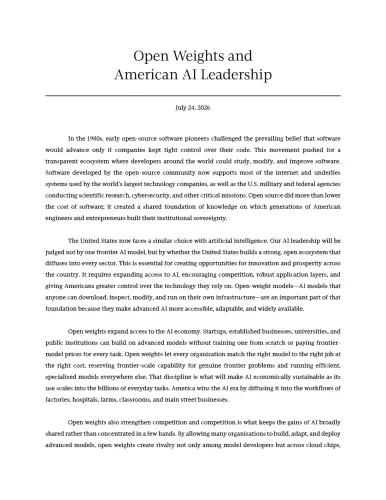
The open-versus-closed AI debate has been one of the defining fault lines in United States technology policy. Proponents of open-weight AI argue it democratises access, accelerates innovation and prevents a handful of large corporations from monopolising foundational technology. Critics — typically large proprietary AI labs — contend that open release poses safety, misuse and national security risks.
Sacks, in his role as the Trump administration's AI and Crypto Czar, has been a consistent advocate for reducing regulatory friction on AI development. His office is expected to shape any forthcoming White House frameworks on AI model licensing and release requirements. The post suggests the administration views lobbying by closed-model companies against open-weight AI as anticompetitive rather than safety-motivated.
Stakeholders and Impact
The immediate stakeholders are the sprawling ecosystem of independent developers, start-ups, academic researchers and governments — including in India — that rely on open-weight models to build AI applications without paying per-API-call fees to large labs. For the Indian technology sector, which has seen significant activity around fine-tuning open models for regional languages and local use cases, the policy direction from Washington DC carries direct commercial implications.
Proprietary AI laboratories, which have invested billions of dollars building closed systems and recurring revenue models around API access, stand to lose competitive ground if the White House actively blocks regulatory efforts that would restrict open-weight releases. Sacks's blunt language — 'Read the room' — signals that such lobbying is unlikely to find a receptive audience in the current administration.
What's Next
Observers will watch for formal policy statements or executive guidance from the AI and Crypto Czar's office that codify support for open-weight AI, potentially including language in any forthcoming national AI strategy or export-control review. The post by Sacks, while informal in tone, carries weight given his dual role as a senior administration official and an influential voice in Silicon Valley investor circles. Any regulatory framework that explicitly protects the right to release open-weight models would have lasting consequences for the global AI competitive landscape.
Point of View
And it lands squarely against proprietary AI lobbying efforts. The language is unusually combative for a sitting official, suggesting the administration sees closed-model companies' regulatory advocacy as a competitive threat to US innovation rather than a legitimate safety concern. This fits a broader arc in which the White House has framed open AI development as aligned with American technological leadership and economic competition, particularly against state-backed AI programmes abroad. For global markets, including India, the message is that Washington's current posture favours an open AI ecosystem — and companies or governments betting on that openness have a powerful ally for now.
NationPress
25 Oct 2026
Frequently Asked Questions
What did David Sacks say about open-weight AI?
David Sacks, the White House AI and Crypto Czar, posted on July 25, 2026 that open-weight AI 'should be allowed' and accused an unnamed company of lobbying to undermine the open model ecosystem.
What is the difference between open-source AI and open-weight AI?
Open-source AI typically means releasing training code, data and model weights publicly. Open-weight AI refers specifically to releasing the trained model weights so developers can run and fine-tune the model, without necessarily making the full training pipeline public — the approach used by Meta's Llama models.
Which company was David Sacks criticising?
Sacks did not name a specific company in his post. The research background indicates the post was directed at a proprietary AI developer, but the identity remains unspecified in the public post.
What is David Sacks's role in the Trump administration?
David Sacks serves as the White House AI and Crypto Czar in the Trump administration. He is also co-founder and general partner of Craft Ventures and a co-host of the All-In Podcast.
How does the US open-weight AI debate affect India?
Indian developers, start-ups and researchers heavily use open-weight models to build AI tools for regional languages and local applications. A US policy that protects open-weight releases reduces barriers for Indian technology companies that cannot afford proprietary API costs.