Is India the 'Defining Partner of the 21st Century' to Counter China?
Click to start listening
Synopsis
US lawmakers characterize the US-India partnership as essential in the 21st century, urging enhanced collaboration to address China's increasing threats. Their discussions emphasize the importance of military and economic ties in maintaining regional stability amidst rising tensions.
Key Takeaways
- The US-India partnership is vital for countering China's aggression.
- Military, economic, and technological coordination is essential.
- India's resistance to Chinese pressure has been significant.
- US tariffs on India could undermine strategic trust.
- Prospects for trade between the two nations are promising.
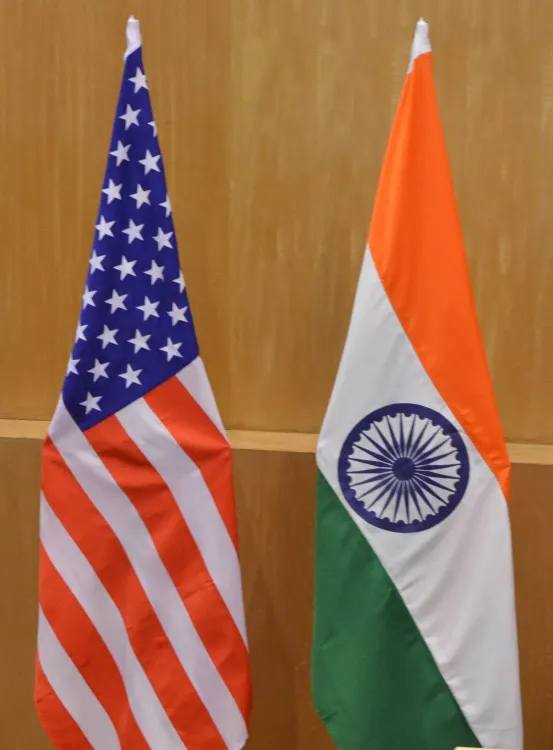
Washington, Dec 11 (NationPress) US lawmakers and prominent foreign policy analysts have identified the partnership between the United States and India as "a defining relationship of the 21st century". They caution that the aggressive stance of China necessitates enhanced military, economic, and technological collaboration between Washington and New Delhi.
During a House Foreign Affairs Subcommittee hearing on the US–India strategic partnership on Wednesday (local time), Chairman Congressman Bill Huizenga emphasized that the relationship "is no longer just important; it is a defining relationship of the 21st century". He stated that "if America seeks a free Indo-Pacific… our partnership with India is essential."
Huizenga highlighted that "an increasingly aggressive China threatens regional stability", referring to Beijing's expanding maritime presence, military coercion along the border, and an overt attempt to "encircle and control the Indian Ocean."
Experts testified that India has demonstrated the "stiffest resistance" to Chinese pressure. Jeff Smith from the Heritage Foundation noted that India has effectively "stopped Chinese coercion at their border" and, unlike the US, was able to ban TikTok almost instantaneously. He remarked that India has imposed strict restrictions on Chinese investments and has emerged as one of Washington's most crucial strategic allies.
Experts highlighted that India's role spans various domains — from maritime deterrence to intelligence-sharing and advancements in emerging technologies. Smith elaborated that both nations are "tracking Chinese submarines together in the Indian Ocean", conducting joint patrols in the South China Sea, and engaging in mountain warfare exercises in the Himalayas.
Dhruva Jaishankar from ORF America indicated that the partnership has flourished due to "economic opportunities for both nations" and a mutual concern regarding China's rise. He pointed out that China's military mobilization in 2020 led to clashes resulting in the deaths of 20 Indian military personnel, and noted that Beijing's network of ports and naval assets across the Indo-Pacific could potentially secure critical choke points.
Despite advancements, lawmakers expressed concern over recent US trade actions, including significant tariffs, which could destabilize these ties. Ranking Member Sydney Kamlager-Dove sharply criticized the current administration's approach, stating that Trump "will be the American President that lost India", warning that coercive trade measures "are causing real and lasting damage" to strategic trust.
Kamlager-Dove pointed out that the tariff rate on India exceeds that on China, emphasizing that Washington should not "drive strategic partners into the arms of our adversaries."
India's concerns also encompass Washington's renewed engagement with Pakistan's military leadership. Jaishankar articulated that India's perspective, shaped by "a long and well-documented history" of Pakistan's use of terrorist proxies, suggests that "third-party mediation has often fueled Pakistan's adventurism."
Witnesses and lawmakers unanimously agreed that the partnership is vital. In a rapid series of inquiries, the ranking member asked whether India is essential to countering China's influence, if India's role in the Quad promotes a free and open Indo-Pacific, and whether a robust partnership enhances deterrence. All three witnesses replied: "Yes."
Sameer Lalwani of the German Marshall Fund asserted that India can "shoulder more day-to-day security responsibilities in the Indian Ocean," complicate Chinese military strategies, and provide industrial capacity during crises. However, he warned that a "implementation gap" in executing major initiatives, including defense co-production, could hinder progress.
Huizenga reiterated that maritime security will remain a central focus. India's strategic location along vital sea lines means that Chinese control in the region "could have dangerous leverage over the global economy." Smith urged for expanded coordination around the Andaman and Nicobar Islands, describing it as "an extremely valuable asset" for monitoring naval traffic entering the Indian Ocean.
Experts argued that despite recent tensions, the rationale for deeper engagement remains compelling. Smith cautioned that it would be "strategic malpractice of the highest order to discard the quarter-century dividend of trust", while Jaishankar maintained that both nations can still aim for "$500 billion in trade by 2030," enhanced cooperation on AI and defense, and new corridors linking the Middle East and Europe.
India–US defense relations have accelerated over the last decade, bolstered by foundational military agreements and Quad collaboration with Japan and Australia. China's assertive posture, from the South China Sea to the Line of Actual Control, has compelled the United States and India to work more closely in maritime security, technology, and supply chain resilience.
Bilateral trade now surpasses $200 billion annually, with both countries viewing each other as crucial to balancing China's influence in the Indo-Pacific. Despite political fluctuations, analysts predict that security and technology collaboration will deepen into 2026 and beyond.
Point of View
It is essential to recognize the growing importance of the US-India partnership in today's geopolitical landscape. This relationship not only strengthens both nations but also plays a pivotal role in countering aggressive moves by China, ensuring stability in the Indo-Pacific region.
NationPress
12/12/2025
Frequently Asked Questions
Why is the US-India partnership considered crucial?
The US-India partnership is viewed as crucial due to China's aggressive posture, which necessitates stronger military, economic, and technological cooperation to maintain regional stability.
What are the key areas of collaboration between the US and India?
Key areas of collaboration include maritime security, intelligence sharing, defense technology, and economic trade, particularly in countering China's influence in the Indo-Pacific.
How has India's response to Chinese pressure been characterized?
India's response to Chinese pressure has been characterized as showing the 'stiffest resistance', effectively managing border coercion and imposing strict regulations on Chinese investments.
What concerns do US lawmakers have regarding tariffs?
US lawmakers are concerned that recent tariffs imposed on India could destabilize the strategic partnership, leading to a loss of trust and pushing India closer to adversaries.
What is the outlook for US-India trade?
The outlook for US-India trade remains positive, with projections of reaching $500 billion by 2030 through enhanced cooperation in various sectors.